Respiration in Plants — Chapter Summary
ICSE · Class 9 · Biology
Summary of Respiration in Plants for ICSE Class 9 Biology. Part of the ICSE Class 9 Biology syllabus. Respiration is a catabolic process of releasing.
Interactive on Super Tutor
Studying Respiration in Plants? Get the full interactive chapter.
Quizzes, flashcards, AI doubt-solver and a step-by-step study plan — built for chapter summary and more.
Free trial, no card needed.
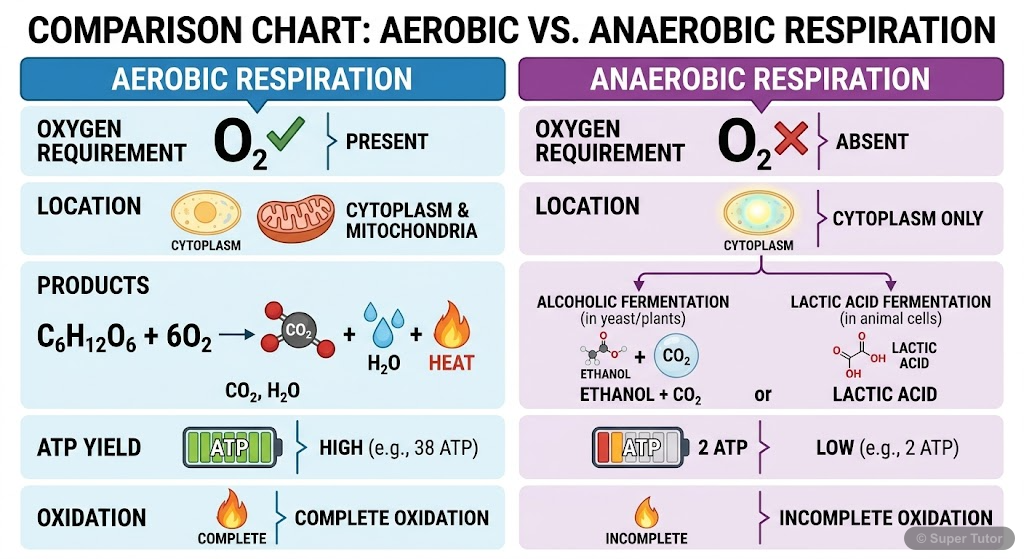
One of 11 illustrations for Respiration in Plants in Super Tutor — alongside flashcards, concept maps and practice questions.
Overview
Respiration is a catabolic process of releasing energy from simple sugar glucose for carrying out life processes. In plants, respiration happens in every living cell and energy is released through the breakdown of glucose in a series of steps. The process uses ATP as the immediate energy source, so
Key Concepts
Respiration is the breakdown of glucose
Respiration is the breakdown of glucose in living cells to release energy. It occurs in a series of enzyme-controlled steps and produces carbon dioxid
Glycolysis is the first major phase
Glycolysis is the first major phase of respiration. It converts glucose into pyruvate and occurs in the cytoplasm.
Krebs cycle is the second major
Krebs cycle is the second major phase of respiration. It occurs in mitochondria and helps convert pyruvate into carbon dioxide, water, and ATP.
ATP is the energy
ATP is the energy-storing product of respiration and is called the energy currency of the cell. When energy is used, ATP changes into ADP, and ADP cha
Aerobic respiration occurs in the presence
Aerobic respiration occurs in the presence of oxygen and involves complete breakdown of glucose to carbon dioxide and water. It yields 38 ATP per mole
Learning Objectives
- Understand the meaning of respiration and its role in releasing energy
- Identify the main steps of respiration: glycolysis and Krebs cycle
- Distinguish between aerobic and anaerobic respiration in plants
- Explain how plants obtain oxygen and remove carbon dioxide
- Describe experiments that prove oxygen use, carbon dioxide release, heat production, and anaerobic respiration
Frequently Asked Questions
What are the important topics in Respiration in Plants for ICSE Class 9 Biology?
How should I revise Respiration in Plants for Class 9 exams?
Sources & Official References
Content is aligned to the official syllabus. Refer to the board website for the latest curriculum.
More resources for Respiration in Plants
For serious students
Get the full Respiration in Plants chapter — start free.
Quizzes, flashcards, an AI doubt solver and a study plan for ICSE Class 9 Biology. Free to start, no card needed.