Seed Structure and Germination — Chapter Summary
ICSE · Class 9 · Biology
Summary of Seed Structure and Germination for ICSE Class 9 Biology. Key concepts: Fruit is the enlarged ripened, Seed is the ripened ovule and Grain.
Interactive on Super Tutor
Studying Seed Structure and Germination? Get the full interactive chapter.
Quizzes, flashcards, AI doubt-solver and a step-by-step study plan — built for chapter summary and more.
Free trial, no card needed.
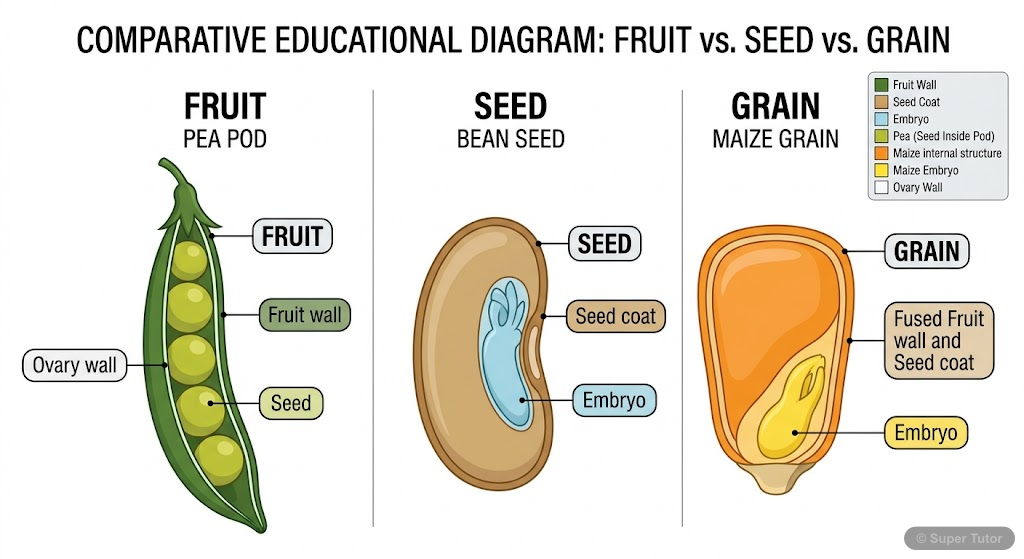
One of 8 illustrations for Seed Structure and Germination in Super Tutor — alongside flashcards, concept maps and practice questions.
Overview
Seed is the ripened ovule and contains an embryo that develops into a new plant. Fruit is the enlarged ripened ovary, and grain is a one-seeded fruit in which the fruit wall and seed coat are fused. Seeds protect the embryo, store food, and make the survival and spread of plants possible. Germinatio
Key Concepts
Fruit is the enlarged ripened ovary
Fruit is the enlarged ripened ovary. The ovarian wall forms the fruit wall, which encloses the seed. Fruit protects the seed and helps in seed dispers
Seed is the ripened ovule
Seed is the ripened ovule. It contains an embryo that develops into a new plant. The seed coat protects the embryo from mechanical damage.
Grain
Grain, such as maize and wheat, is actually a fruit. In grain, the fruit wall and seed coat are fused into one protective layer.
Bean seed is dicotyledonous
Bean seed is dicotyledonous, exalbuminous, and kidney-shaped. It has testa, tegmen, hilum, micropyle, two cotyledons, radicle, and plumule. The testa
Maize grain is monocotyledonous
Maize grain is monocotyledonous, endospermic, and one-seeded. It has scutellum, radicle, plumule, coleorhiza, coleoptile, aleurone layer, and a starch
Learning Objectives
- Understand the meanings of fruit, seed, and grain
- Identify the main parts of a dicot seed and a monocot grain
- Distinguish between bean seed and maize grain
- Explain the conditions needed for germination
- Describe hypogeal, epigeal, and viviparous germination
Frequently Asked Questions
What are the important topics in Seed Structure and Germination for ICSE Class 9 Biology?
How should I revise Seed Structure and Germination for Class 9 exams?
Sources & Official References
Content is aligned to the official syllabus. Refer to the board website for the latest curriculum.
More resources for Seed Structure and Germination
For serious students
Get the full Seed Structure and Germination chapter — start free.
Quizzes, flashcards, an AI doubt solver and a study plan for ICSE Class 9 Biology. Free to start, no card needed.