Chapter 19 of 19
Revision Notes
Waste Generation and Management — Revision Notes
ICSE · Class 9 · Biology
Waste Generation and Management revision notes for ICSE Class 9 Biology: 4 topics in quick points. Part of the ICSE Class 9 Biology syllabus.
43 questions40 flashcards5 concepts
Interactive on Super Tutor
Studying Waste Generation and Management? Get the full interactive chapter.
Quizzes, flashcards, AI doubt-solver and a step-by-step study plan — built for revision notes and more.
Free trial, no card needed.
Super Tutor
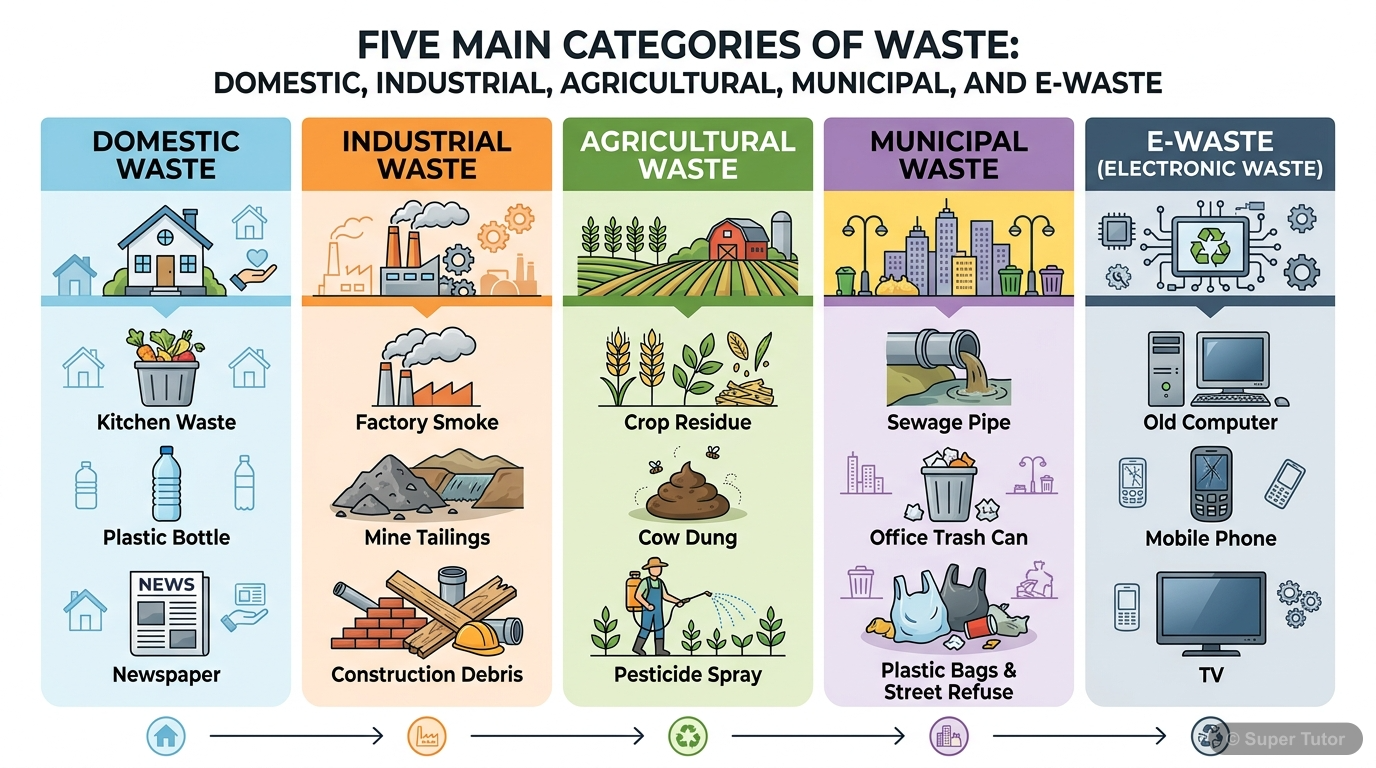
Learn better with visuals Super Tutor pairs illustrations like this with notes and quizzes for Waste Generation and Management.
Key Topics to Revise
1
1. Major Categories of Waste
- Waste can be broadly divided into five major categories: domestic, industrial, agricultural, municipal, and e-waste.
- Domestic waste comes from homes and includes kitchen waste, plastics, glass, rags, and paper.
- Industrial waste comes from factories, thermal plants, mining operations, cement industries, oil refineries, and construction units.
2
2. Domestic, Industrial, and Agricultural Waste
- Domestic waste includes kitchen waste such as peelings of vegetables and fruits, shells, stale food, used tea leaves, and leftovers.
- Domestic waste also includes plastics, broken glass, rags, and paper.
- Some domestic rag and paper waste is reused or sold to raddiwalas.
3
3. Municipal Waste, Sewage, and Septic Tanks
- Municipal waste includes household discharge of excreta and kitchen washings, and discharge from public toilets, hospitals, hotels, restaurants, and offices.
- This waste is carried away through sewers and is called sewage.
- Municipal sewage is separated into degradable and non-degradable parts.
4
4. e-Waste and Laboratory Wastes
- e-waste consists of discarded computers, TVs, refrigerators, radios, mobile phones, mobile batteries, fluorescent tubes, electronic toys, medical instruments, and lead-acid batteries.
- e-waste is mostly generated in large cities, but it is also increasing in smaller cities and towns.
- e-waste contains harmful substances such as lead, cadmium, and mercury.
Get complete notes with diagrams and examples
Full NotesKey Concepts
Waste is any substance discarded afterWaste can be broadly divided intoDomestic waste comes from homesIndustrial waste comes from factoriesAgricultural waste is left behind after
Frequently Asked Questions
What are the important topics in Waste Generation and Management for ICSE Class 9 Biology?
Key topics in Waste Generation and Management include Major Categories of Waste, Domestic, Industrial, and Agricultural Waste, Municipal Waste, Sewage, and Septic Tanks, e-Waste and Laboratory Wastes. Study these first, then practise questions on each for Class 9 exams.
How should I revise Waste Generation and Management for Class 9 exams?
Learn the core ideas first, then work through the 43 practice questions on Waste Generation and Management. Revise definitions regularly and use flashcards for quick recall before the exam.
Sources & Official References
Content is aligned to the official syllabus. Refer to the board website for the latest curriculum.
More resources for Waste Generation and Management
For serious students
Get the full Waste Generation and Management chapter — start free.
Quizzes, flashcards, an AI doubt solver and a study plan for ICSE Class 9 Biology. Free to start, no card needed.