Humidity — Flashcards
ICSE · Class 9 · Geography
40 flashcards for Humidity (ICSE Class 9 Geography) to test yourself on key terms and facts. Sample: "What does humidity mean?"
Interactive on Super Tutor
Studying Humidity? Get the full interactive chapter.
Quizzes, flashcards, AI doubt-solver and a step-by-step study plan — built for flashcards and more.
Free trial, no card needed.
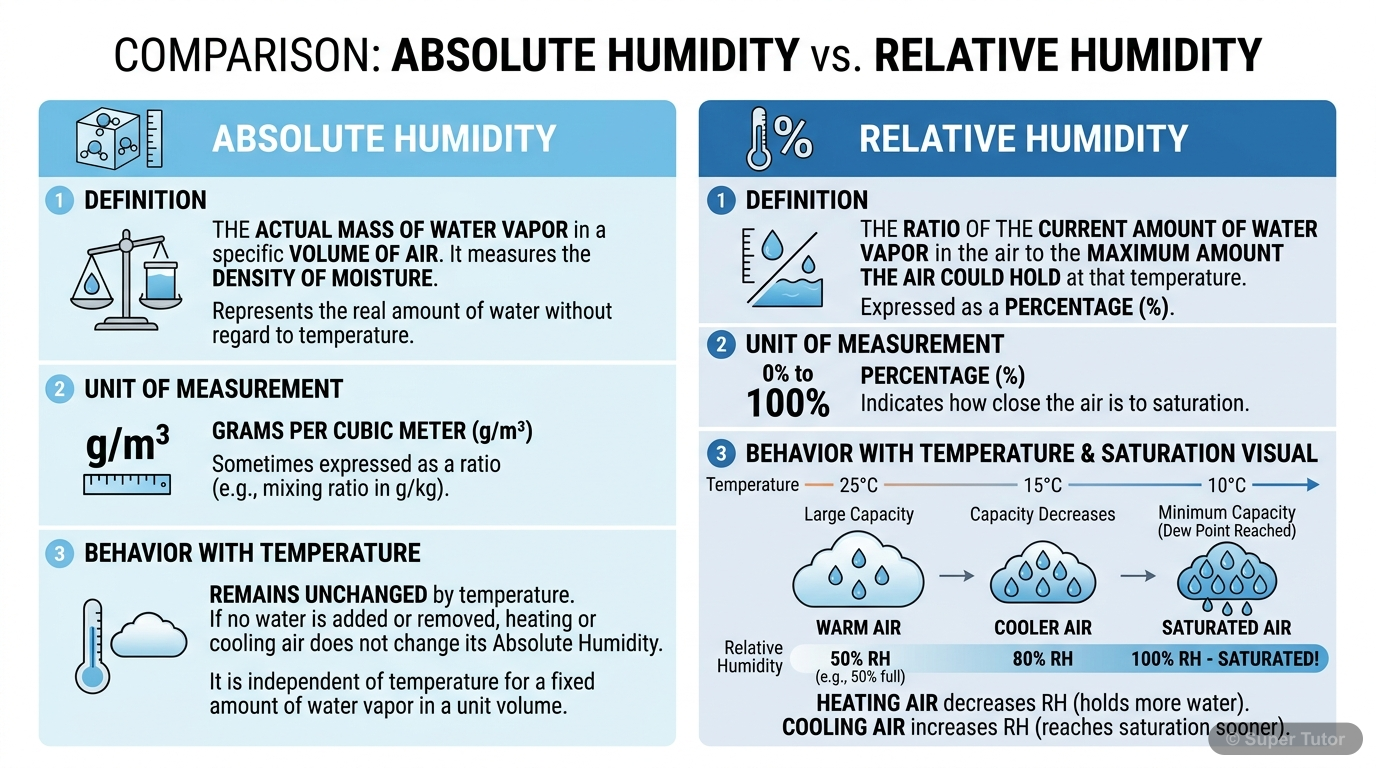
Learn better with visuals Super Tutor pairs illustrations like this with notes and quizzes for Humidity.
What does humidity mean?
Answer
Humidity is the amount of water vapour present in the air at a particular time and place. It changes from place to place and with temperature.
What is relative humidity?
Answer
Relative humidity is the ratio between the actual amount of water vapour present in the air and the maximum amount of water the air can hold at that temperature, expressed as a percentage. A value of …
What is the formula for relative humidity?
Answer
Relative Humidity = (The actual amount of water vapour present in the air / The maximum amount of water vapour the air can hold at that temperature) × 100. The answer is always expressed in percentage…
What is absolute humidity?
Answer
Absolute humidity is the actual amount of water vapour present in a given volume of air, regardless of temperature. It is expressed in grams of moisture per cubic metre of air, written as g/m3.
Compare relative humidity and absolute humidity.
Answer
Relative humidity shows how close the air is to saturation and is written as a percentage. Absolute humidity shows the actual amount of water vapour in air and is written in g/m3. Relative humidity ch…
How does humidity change with height?
Answer
Humidity decreases with height because rarified air cannot hold more moisture. So air near the ground usually contains more moisture than air at higher levels.
Why do humans feel hotter when relative humidity is high?
Answer
When relative humidity is high, sweat does not evaporate easily from the body. Since evaporation cools the body, less evaporation makes the air feel hotter than the actual temperature.
Why do humans feel cooler when relative humidity is low?
Answer
When relative humidity is low, sweat evaporates easily from the skin. This evaporation removes heat from the body, so the air feels cooler than the actual temperature.
+32 more flashcards
Practise AllFrequently Asked Questions
What are the important topics in Humidity for ICSE Class 9 Geography?
How many flashcards are available for Humidity?
How should I revise Humidity for Class 9 exams?
Sources & Official References
Content is aligned to the official syllabus. Refer to the board website for the latest curriculum.
More resources for Humidity
Practice Quiz
Test yourself with a quick quiz
Important Questions
Exam-style questions with answers
Revision Notes
Key points for last-minute revision
Chapter Summary
Understand the chapter at a glance
Concept Maps
See how topics connect
Study Plan
Step-by-step plan for this chapter
Syllabus
What topics to cover
For serious students
Get the full Humidity chapter — start free.
Quizzes, flashcards, an AI doubt solver and a study plan for ICSE Class 9 Geography. Free to start, no card needed.