Pollution - Types and Sources — Flashcards
ICSE · Class 9 · Geography
40 flashcards for Pollution - Types and Sources (ICSE Class 9 Geography) to test yourself on key terms and facts. Sample: "What is pollution?"
Interactive on Super Tutor
Studying Pollution - Types and Sources? Get the full interactive chapter.
Quizzes, flashcards, AI doubt-solver and a step-by-step study plan — built for flashcards and more.
Free trial, no card needed.
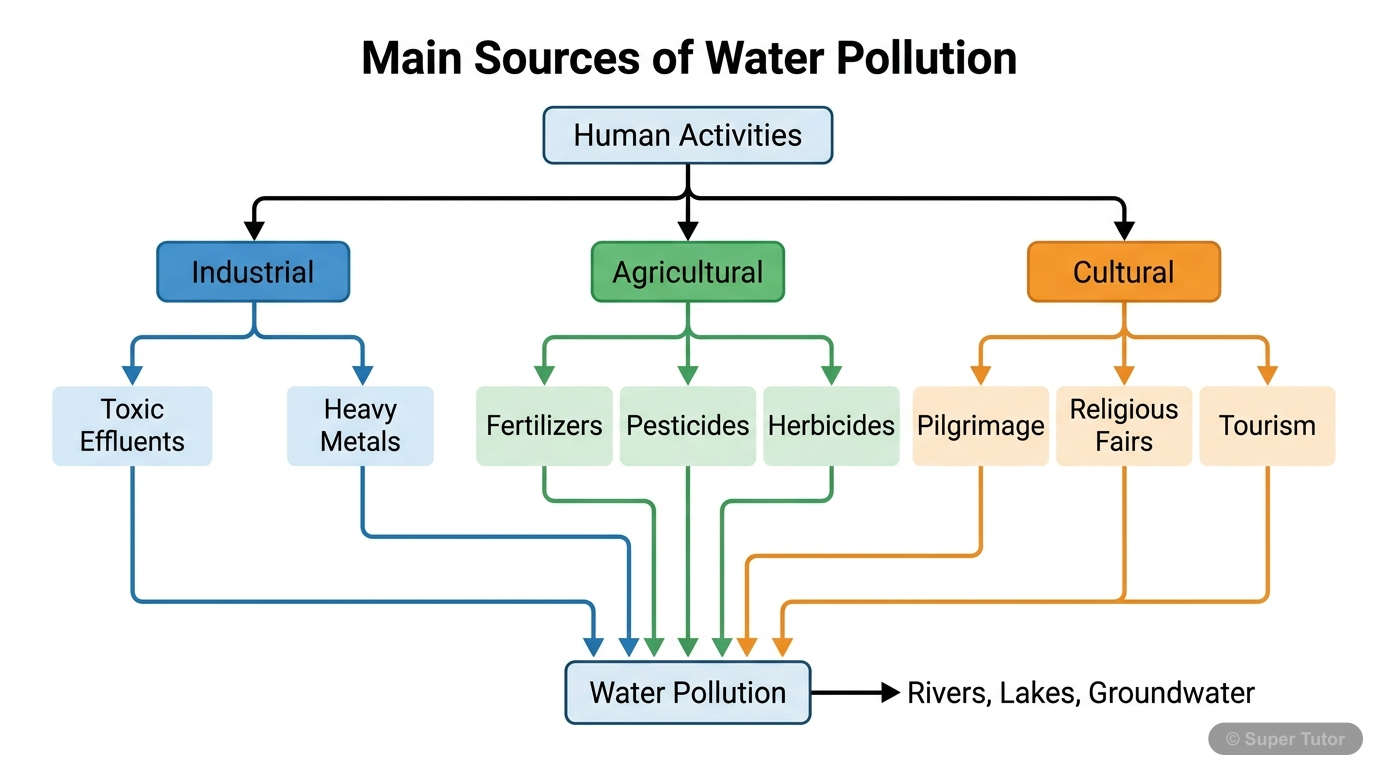
One of 6 illustrations for Pollution - Types and Sources in Super Tutor — alongside flashcards, concept maps and practice questions.
What is pollution?
Answer
Pollution is any activity that violates the original character of nature and leads to its degradation. It is caused by improper management of resources or careless human activity.
What is a pollutant? Give examples.
Answer
A pollutant is a substance that causes pollution. Examples include carbon dioxide and carbon monoxide. Pollutants may be biodegradable like domestic garbage or non-biodegradable like glass and plastic…
What are the main types of environmental pollution?
Answer
The main types are air pollution, water pollution, soil pollution, radiation pollution, and noise pollution. These affect life, health, and natural systems in different ways.
What is the composition of air that supports life on Earth?
Answer
Air that supports life on Earth has 78% nitrogen, 21% oxygen, and 1% other gases. This balance is important for living organisms and natural processes.
What is air pollution?
Answer
Air pollution occurs when large amounts of gases and tiny particles are released into the air and disturb the ecological balance. It can harm people, animals, plants, and the atmosphere.
What are primary air pollutants?
Answer
Primary air pollutants are pollutants that are directly released into the air. Examples include smoke, dust, ash, sulphur oxide, nitrogen oxide, and radioactive compounds in SPM.
What are secondary air pollutants?
Answer
Secondary air pollutants are formed due to chemical interactions between atmospheric components and primary pollutants. Smog and ozone are examples.
What is SPM?
Answer
SPM stands for Suspended Particulate Matter. It includes smoke, dust, ash, sulphur oxide, nitrogen oxide, and radioactive compounds. It is a primary air pollutant.
+32 more flashcards
Practise AllFrequently Asked Questions
What are the important topics in Pollution - Types and Sources for ICSE Class 9 Geography?
How many flashcards are available for Pollution - Types and Sources?
How should I revise Pollution - Types and Sources for Class 9 exams?
Sources & Official References
Content is aligned to the official syllabus. Refer to the board website for the latest curriculum.
More resources for Pollution - Types and Sources
Practice Quiz
Test yourself with a quick quiz
Important Questions
Exam-style questions with answers
Revision Notes
Key points for last-minute revision
Chapter Summary
Understand the chapter at a glance
Concept Maps
See how topics connect
Study Plan
Step-by-step plan for this chapter
Syllabus
What topics to cover
For serious students
Get the full Pollution - Types and Sources chapter — start free.
Quizzes, flashcards, an AI doubt solver and a study plan for ICSE Class 9 Geography. Free to start, no card needed.