lnsolation — Flashcards
ICSE · Class 9 · Geography
36 flashcards for lnsolation (ICSE Class 9 Geography) to test yourself on key terms and facts. Sample: "What is insolation?"
Interactive on Super Tutor
Studying lnsolation? Get the full interactive chapter.
Quizzes, flashcards, AI doubt-solver and a step-by-step study plan — built for flashcards and more.
Free trial, no card needed.
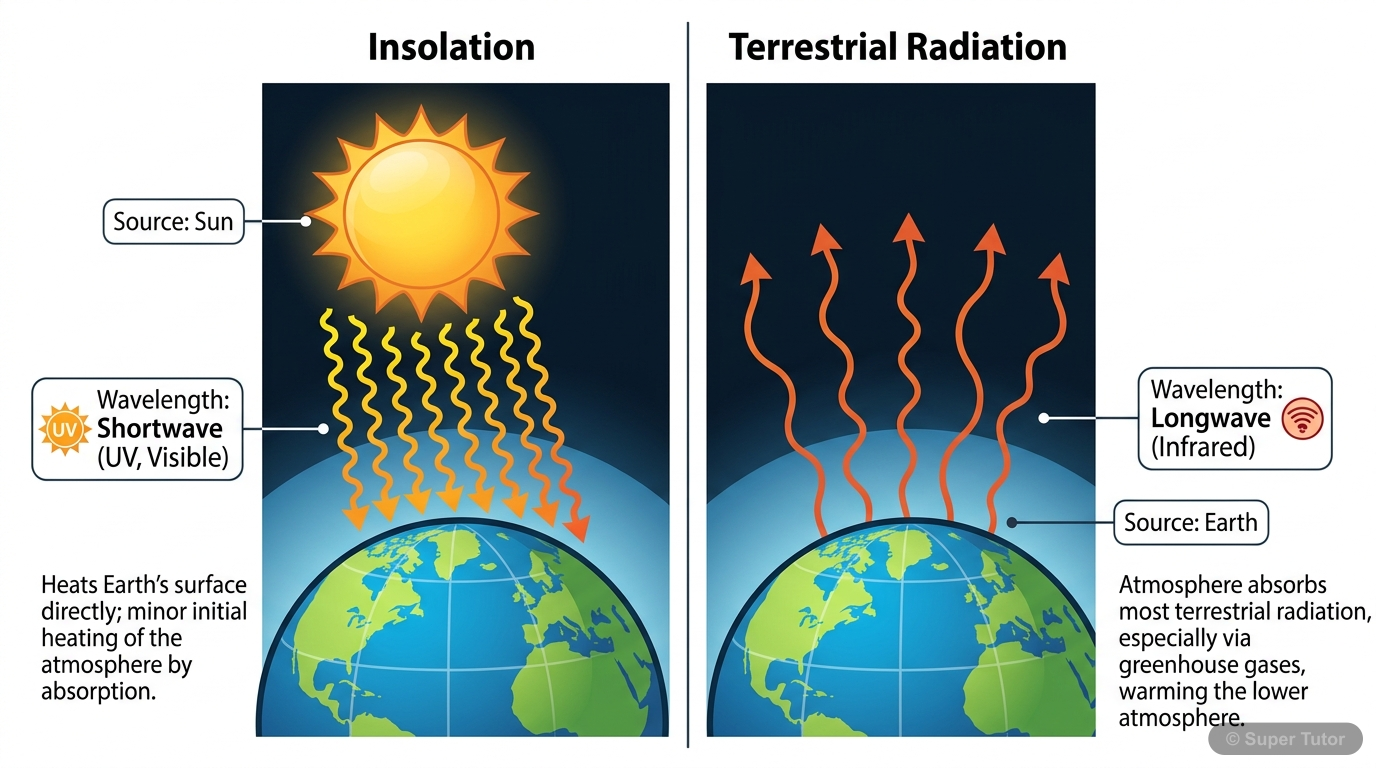
One of 5 illustrations for lnsolation in Super Tutor — alongside flashcards, concept maps and practice questions.
What is insolation?
Answer
Insolation is incoming solar radiation received by the Earth. It is the energy that reaches the Earth from the Sun and helps produce heat, light, weather, and climate.
Why is the Sun called the ultimate source of energy?
Answer
The Sun is the ultimate source of light and energy for the various phenomena that take place on the Earth's surface and in its atmosphere. Without solar energy, life and climate processes on Earth wou…
What kind of body is the Sun, and what is its surface temperature?
Answer
The Sun is a star of average size. Its surface temperature is about 6000°C, and it emits energy as electromagnetic radiation.
How does solar energy travel from the Sun to the Earth?
Answer
Solar energy travels in the form of rays at a speed of about 30,000 km/sec. It takes nearly 8 minutes to reach the Earth.
Why is insolation minimum at the poles?
Answer
Insolation is minimum at the poles because the Sun's rays are slanting there and pass through a greater extent of the atmosphere. More heat is lost on the way. Places near the equator are warmer becau…
What are infrared rays and ultraviolet rays?
Answer
Infrared rays are longer waves that are largely absorbed in the atmosphere. Ultraviolet rays are shorter waves that reach the Earth's surface as solar radiation.
What is terrestrial radiation?
Answer
Terrestrial radiation is long wave electromagnetic radiation originating from Earth and its atmosphere. It is the radiation emitted by naturally radioactive materials on Earth including uranium, thori…
How is the atmosphere heated?
Answer
The atmosphere is heated by three main processes: convection, conduction, and radiation. Convection transfers heat by movement of air, conduction transfers heat by direct contact, and radiation causes…
+28 more flashcards
Practise AllFrequently Asked Questions
What are the important topics in lnsolation for ICSE Class 9 Geography?
How many flashcards are available for lnsolation?
How should I revise lnsolation for Class 9 exams?
Sources & Official References
Content is aligned to the official syllabus. Refer to the board website for the latest curriculum.
More resources for lnsolation
Practice Quiz
Test yourself with a quick quiz
Important Questions
Exam-style questions with answers
Revision Notes
Key points for last-minute revision
Formula Sheet
The chapter's formulas in one place
Chapter Summary
Understand the chapter at a glance
Concept Maps
See how topics connect
Study Plan
Step-by-step plan for this chapter
Syllabus
What topics to cover
For serious students
Get the full lnsolation chapter — start free.
Quizzes, flashcards, an AI doubt solver and a study plan for ICSE Class 9 Geography. Free to start, no card needed.