Earth's Structure — Flashcards
ICSE · Class 9 · Geography
34 flashcards for Earth's Structure (ICSE Class 9 Geography) to test yourself on key terms and facts. Sample: "What are the three main parts of the Earth?"
Interactive on Super Tutor
Studying Earth's Structure? Get the full interactive chapter.
Quizzes, flashcards, AI doubt-solver and a step-by-step study plan — built for flashcards and more.
Free trial, no card needed.
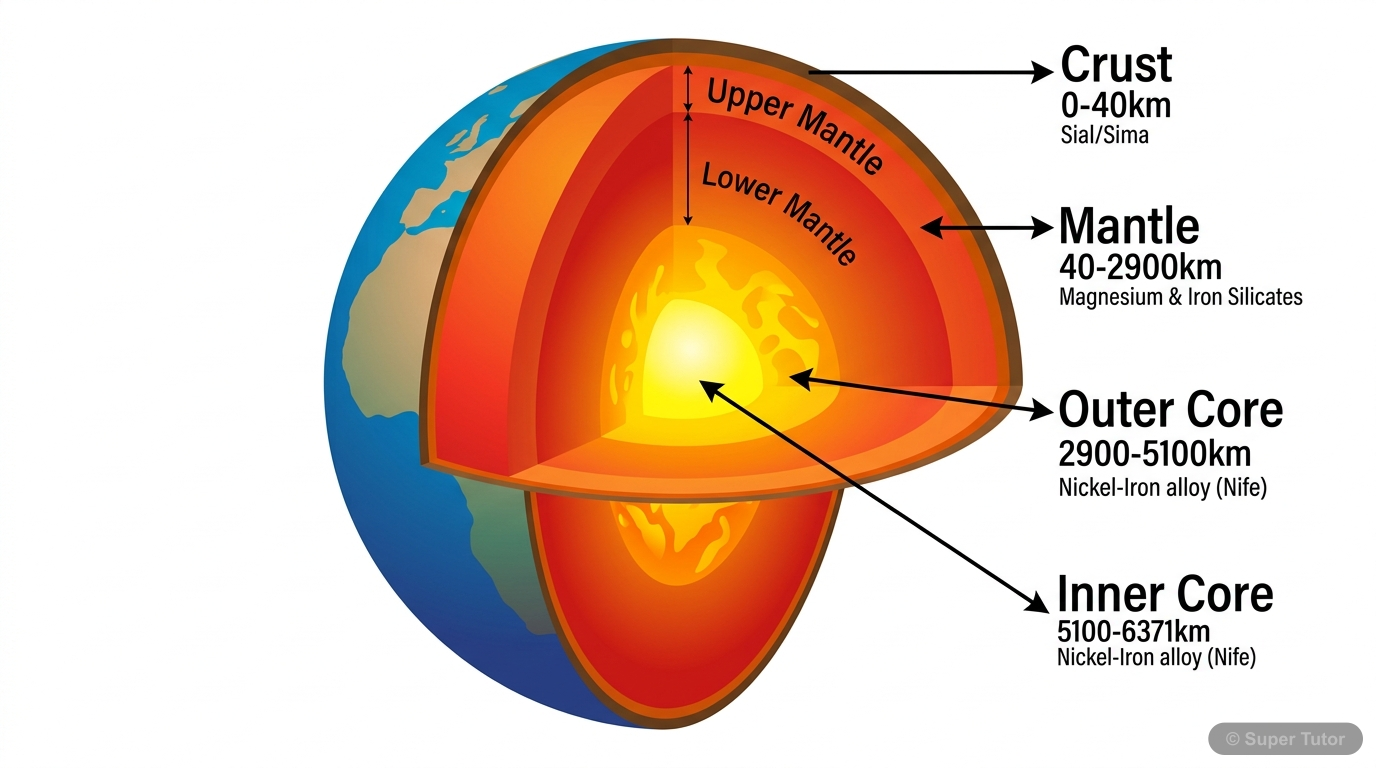
Learn better with visuals Super Tutor pairs illustrations like this with notes and quizzes for Earth's Structure.
What are the three main parts of the Earth?
Answer
Earth is composed of three parts: crust, mantle, and core. These layers differ in thickness, composition, temperature, pressure, and density.
What is the crust of the Earth?
Answer
The crust is the outermost layer of the Earth. It is about 6 to 48 km thick, and the glossary also gives a thickness range of 5 to 60 km. It is the thin upper shell made of rock.
What does the word Lithosphere mean?
Answer
Lithosphere is the name used for the crust. The word comes from the Greek word Lithos, meaning rock. It refers to the Earth’s outer rocky layer.
What are Sial and Sima?
Answer
Sial is the upper or continental layer of the crust, made mainly of silica and aluminium. Sima is the lower continuous layer of the crust, made mainly of silica and magnesium.
Why is the continental layer called Sial?
Answer
It is called Sial because silica and aluminium are the main materials present in it. Its composition is like granite, and its density is about 2.7.
Why is the lower crust layer called Sima?
Answer
It is called Sima because silica and magnesium are the main materials present in it. Its composition is similar to basalt, and its density is about 2.95.
How do Sial and Sima differ?
Answer
Sial is the upper, discontinuous, lighter layer of the crust, while Sima is the lower, continuous, heavier layer. Sial has density about 2.7, while Sima has density about 2.95. Sial is like granite, a…
What is the importance of the crust under continents and oceans?
Answer
In continental areas, the granitic and basaltic layers together reach about 45 to 48 km thickness. Under the ocean floor, the basaltic layer is the thinnest part of the crust. The crust is thickest be…
+26 more flashcards
Practise AllFrequently Asked Questions
What are the important topics in Earth's Structure for ICSE Class 9 Geography?
How many flashcards are available for Earth's Structure?
How should I revise Earth's Structure for Class 9 exams?
Sources & Official References
Content is aligned to the official syllabus. Refer to the board website for the latest curriculum.
More resources for Earth's Structure
Practice Quiz
Test yourself with a quick quiz
Important Questions
Exam-style questions with answers
Revision Notes
Key points for last-minute revision
Formula Sheet
The chapter's formulas in one place
Chapter Summary
Understand the chapter at a glance
Concept Maps
See how topics connect
Study Plan
Step-by-step plan for this chapter
Syllabus
What topics to cover
For serious students
Get the full Earth's Structure chapter — start free.
Quizzes, flashcards, an AI doubt solver and a study plan for ICSE Class 9 Geography. Free to start, no card needed.