Chemical Kinetics — Chapter Summary
Madhya Pradesh Board · Class 12 · Chemistry
Summary of Chemical Kinetics for Madhya Pradesh Board Class 12 Chemistry. Part of the Madhya Pradesh Board Class 12 Chemistry syllabus.
Interactive on Super Tutor
Studying Chemical Kinetics? Get the full interactive chapter.
Quizzes, flashcards, AI doubt-solver and a step-by-step study plan — built for chapter summary and more.
Free trial, no card needed.
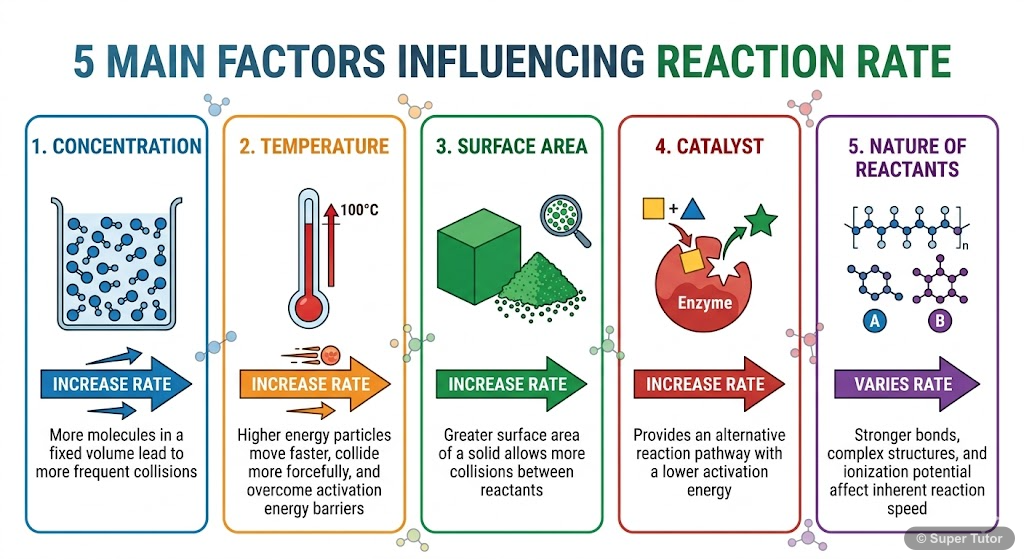
Learn better with visuals Super Tutor pairs illustrations like this with notes and quizzes for Chemical Kinetics.
Overview
Chemical kinetics is the branch of chemistry that deals with reaction rates and reaction mechanisms. It explains how fast a reaction occurs, why some reactions are instantaneous while others are slow, and how concentration, temperature, and catalysts change the rate. Thermodynamics tells whether a r
Key Concepts
Rate of reaction is the change
Rate of reaction is the change in concentration of a reactant or product in unit time. It can be written as rate of disappearance of a reactant or rat
Average rate is measured over
Average rate is measured over a time interval and uses total change in concentration divided by time taken. Instantaneous rate is the rate at a partic
Rate law is the expression
Rate law is the expression that relates reaction rate to the molar concentrations of reactants raised to powers determined experimentally. The rate co
The order of a reaction
The order of a reaction is the sum of the powers of concentration terms in the rate law. It may be zero, fractional, or an integer. It is an experimen
Molecularity is the number of reacting
Molecularity is the number of reacting species that collide simultaneously in an elementary reaction. It can never be zero or fractional and has meani
Learning Objectives
- Define average rate and instantaneous rate of a reaction
- Express reaction rate in terms of change in concentration or partial pressure
- Differentiate between elementary and complex reactions
- Distinguish between order of reaction and molecularity
- Define rate constant and interpret its units
Frequently Asked Questions
What are the important topics in Chemical Kinetics for Madhya Pradesh Board Class 12 Chemistry?
How should I revise Chemical Kinetics for the Madhya Pradesh Board Class 12 board exam?
Sources & Official References
Content is aligned to the official syllabus. Refer to the board website for the latest curriculum.
More resources for Chemical Kinetics
Practice Quiz
Test yourself with a quick quiz
Important Questions
Exam-style questions with answers
Revision Notes
Key points for last-minute revision
Formula Sheet
The chapter's formulas in one place
Concept Maps
See how topics connect
Study Plan
Step-by-step plan for this chapter
Flashcards
Quick-fire cards for active recall
Syllabus
What topics to cover
NCERT Solutions
Every textbook question solved step by step
For serious students
Get the full Chemical Kinetics chapter — start free.
Quizzes, flashcards, an AI doubt solver and a study plan for Madhya Pradesh Board Class 12 Chemistry. Free to start, no card needed.