Solutions — Chapter Summary
Madhya Pradesh Board · Class 12 · Chemistry
Summary of Solutions for Madhya Pradesh Board Class 12 Chemistry. Part of the Madhya Pradesh Board Class 12 Chemistry syllabus.
Interactive on Super Tutor
Studying Solutions? Get the full interactive chapter.
Quizzes, flashcards, AI doubt-solver and a step-by-step study plan — built for chapter summary and more.
Free trial, no card needed.
Learn better with visuals Super Tutor pairs illustrations like this with notes and quizzes for Solutions.
Overview
Solutions are homogeneous mixtures of two or more components with uniform composition and properties throughout. The component present in the largest quantity is the solvent, and it determines the physical state of the solution. Solutions occur in gas, liquid, and solid forms, and their behaviour de
Key Concepts
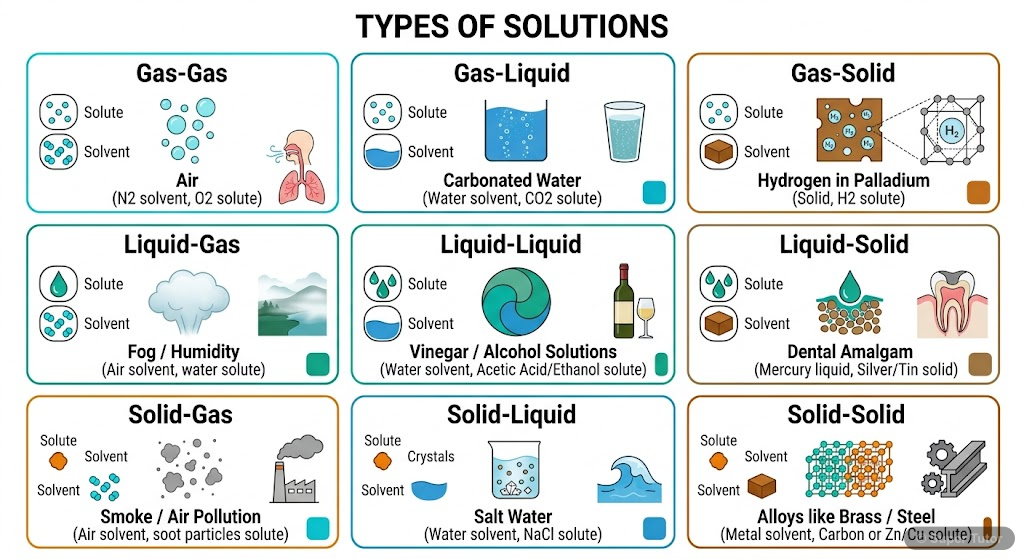
Binary solutions may be gaseous
Binary solutions may be gaseous, liquid, or solid depending on the states of solute and solvent. Examples include gas in gas, gas in liquid, liquid in
Concentration is expressed as mass %
Concentration is expressed as mass %, volume %, ppm, mole fraction, molarity, and molality. Mass %, ppm, mole fraction, and molality are temperature-i
Solubility is the maximum amount
Solubility is the maximum amount of solute that can dissolve in a given amount of solvent at a specified temperature and pressure. Polar solutes disso
The solubility of solids in liquids
The solubility of solids in liquids is not significantly affected by pressure. For a solid in a liquid, solubility may increase with temperature if di
At constant temperature
At constant temperature, the solubility of a gas in a liquid is directly proportional to the partial pressure of the gas above the solution. The commo
Learning Objectives
- Describe the formation and classification of different types of solutions.
- Express concentration in mass percentage, volume percentage, ppm, mole fraction, molarity, and molality.
- State and apply Henry's law and Raoult's law.
- Distinguish between ideal and non-ideal solutions.
- Explain positive and negative deviation from Raoult's law and identify azeotropes.
Frequently Asked Questions
What are the important topics in Solutions for Madhya Pradesh Board Class 12 Chemistry?
How should I revise Solutions for the Madhya Pradesh Board Class 12 board exam?
Sources & Official References
Content is aligned to the official syllabus. Refer to the board website for the latest curriculum.
More resources for Solutions
Practice Quiz
Test yourself with a quick quiz
Important Questions
Exam-style questions with answers
Revision Notes
Key points for last-minute revision
Formula Sheet
The chapter's formulas in one place
Concept Maps
See how topics connect
Study Plan
Step-by-step plan for this chapter
Flashcards
Quick-fire cards for active recall
Syllabus
What topics to cover
NCERT Solutions
Every textbook question solved step by step
For serious students
Get the full Solutions chapter — start free.
Quizzes, flashcards, an AI doubt solver and a study plan for Madhya Pradesh Board Class 12 Chemistry. Free to start, no card needed.