Transport and Communication — NCERT Solutions
Madhya Pradesh Board · Class 12 · Geography
NCERT Solutions for Transport and Communication, Madhya Pradesh Board Class 12 Geography: 10 textbook questions solved step by step. Covers Exercises.
Interactive on Super Tutor
Studying Transport and Communication? Get the full interactive chapter.
Quizzes, flashcards, AI doubt-solver and a step-by-step study plan — built for NCERT solutions and more.
Free trial, no card needed.
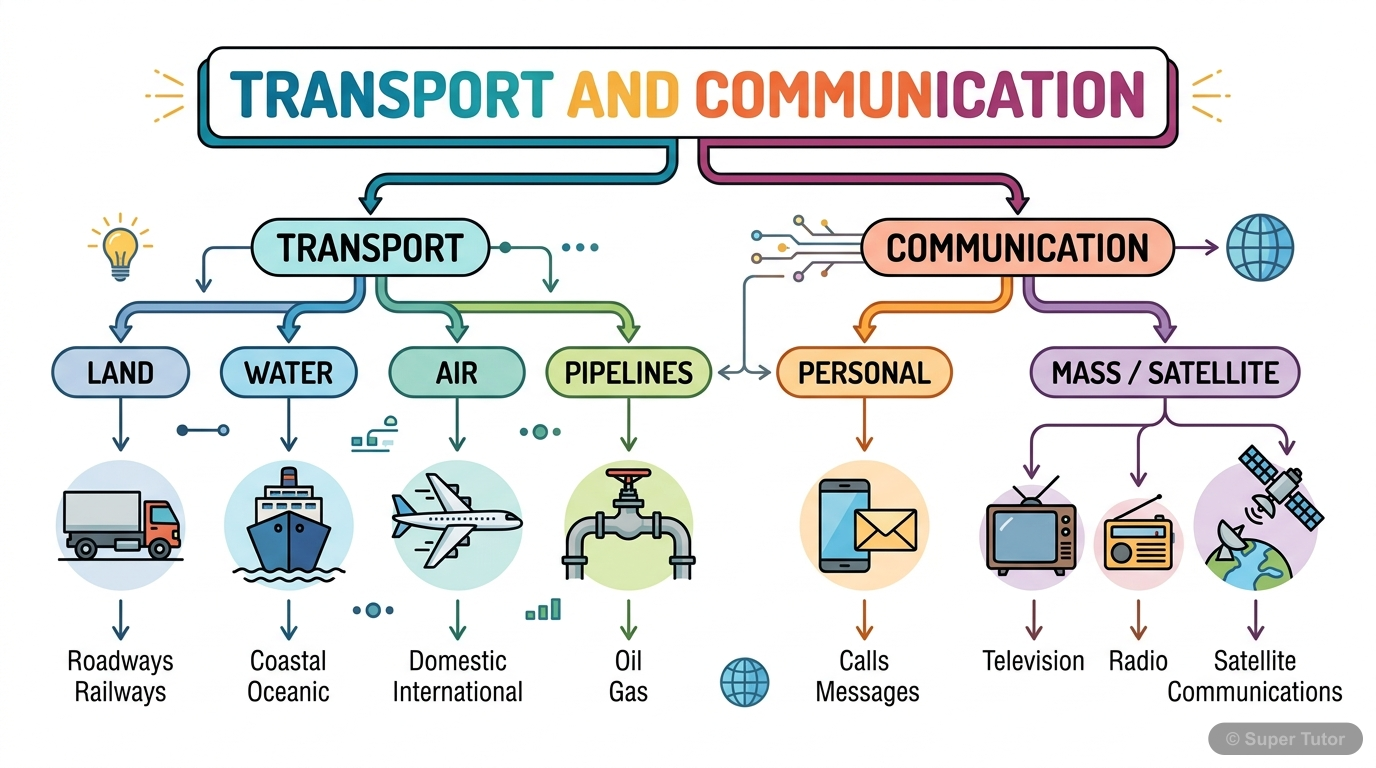
One of 9 illustrations for Transport and Communication in Super Tutor — alongside flashcards, concept maps and practice questions.
The first 5 solutions are open to read. The other 5 are free with a Super Tutor account.
Exercises
1(i)In how many zones has the Indian Railways system been divided?
(a) 9
(b) 12
(c) 17
(d) 14Show solution
Correct Answer: (c) 17
The Indian Railways network has been divided into 17 zones for administrative and operational purposes. Each zone is headed by a General Manager and is further divided into divisions. The zones include Northern, Southern, Eastern, Western, Central, North Eastern, Northeast Frontier, South Eastern, South Central, East Central, East Coast, North Central, North Western, South East Central, South Western, West Central, and Metro Railway (Kolkata).
1(ii)On which river and between which two places does the National Water Way No. 1 lie?
(a) The Brahmaputra, Sadiya-Dhubri
(b) The Ganga, Haldia-Prayagraj
(c) West Coast Canal, Kottapuram to Kollam
(d) Godavari-Kakinada PuducherryShow solution
Correct Answer: (b) The Ganga, Haldia-Prayagraj
National Waterway No. 1 (NW-1) lies on the river Ganga, stretching between Haldia (in West Bengal) and Prayagraj (in Uttar Pradesh). It has a total length of about 1,620 km and was declared a National Waterway in 1986. It is the longest national waterway in India.
1(iii)In which of the following year was the first radio programme broadcast?
(a) 1911
(b) 1936
(c) 1927
(d) 1923Show solution
Correct Answer: (d) 1923
The first radio programme in India was broadcast in 1923 by the Radio Club of Bombay. Subsequently, the Indian Broadcasting Service was launched in 1927, and All India Radio (AIR) was established in 1936. Radio remains one of the most widespread means of mass communication in India, especially in rural areas.
2(i)Which activity does transportation convey? Name three major modes of transportation.Show solution
Answer:
Given/Concept: Transportation is a service or facility by which persons, manufactured goods, and raw materials are carried from one place to another.
Transportation conveys people and goods from one location to another, thereby facilitating trade, commerce, and social interaction. It is the backbone of economic development as it links producers with consumers and integrates markets.
Three major modes of transportation are:
- Land transport – includes roadways and railways.
- Water transport – includes inland waterways and oceanic/sea routes.
- Air transport – includes domestic and international air services.
These modes together form an integrated transport network that supports the economic and social fabric of the country.
2(ii)Discuss advantages and disadvantages of pipeline transportation.Show solution
Answer:
Concept: Pipelines are used to transport liquids (water, petroleum, natural gas) and even slurry (crushed coal mixed with water) over long distances.
Advantages of Pipeline Transportation:
- It can be laid through difficult terrains (mountains, deserts, under water) where other modes are difficult.
- It involves low running cost and requires minimal maintenance once laid.
- It provides a continuous flow of materials without interruption.
- It is an energy-efficient and environment-friendly mode of transport.
- Reduces road and rail congestion by transporting bulk liquids.
Disadvantages of Pipeline Transportation:
- The initial cost of laying pipelines is very high.
- It is not flexible — once laid, it cannot be easily relocated.
- It is suitable only for liquids, gases, and slurry — not for solid goods.
- Leakages are difficult to detect and can cause environmental damage.
- It is vulnerable to sabotage and accidents.
Free with a Super Tutor account
Free with a Super Tutor account
Free with a Super Tutor account
Free with a Super Tutor account
Free with a Super Tutor account
5 more solved questions in Transport and Communication
They are free with a Super Tutor account, along with practice quizzes and flashcards for this chapter. Free to start, no card needed.
Frequently Asked Questions
What are the important topics in Transport and Communication for Madhya Pradesh Board Class 12 Geography?
Are these NCERT Solutions for Transport and Communication free?
How should I revise Transport and Communication for the Madhya Pradesh Board Class 12 board exam?
Sources & Official References
Content is aligned to the official syllabus. Refer to the board website for the latest curriculum.
More resources for Transport and Communication
Practice Quiz
Test yourself with a quick quiz
Important Questions
Exam-style questions with answers
Revision Notes
Key points for last-minute revision
Chapter Summary
Understand the chapter at a glance
Concept Maps
See how topics connect
Study Plan
Step-by-step plan for this chapter
Flashcards
Quick-fire cards for active recall
Syllabus
What topics to cover
For serious students
Get the full Transport and Communication chapter — start free.
Quizzes, flashcards, an AI doubt solver and a study plan for Madhya Pradesh Board Class 12 Geography. Free to start, no card needed.