Current Electricity — Chapter Summary
Madhya Pradesh Board · Class 12 · Physics
Summary of Current Electricity for Madhya Pradesh Board Class 12 Physics. Part of the Madhya Pradesh Board Class 12 Physics syllabus.
Interactive on Super Tutor
Studying Current Electricity? Get the full interactive chapter.
Quizzes, flashcards, AI doubt-solver and a step-by-step study plan — built for chapter summary and more.
Free trial, no card needed.
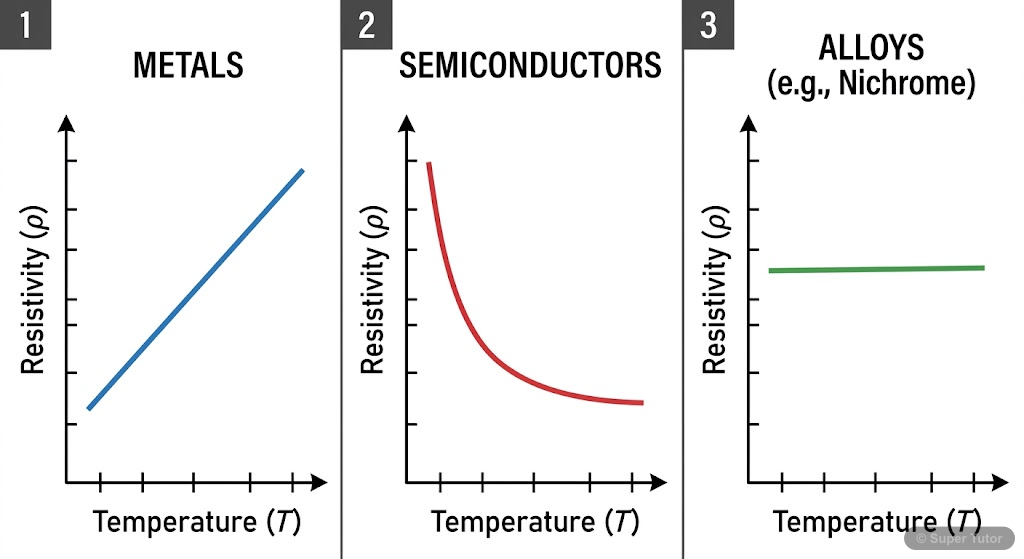
One of 13 illustrations for Current Electricity in Super Tutor — alongside flashcards, concept maps and practice questions.
Overview
Current electricity deals with the flow of electric charge in conductors and the laws that describe steady currents. Electric current is defined as the net charge crossing a cross-section per unit time, and for a time-varying situation it is the limiting rate of charge flow. In steady conduction, cu
Key Concepts
Current is the net charge passing
Current is the net charge passing through a cross-section per unit time. For steady current, I = q/t. For a changing current, I(t) = lim_{Δt→0} ΔQ/Δt.
Current is a scalar quantity
Current is a scalar quantity, even though it is represented by an arrow in circuit diagrams. Direction is shown for convenience, but currents do not o
For a uniform conductor
For a uniform conductor, R = ρl/A. Resistance depends on length and cross-sectional area, while resistivity depends only on the material. The SI unit
Ohm's law states V = RI
Ohm's law states V = RI for many conductors under suitable conditions, and in vector form j = σE or E = jρ. The assertion that V = IR is Ohm's law is
In an electric field
In an electric field, electrons accelerate between collisions and acquire an average drift velocity v_d = -eEτ/m. The current density is j = (ne²/m)τE
Learning Objectives
- Define electric current in steady and general form.
- Understand current as a scalar quantity and current density as a vector quantity.
- Relate resistance to conductor dimensions and resistivity.
- Explain Ohm's law and its vector form.
- Describe drift velocity, relaxation time, mobility, and the microscopic origin of resistivity.
Frequently Asked Questions
What are the important topics in Current Electricity for Madhya Pradesh Board Class 12 Physics?
How should I revise Current Electricity for the Madhya Pradesh Board Class 12 board exam?
Sources & Official References
Content is aligned to the official syllabus. Refer to the board website for the latest curriculum.
More resources for Current Electricity
Practice Quiz
Test yourself with a quick quiz
Important Questions
Exam-style questions with answers
Revision Notes
Key points for last-minute revision
Formula Sheet
The chapter's formulas in one place
Concept Maps
See how topics connect
Study Plan
Step-by-step plan for this chapter
Flashcards
Quick-fire cards for active recall
Syllabus
What topics to cover
NCERT Solutions
Every textbook question solved step by step
For serious students
Get the full Current Electricity chapter — start free.
Quizzes, flashcards, an AI doubt solver and a study plan for Madhya Pradesh Board Class 12 Physics. Free to start, no card needed.