Electric Charges and Fields — Chapter Summary
Madhya Pradesh Board · Class 12 · Physics
Summary of Electric Charges and Fields for Madhya Pradesh Board Class 12 Physics. Part of the Madhya Pradesh Board Class 12 Physics syllabus.
Interactive on Super Tutor
Studying Electric Charges and Fields? Get the full interactive chapter.
Quizzes, flashcards, AI doubt-solver and a step-by-step study plan — built for chapter summary and more.
Free trial, no card needed.
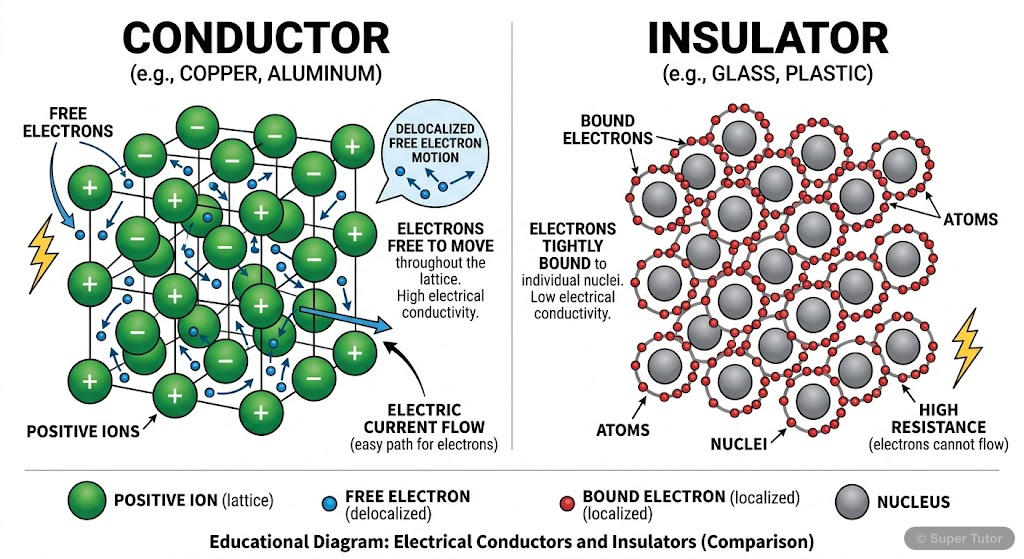
One of 23 illustrations for Electric Charges and Fields in Super Tutor — alongside flashcards, concept maps and practice questions.
Overview
Electric charges are the basic source of electrostatic phenomena. Static means anything that does not move or change with time. Electrostatics deals with the study of forces, fields and potentials arising from static charges. The chapter begins with simple observations such as attraction after rubbi
Key Concepts
Electric charge exists in two kinds
Electric charge exists in two kinds, positive and negative. Like charges repel and unlike charges attract. The charge on a glass rod rubbed with silk
Conductors allow electric charge to move
Conductors allow electric charge to move freely; metals, human and animal bodies and earth are conductors. Insulators resist charge movement; glass, p
Electric charge exists in discrete units
Electric charge exists in discrete units. Any charge q is given by q = ne, where n is an integer and e is the elementary charge. The value of e is 1.6
The total charge of an isolated
The total charge of an isolated system remains constant. During charging by rubbing, charge is only transferred from one body to another.
The force between two point charges
The force between two point charges is proportional to the product of their charges and inversely proportional to the square of the distance between t
Learning Objectives
- Understand the nature and types of electric charge
- Explain charging by rubbing and charge transfer by electrons
- Distinguish between conductors and insulators
- Use the ideas of additivity, conservation and quantisation of charge
- Apply Coulomb’s law to calculate electrostatic force between point charges
Frequently Asked Questions
What are the important topics in Electric Charges and Fields for Madhya Pradesh Board Class 12 Physics?
How should I revise Electric Charges and Fields for the Madhya Pradesh Board Class 12 board exam?
Sources & Official References
Content is aligned to the official syllabus. Refer to the board website for the latest curriculum.
More resources for Electric Charges and Fields
Practice Quiz
Test yourself with a quick quiz
Important Questions
Exam-style questions with answers
Revision Notes
Key points for last-minute revision
Formula Sheet
The chapter's formulas in one place
Concept Maps
See how topics connect
Study Plan
Step-by-step plan for this chapter
Flashcards
Quick-fire cards for active recall
Syllabus
What topics to cover
NCERT Solutions
Every textbook question solved step by step
For serious students
Get the full Electric Charges and Fields chapter — start free.
Quizzes, flashcards, an AI doubt solver and a study plan for Madhya Pradesh Board Class 12 Physics. Free to start, no card needed.