Era of one-party dominance — NCERT Solutions
Madhya Pradesh Board · Class 12 · Political Science
NCERT Solutions for Era of one-party dominance, Madhya Pradesh Board Class 12 Political Science: 7 textbook questions solved step by step.
Interactive on Super Tutor
Studying Era of one-party dominance? Get the full interactive chapter.
Quizzes, flashcards, AI doubt-solver and a step-by-step study plan — built for NCERT solutions and more.
Free trial, no card needed.
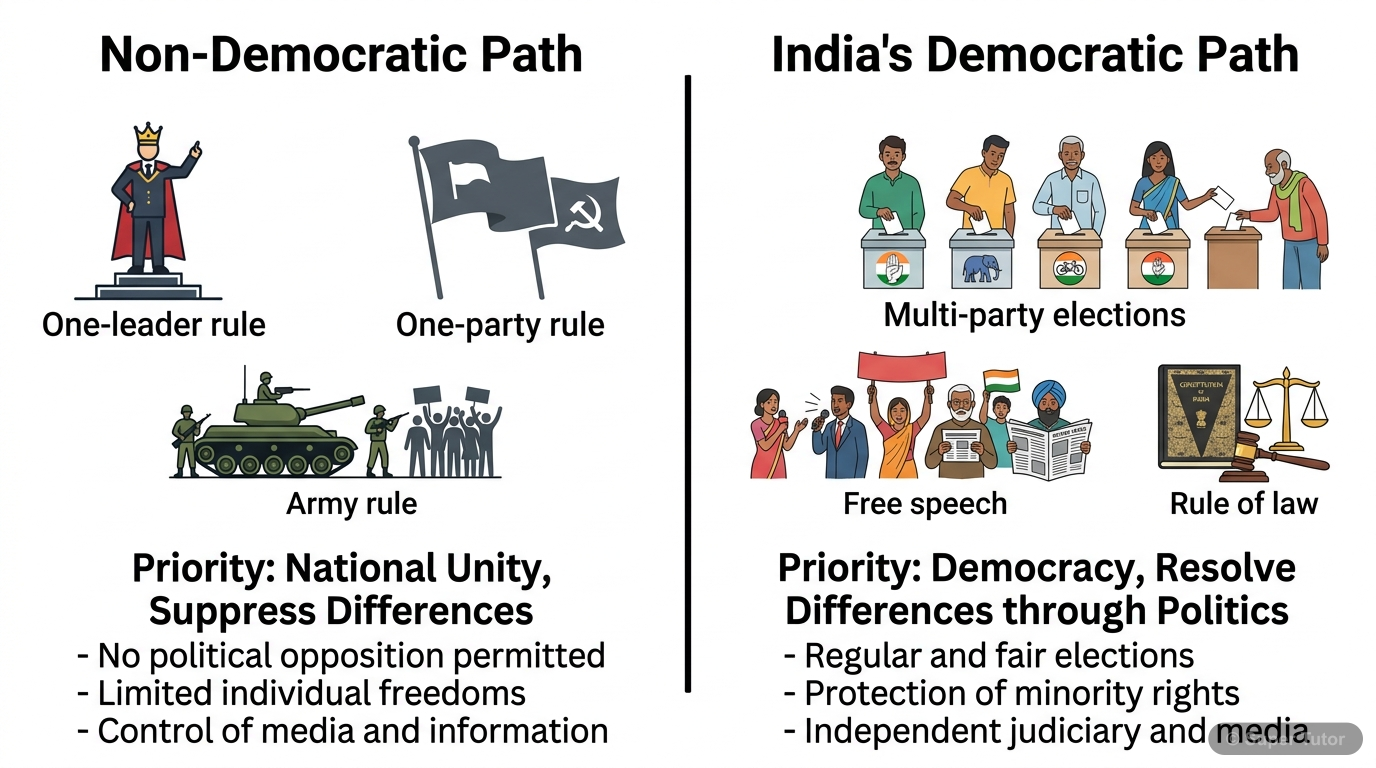
One of 15 illustrations for Era of one-party dominance in Super Tutor — alongside flashcards, concept maps and practice questions.
The first 4 solutions are open to read. The other 3 are free with a Super Tutor account.
Exercise Questions
1Choose the correct option to fill in the blanks.
(a) The First General Elections in 1952 involved simultaneous elections to the Lok Sabha and ...(The President of India/ State Assemblies/ Rajya Sabha/ The Prime Minister)
(b) The party that won the second largest number of Lok Sabha seats in the first elections was the...(Praja Socialist Party/ Bharatiya Jana Sangh/ Communist Party of India/Bharatiya Janata Party)
(c) One of the guiding principles of the ideology of the Swatantra Party was...(Working class interests/ protection of Princely States / economy free from State control / Autonomy of States within the Union)Show solution
(a) State Assemblies
The First General Elections of 1952 were unique in that they involved simultaneous elections to both the Lok Sabha (the lower house of Parliament) and the State Legislative Assemblies across the country. This was done to save time and resources.
(b) Communist Party of India (CPI)
In the first general elections of 1952, the Congress Party won a massive majority with 364 seats. The Communist Party of India emerged as the second largest party in the Lok Sabha, winning 16 seats. (Note: The Bharatiya Janata Party did not exist at that time; it was founded in 1980.)
(c) Economy free from State control
The Swatantra Party, founded in 1959 by C. Rajagopalachari and others, was guided by the principle of a free-market economy — i.e., an economy free from excessive State control and interference. It opposed the socialist economic policies of the Congress government, including nationalisation and state planning.
2Match the following leaders listed in List A with the parties in List B.
List A: (a) S. A. Dange, (b) Shyama Prasad Mukherjee, (c) Minoo Masani, (d) Asoka Mehta
List B: i. Bharatiya Jana Sangh, ii. Swatantra Party, iii. Praja Socialist Party, iv. Communist Party of IndiaShow solution
The correct matching is as follows:
| List A | List B |
|---|---|
| (a) S. A. Dange | iv. Communist Party of India |
| (b) Shyama Prasad Mukherjee | i. Bharatiya Jana Sangh |
| (c) Minoo Masani | ii. Swatantra Party |
| (d) Asoka Mehta | iii. Praja Socialist Party |
Brief Justification:
- S. A. Dange was a prominent Marxist trade union leader and a founding member of the Communist Party of India (CPI).
- Shyama Prasad Mukherjee was a leader of the Hindu Mahasabha who founded the Bharatiya Jana Sangh in 1951.
- Minoo Masani was a co-founder of the Swatantra Party (1959), which advocated free-market economics.
- Asoka Mehta was a socialist leader associated with the Praja Socialist Party, formed by a merger of the Socialist Party and the Kisan Mazdoor Praja Party.
3Four statements regarding one-party dominance are given below. Mark each of them as true or false.
(a) One-party dominance is rooted in the absence of strong alternative political parties.
(b) One-party dominance occurs because of weak public opinion.
(c) One-party dominance is linked to the nation's colonial past.
(d) One-party dominance reflects the absence of democratic ideals in a country.Show solution
(a) TRUE
One-party dominance is indeed rooted partly in the absence of strong, well-organised alternative political parties. In India after Independence, opposition parties were either newly formed, lacked resources, or had a very narrow social base, which allowed the Congress to dominate.
(b) FALSE
One-party dominance does not occur because of weak public opinion. In fact, public opinion was quite active and vibrant in post-Independence India. The dominance of Congress was due to its legacy of the freedom struggle, its organisational strength, and its broad social coalition — not because the public was passive or uninformed.
(c) TRUE
One-party dominance in India is closely linked to the nation's colonial past. The Congress Party led the freedom struggle against British colonial rule and thus enjoyed enormous prestige, legitimacy, and mass support at the time of Independence. This historical advantage gave it a head start over all other parties.
(d) FALSE
One-party dominance does not reflect the absence of democratic ideals. India's one-party dominance under Congress was achieved through free and fair elections in a functioning democracy. Multiple parties contested elections, citizens voted freely, and the Constitution guaranteed democratic rights. It was a case of 'one-party dominance in a multi-party democracy,' not the absence of democracy.
4Take a political map of India (with State outlines) and mark:
(a) two states where Congress was not in power at some point during 1952-67.
(b) two states where the Congress remained in power through this period.Show solution
Given: The period under consideration is 1952–1967, during which Congress dominated Indian politics but did not win everywhere.
(a) Two States where Congress was NOT in power at some point during 1952–67:
- Kerala — In 1957, Kerala became the first state in the world to democratically elect a Communist government. The Communist Party of India (CPI), led by E. M. S. Namboodiripad, formed the government. (The government was later dismissed in 1959 under Article 356.)
- Jammu & Kashmir — The National Conference, led by Sheikh Abdullah and later by Bakshi Ghulam Mohammad, held power in J&K during much of this period, not the Congress directly.
(Other valid examples: Orissa — where Ganatantra Parishad formed the government in coalition; Nagaland — where regional parties dominated.)
(b) Two States where Congress remained in power throughout 1952–67:
- Uttar Pradesh — Congress remained continuously in power in UP throughout this period, with leaders like Govind Ballabh Pant and later C. B. Gupta serving as Chief Ministers.
- Maharashtra — After its formation in 1960, Maharashtra was continuously governed by the Congress Party.
(Other valid examples: Bihar, Madhya Pradesh, Andhra Pradesh, Rajasthan.)
Note: Students should mark these states on a political outline map of India as instructed.
Free with a Super Tutor account
Free with a Super Tutor account
Free with a Super Tutor account
3 more solved questions in Era of one-party dominance
They are free with a Super Tutor account, along with practice quizzes and flashcards for this chapter. Free to start, no card needed.
Frequently Asked Questions
What are the important topics in Era of one-party dominance for Madhya Pradesh Board Class 12 Political Science?
Are these NCERT Solutions for Era of one-party dominance free?
How should I revise Era of one-party dominance for the Madhya Pradesh Board Class 12 board exam?
Sources & Official References
Content is aligned to the official syllabus. Refer to the board website for the latest curriculum.
More resources for Era of one-party dominance
Practice Quiz
Test yourself with a quick quiz
Important Questions
Exam-style questions with answers
Revision Notes
Key points for last-minute revision
Chapter Summary
Understand the chapter at a glance
Concept Maps
See how topics connect
Study Plan
Step-by-step plan for this chapter
Flashcards
Quick-fire cards for active recall
Syllabus
What topics to cover
For serious students
Get the full Era of one-party dominance chapter — start free.
Quizzes, flashcards, an AI doubt solver and a study plan for Madhya Pradesh Board Class 12 Political Science. Free to start, no card needed.