Security in the Contemporary World — NCERT Solutions
Madhya Pradesh Board · Class 12 · Political Science
NCERT Solutions for Security in the Contemporary World, Madhya Pradesh Board Class 12 Political Science: 12 textbook questions solved step by step.
Interactive on Super Tutor
Studying Security in the Contemporary World? Get the full interactive chapter.
Quizzes, flashcards, AI doubt-solver and a step-by-step study plan — built for NCERT solutions and more.
Free trial, no card needed.
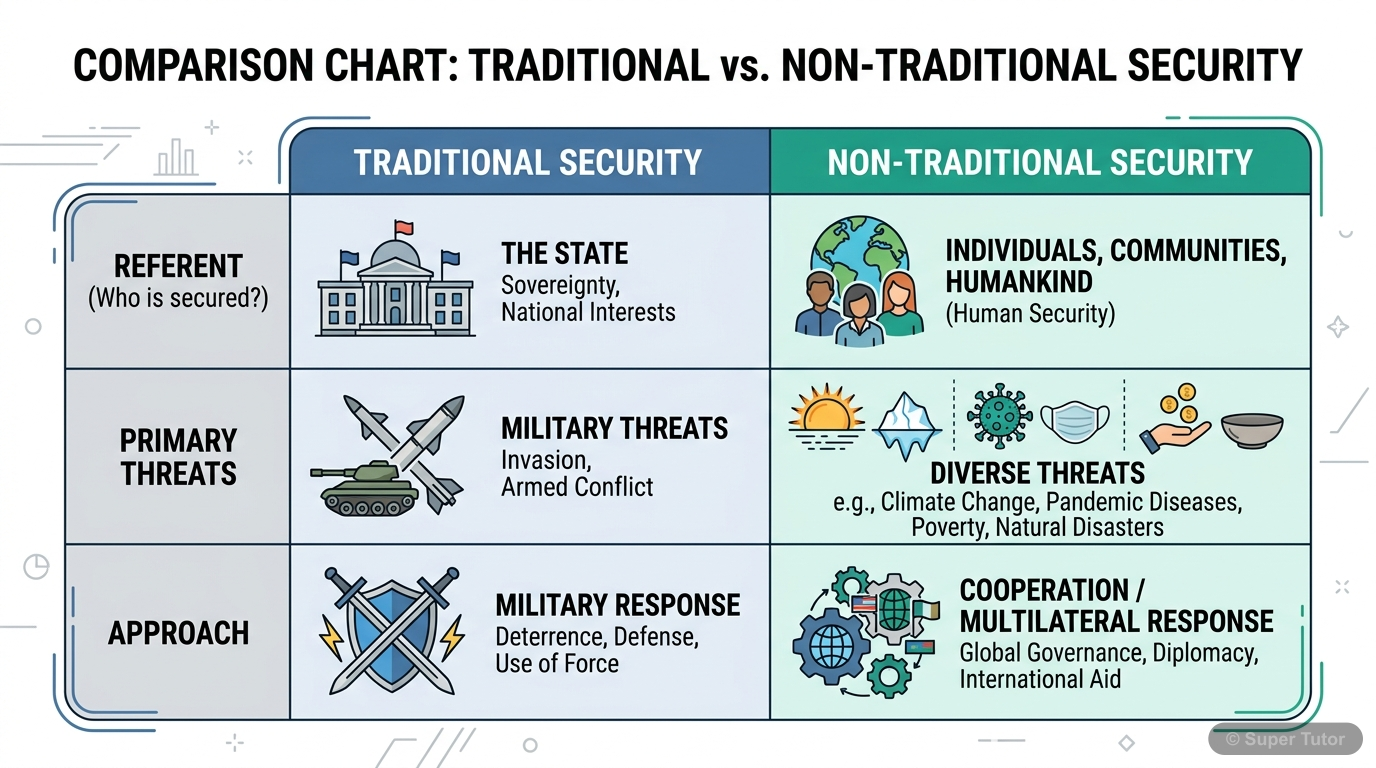
One of 7 illustrations for Security in the Contemporary World in Super Tutor — alongside flashcards, concept maps and practice questions.
The first 6 solutions are open to read. The other 6 are free with a Super Tutor account.
CBSE Class 12 Political Science (Contemporary World Politics)
1Match the terms with their meaning:
i. Confidence Building Measures (CBMs)
ii. Arms Control
iii. Alliance
iv. Disarmament
a. Giving up certain types of weapons
b. A process of exchanging information on defence matters between nations on a regular basis
c. A coalition of nations meant to deter or defend against military attacks
d. Regulates the acquisition or development of weaponsShow solution
The correct matching is as follows:
Explanation:
- CBMs (i → b): Confidence Building Measures involve a regular, institutionalised process of exchanging information on defence and military matters between nations so as to reduce suspicion and the risk of accidental war.
- Arms Control (ii → d): Arms Control does not eliminate weapons altogether but regulates (limits) the acquisition, development, or deployment of certain categories of weapons through treaties and agreements (e.g., SALT, START).
- Alliance (iii → c): An Alliance is a coalition or grouping of nations that come together to deter a common threat or to defend against military attacks collectively (e.g., NATO).
- Disarmament (iv → a): Disarmament requires all states to give up certain types of weapons entirely (e.g., the Chemical Weapons Convention requires states to destroy their chemical weapons stockpiles).
2Which among the following would you consider as a traditional security concern / non-traditional security concern / not a threat?
a. The spread of chikungunya / dengue fever
b. Inflow of workers from a neighbouring nation
c. Emergence of a group demanding nationhood for their region
d. Emergence of a group demanding autonomy for their region
e. A newspaper that is critical of the armed forces in the countryShow solution
Given: A list of situations to be classified as traditional security concern, non-traditional security concern, or not a threat.
Classification:
| Situation | Category | Reason |
|---|---|---|
| a. Spread of chikungunya/dengue fever | Non-Traditional Security Concern | Epidemic diseases threaten human security and the well-being of large populations; they are not military threats but endanger human lives on a large scale. |
| b. Inflow of workers from a neighbouring nation | Not a Threat (in most contexts) | Migration of workers is generally an economic phenomenon. It may create social tensions but is not inherently a security threat; it can even be beneficial economically. |
| c. Emergence of a group demanding nationhood for their region | Traditional Security Concern | A secessionist movement that demands a separate nation challenges the territorial integrity and sovereignty of the state — a core traditional security concern. |
| d. Emergence of a group demanding autonomy for their region | Not a Threat / possibly Non-Traditional | Demands for autonomy within a democratic framework are a political/governance issue. If pursued peacefully, it is not a security threat; it is a legitimate political demand. |
| e. A newspaper critical of the armed forces | Not a Threat | A free press criticising the military is a feature of democracy and freedom of expression. It does not constitute a security threat to the state. |
Conclusion: Traditional security concerns relate to military threats to the state's sovereignty and territorial integrity. Non-traditional concerns include threats to human security such as disease, poverty, and environmental degradation. Not every social or political phenomenon constitutes a security threat.
3What is the difference between traditional and non-traditional security? Which category would the creation and sustenance of alliances belong to?Show solution
Given: We need to distinguish between traditional and non-traditional security and classify alliances.
Traditional Security:
- Focuses on military threats to the state — its sovereignty, territorial integrity, and political independence.
- The referent object (what is being protected) is the state.
- Threats come from other states through war, conquest, or coercion.
- Responses include: building military capability, forming alliances, maintaining balance of power, and arms control/disarmament.
- Example: One country threatening to invade another.
Non-Traditional Security:
- Focuses on threats to human security and global security that go beyond military threats.
- The referent object is the individual/community/humanity as a whole.
- Threats include: terrorism, poverty, climate change, pandemics, human rights violations, refugee crises, drug trafficking, etc.
- Responses require international cooperation, multilateral institutions, and development policies.
- Example: Global warming, spread of HIV/AIDS, international terrorism.
Key Differences:
| Basis | Traditional Security | Non-Traditional Security |
|---|---|---|
| Nature of Threat | Military | Non-military (economic, environmental, social) |
| Referent Object | State | Individual / Humanity |
| Source of Threat | Other states | Non-state actors, nature, poverty |
| Response | Military power, alliances | Cooperation, diplomacy, development |
Classification of Alliances:
The creation and sustenance of alliances belongs to the traditional security perspective. Alliances are coalitions of states formed to increase collective military capability, deter aggression from rival states, and defend against military attacks. They are a classic instrument of statecraft in the traditional security framework (e.g., NATO was formed to counter the Soviet military threat during the Cold War).
4What are the differences in the threats that people in the Third World face and those living in the First World face?Show solution
Given: We need to compare security threats faced by people in the Third World (developing countries) versus the First World (developed/industrialised countries).
Threats faced by people in the Third World:
- Internal security threats are more prominent — civil wars, ethnic conflicts, secessionist movements, and insurgencies are common.
- Poverty and underdevelopment — lack of food, clean water, healthcare, and basic necessities pose a constant threat to human security.
- State-sponsored violence — in many Third World states, the government itself is a source of threat to its own citizens through repression, human rights violations, and genocide.
- Weak state institutions — inability to provide security, justice, or basic services makes populations vulnerable.
- Colonial legacy — many borders were drawn arbitrarily by colonial powers, leading to ethnic and territorial conflicts.
- Disease and epidemics — lack of healthcare infrastructure makes populations vulnerable to diseases like malaria, tuberculosis, etc.
- Environmental threats — deforestation, desertification, and natural disasters hit harder due to lack of resources to cope.
Threats faced by people in the First World:
- External military threats are the primary traditional concern, though these have reduced after the Cold War.
- Terrorism — especially international terrorism (e.g., 9/11 in the USA) is a major concern.
- Cyber security threats — attacks on critical infrastructure, financial systems, and data.
- Immigration and refugee flows — seen as a social and security challenge.
- Economic threats — financial crises, job losses due to globalisation.
- Environmental threats — climate change, though they have greater resources to adapt.
- Weapons of Mass Destruction (WMDs) — proliferation of nuclear, chemical, and biological weapons.
Key Difference: In the Third World, threats are often internal, human-security-based, and structural (poverty, weak governance), whereas in the First World, threats are more external, military, or technological in nature. People in the Third World face threats from both their own states and from non-state actors, while First World citizens are more threatened by external actors and non-traditional threats like terrorism and cyber attacks.
5Is terrorism a traditional or non-traditional threat to security?Show solution
Answer: Terrorism is a non-traditional threat to security.
Explanation:
Traditional security concerns itself with military threats from other states — wars, invasions, and interstate conflicts. The state is both the referent object (what is protected) and the primary actor.
Terrorism, however, has the following characteristics that place it firmly in the non-traditional category:
- Non-state actors: Terrorism is mostly carried out by non-state actors — organised groups, networks, or individuals — not by sovereign states. (e.g., Al-Qaeda, ISIS)
- Targets civilians: Terrorism deliberately targets civilians and non-combatants to spread fear and achieve political goals, unlike conventional warfare which targets military forces.
- Transnational nature: Modern terrorism crosses national borders and cannot be addressed by a single state's military alone. It requires international cooperation, intelligence sharing, and multilateral responses.
- Unconventional methods: Terrorists use suicide bombings, hijackings, cyber attacks, and biological/chemical agents — methods outside the scope of traditional military confrontation.
- Threatens human security: Terrorism threatens the lives and security of ordinary individuals, not just the state's territorial integrity.
- Cannot be countered by traditional means alone: Military power and nuclear deterrence are largely ineffective against terrorist networks. Responses require policing, intelligence, diplomacy, and addressing root causes like poverty and political grievances.
Conclusion: Because terrorism involves non-state actors, targets civilians, crosses borders, and requires non-military responses, it is classified as a non-traditional security threat. However, it is important to note that some scholars argue it has elements of both — when states sponsor terrorism, it acquires a traditional dimension as well.
6What are the choices available to a state when its security is threatened, according to the traditional security perspective?Show solution
Given: We need to identify the options available to a state facing a security threat under the traditional security framework.
Concept: The traditional security perspective focuses on military threats to the state's sovereignty and territorial integrity. When a state perceives such a threat, it has the following choices:
1. Surrender:
The state can give in to the demands of the threatening power. This is rarely chosen as it compromises sovereignty, but it may be considered when the power differential is overwhelming.
2. Deterrence (Prevention of War):
The state can try to prevent war by making the cost of attack too high for the aggressor. This is done by:
- Building up military strength and capability.
- Developing nuclear weapons as a deterrent (the logic: 'if you attack me, I will destroy you too').
- The goal is to convince the adversary that war is not worth fighting.
3. Defence (Limiting War):
If deterrence fails and war begins, the state can defend itself to:
- Protect its territory from conquest.
- Limit the damage caused by the war.
- Deny the attacker their objectives.
4. Alliance Building:
A state can join or form an alliance with other states to:
- Increase collective military power.
- Deter a common enemy.
- Share the burden of defence.
- Example: NATO was formed by Western nations to deter Soviet aggression.
5. Balance of Power:
A state can try to maintain or restore the balance of power by:
- Building up its own military.
- Forming alliances to counterbalance a rising or threatening power.
- The idea is that no single state should become so powerful that it can dominate others.
6. Arms Control and Disarmament:
States can negotiate treaties to:
- Limit the development or deployment of certain weapons (Arms Control).
- Completely eliminate certain categories of weapons (Disarmament).
- This reduces the risk of war by mutual agreement.
Conclusion: The traditional security perspective thus offers a state a spectrum of choices ranging from military build-up and alliances to diplomatic instruments like arms control, all aimed at protecting the state from military threats.
Free with a Super Tutor account
Free with a Super Tutor account
Free with a Super Tutor account
Free with a Super Tutor account
Free with a Super Tutor account
Free with a Super Tutor account
6 more solved questions in Security in the Contemporary World
They are free with a Super Tutor account, along with practice quizzes and flashcards for this chapter. Free to start, no card needed.
Frequently Asked Questions
What are the important topics in Security in the Contemporary World for Madhya Pradesh Board Class 12 Political Science?
Are these NCERT Solutions for Security in the Contemporary World free?
How should I revise Security in the Contemporary World for the Madhya Pradesh Board Class 12 board exam?
Sources & Official References
Content is aligned to the official syllabus. Refer to the board website for the latest curriculum.
More resources for Security in the Contemporary World
Practice Quiz
Test yourself with a quick quiz
Important Questions
Exam-style questions with answers
Revision Notes
Key points for last-minute revision
Chapter Summary
Understand the chapter at a glance
Concept Maps
See how topics connect
Study Plan
Step-by-step plan for this chapter
Flashcards
Quick-fire cards for active recall
Syllabus
What topics to cover
For serious students
Get the full Security in the Contemporary World chapter — start free.
Quizzes, flashcards, an AI doubt solver and a study plan for Madhya Pradesh Board Class 12 Political Science. Free to start, no card needed.