Globalizations and Social Change — NCERT Solutions
Madhya Pradesh Board · Class 12 · Sociology
NCERT Solutions for Globalizations and Social Change, Madhya Pradesh Board Class 12 Sociology: 4 textbook questions solved step by step.
Interactive on Super Tutor
Studying Globalizations and Social Change? Get the full interactive chapter.
Quizzes, flashcards, AI doubt-solver and a step-by-step study plan — built for NCERT solutions and more.
Free trial, no card needed.
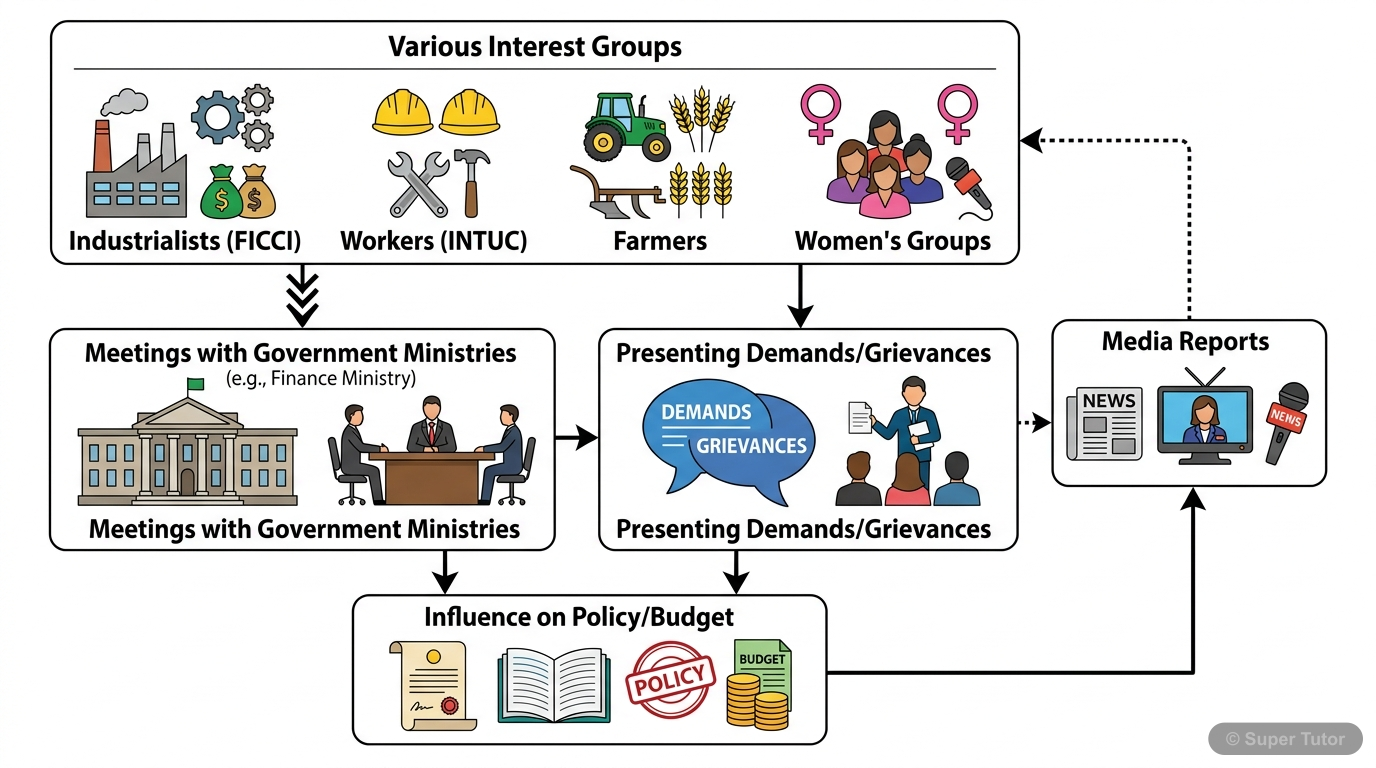
Learn better with visuals Super Tutor pairs illustrations like this with notes and quizzes for Globalizations and Social Change.
The first 2 solutions are open to read. The other 2 are free with a Super Tutor account.
Questions — Globalisation and Social Change
1Choose any topic that is of interest to you and discuss how you think globalisation has affected it. You could choose cinema, work, marriage or any other topic.Show solution
Topic Chosen: Cinema
Given / Introduction:
Globalisation refers to the increasing interconnectedness of societies across the world through flows of capital, goods, services, people, technology, and ideas. Cinema is one of the most powerful cultural forms, and its transformation under globalisation is clearly visible in India.
Impact of Globalisation on Indian Cinema:
1. Technological Changes:
Globalisation has brought advanced filmmaking technologies — digital cameras, CGI (Computer Generated Imagery), Dolby sound systems, and multiplex theatres — to India. Films like Baahubali and RRR reflect this technological leap made possible by global exchange.
2. Expansion of Markets:
Indian cinema, especially Bollywood, now targets a global audience. Films are released simultaneously in India, the USA, the UK, Australia, and other countries. The Indian diaspora has become an important market, and storylines increasingly reflect the lives of Non-Resident Indians (NRIs).
3. Cultural Hybridisation:
Indian films now blend Indian narratives with Western music, fashion, dance styles, and themes. Songs mix Hindi lyrics with English phrases; costumes reflect global fashion trends. This is an example of cultural hybridisation — neither purely Indian nor purely Western.
4. Entry of Multinational Capital:
Multinational corporations and foreign studios have invested in Indian film production and distribution. Hollywood studios like Disney and Sony have co-produced or distributed Indian films, changing the economics of the industry.
5. Threat to Regional and Local Cinema:
While Bollywood has globalised, smaller regional language cinemas face competition from both Bollywood and Hollywood. Local cultural expressions may get marginalised as global and national mainstream cinema dominates multiplexes.
6. New Themes and Narratives:
Globalisation has introduced new themes into Indian cinema — corporate life, call centres, migration, cross-cultural romance, and global terrorism — reflecting the changed social reality of Indians.
Conclusion:
Globalisation has profoundly transformed Indian cinema — expanding its reach, upgrading its technology, and hybridising its culture. However, it has also raised concerns about cultural homogenisation and the marginalisation of local voices. Using sociological imagination, we can see that cinema both reflects and shapes the social changes brought by globalisation.
2What are the distinctive features of a globalised economy? Discuss.Show solution
Given:
Globalisation of the economy refers to the integration of national economies into a single global economy through trade, foreign investment, capital flows, migration, and the spread of technology.
Concept Used:
A globalised economy is characterised by the free movement of goods, services, capital, and labour across national boundaries, driven largely by advances in communication and transport technology.
Distinctive Features of a Globalised Economy:
1. Free Flow of Capital:
In a globalised economy, capital moves freely across national borders. Multinational corporations (MNCs) invest in countries where labour and raw materials are cheapest, seeking maximum profit. Foreign Direct Investment (FDI) and portfolio investment flow across the world at great speed.
2. Dominance of Multinational Corporations (MNCs):
MNCs are the key actors in a globalised economy. They operate in multiple countries, organise production globally, and control large shares of world trade. Companies like Apple, Samsung, and Unilever source raw materials from one country, manufacture in another, and sell globally.
3. New International Division of Labour:
Globalisation has created a new international division of labour. High-skill, high-wage jobs (research, design, management) remain in developed countries, while low-skill, low-wage manufacturing and assembly work is outsourced to developing countries like India, China, and Bangladesh.
4. Role of Information Technology:
The globalised economy is driven by information technology. The internet, telecommunications, and digital platforms allow instantaneous financial transactions, remote work, and global supply chain management. This has given rise to what some call the 'new economy' or 'knowledge economy.'
5. Growth of the Service Sector:
A globalised economy sees rapid growth in services — finance, insurance, IT, business process outsourcing (BPO), and consultancy — alongside the decline of traditional manufacturing in developed countries. India's IT and BPO sectors are a direct product of economic globalisation.
6. Trade Liberalisation:
Globalisation involves the removal or reduction of trade barriers such as tariffs, quotas, and subsidies. International institutions like the World Trade Organisation (WTO) promote free trade, allowing goods and services to move more freely between countries.
7. Financial Integration:
Stock markets, currency markets, and banking systems across the world are deeply interconnected. A financial crisis in one country (e.g., the 2008 US financial crisis) rapidly spreads to others, demonstrating the depth of global financial integration.
8. Flexible and Informalised Labour:
Globalisation promotes flexible labour markets — short-term contracts, part-time work, and outsourcing — to reduce costs. This has led to the informalisation of labour in many developing countries, including India.
Conclusion:
A globalised economy is thus characterised by the free movement of capital, the dominance of MNCs, a new international division of labour, technological integration, trade liberalisation, and flexible labour arrangements. While it has created new opportunities for growth, it has also deepened inequalities between and within nations.
Free with a Super Tutor account
Free with a Super Tutor account
2 more solved questions in Globalizations and Social Change
They are free with a Super Tutor account, along with practice quizzes and flashcards for this chapter. Free to start, no card needed.
Frequently Asked Questions
What are the important topics in Globalizations and Social Change for Madhya Pradesh Board Class 12 Sociology?
Are these NCERT Solutions for Globalizations and Social Change free?
How should I revise Globalizations and Social Change for the Madhya Pradesh Board Class 12 board exam?
Sources & Official References
Content is aligned to the official syllabus. Refer to the board website for the latest curriculum.
More resources for Globalizations and Social Change
Practice Quiz
Test yourself with a quick quiz
Important Questions
Exam-style questions with answers
Revision Notes
Key points for last-minute revision
Chapter Summary
Understand the chapter at a glance
Concept Maps
See how topics connect
Study Plan
Step-by-step plan for this chapter
Flashcards
Quick-fire cards for active recall
Syllabus
What topics to cover
For serious students
Get the full Globalizations and Social Change chapter — start free.
Quizzes, flashcards, an AI doubt solver and a study plan for Madhya Pradesh Board Class 12 Sociology. Free to start, no card needed.