Cultural Change — NCERT Solutions
Madhya Pradesh Board · Class 12 · Sociology
NCERT Solutions for Cultural Change, Madhya Pradesh Board Class 12 Sociology: 5 textbook questions solved step by step. Covers Exercises.
Interactive on Super Tutor
Studying Cultural Change? Get the full interactive chapter.
Quizzes, flashcards, AI doubt-solver and a step-by-step study plan — built for NCERT solutions and more.
Free trial, no card needed.
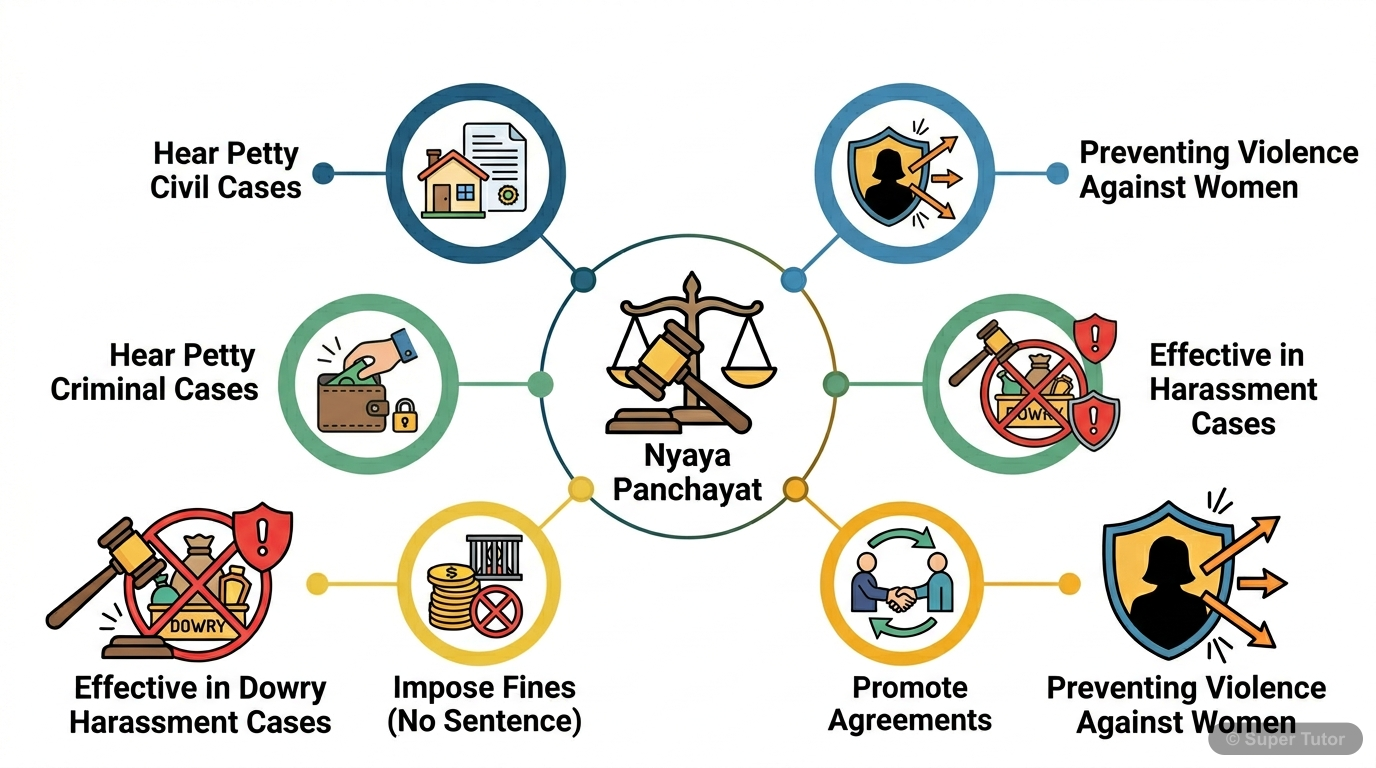
Learn better with visuals Super Tutor pairs illustrations like this with notes and quizzes for Cultural Change.
The first 3 solutions are open to read. The other 2 are free with a Super Tutor account.
Exercises
1Write a critical essay on sanskritisation.Show solution
Introduction — What is Sanskritisation?
The concept of 'Sanskritisation' was introduced by the sociologist M.N. Srinivas. He first used it in his study of the Coorgs of Karnataka and later elaborated it in his work Social Change in Modern India (1966). Sanskritisation refers to the process by which a lower caste, tribe, or other group changes its customs, rituals, ideology, and way of life in the direction of a higher, and frequently 'twice-born' (dwija) caste. By adopting the practices, symbols, and beliefs of upper castes — such as vegetarianism, teetotalism, wearing the sacred thread, performing certain rituals, and using Sanskrit terms — a lower caste group attempts to claim a higher position in the caste hierarchy.
Key Features of Sanskritisation
- It is a process of upward social mobility within the caste system, not a challenge to the system itself.
- It involves imitation of the lifestyle, rituals, and beliefs of upper castes (especially Brahmins, Kshatriyas, or Vaishyas).
- It is not limited to Brahmin practices alone; in different regions, the 'reference group' (the caste being imitated) may be a dominant non-Brahmin caste.
- It leads to a change in ritual status rather than in economic or political status in the short run.
Critical Evaluation
While Sanskritisation is a useful analytical tool, it has been subjected to several important criticisms:
- Reinforces the caste hierarchy: Sanskritisation does not question or dismantle the caste system. It only allows lower castes to move within the existing hierarchical framework. The system of inequality itself remains intact. A group may improve its ritual rank but the logic of caste-based discrimination continues.
- Excludes women and Dalits: The process has often been exclusionary. Women's position within the family may actually become more restricted as a group sanskritises — for example, imposing purdah (veiling) on women who previously did not observe it, or restricting their freedom of movement and work. For Dalits, the process is even more fraught because upper castes may resist their claims to higher status.
- Not a universal process: Sanskritisation is not the only path of social mobility. Many communities have sought upward mobility through education, economic advancement, or political assertion (as seen in Dalit movements inspired by Dr. B.R. Ambedkar, who explicitly rejected Sanskritisation in favour of conversion and constitutional rights).
- Ignores structural change: By focusing on cultural imitation, Sanskritisation diverts attention from the need for structural transformation — redistribution of land, access to education, and political representation.
- Concept of 'dominant caste': Srinivas himself acknowledged that the reference group for Sanskritisation is not always the Brahmin caste. In many regions, a numerically large and economically powerful 'dominant caste' (which may not be Brahmin) serves as the model. This complicates the concept.
- One-way cultural flow: The concept assumes a one-way flow of cultural influence from upper to lower castes. In reality, cultural exchange is multi-directional. Lower castes have also influenced upper-caste practices.
Gender and Sanskritisation (a specific critical dimension)
As noted by scholars like Uma Chakravarti, when a lower-caste group sanskritises, women often bear the greatest burden. Practices such as restricting women's labour outside the home, enforcing stricter codes of dress and behaviour, and controlling women's sexuality are adopted as markers of 'respectability' and higher-caste status. Thus, Sanskritisation can reinforce patriarchal control over women even as it seeks to improve the group's caste status.
Conclusion
Sanskritisation remains an important sociological concept for understanding social mobility and cultural change in India. However, it must be critically assessed. It is a process that works within the caste system rather than against it. It does not challenge the fundamental inequalities of caste; it merely allows some groups to negotiate a slightly better position within an unjust hierarchy. Movements for genuine social transformation — such as the Dalit movement, the women's movement, and the anti-caste movement — have often explicitly rejected Sanskritisation as a strategy and have instead demanded structural change, constitutional rights, and social dignity.
2Westernisation is often just about adoption of western attire and lifestyle. Are there other aspects to being westernised? Or is that about modernisation? Discuss.Show solution
Introduction
A common, everyday understanding of 'Westernisation' reduces it to the adoption of Western clothes (jeans, suits), food habits (fast food), music, or entertainment. While these surface-level changes are visible and real, sociologists argue that Westernisation is a far deeper and more complex process. It is also important to distinguish Westernisation from Modernisation, as the two are related but not identical.
What is Westernisation?
M.N. Srinivas defined Westernisation as the changes brought about in Indian society and culture as a result of over 150 years of British rule. It encompasses changes at multiple levels:
- Technology and material culture: Introduction of railways, telegraph, printing press, modern medicine, and new agricultural techniques.
- Institutions: New legal and administrative systems, a modern bureaucracy, universities, and a free press were all Western introductions that transformed Indian society.
- Ideas and values: This is perhaps the most significant dimension. Western ideas of liberty, equality, fraternity, democracy, secularism, individualism, and human rights profoundly influenced Indian thinkers, reformers, and nationalists.
- Social reformers like Raja Ram Mohan Roy, Jyotiba Phule, and B.R. Ambedkar drew on Western liberal and Enlightenment ideas to critique caste discrimination, the oppression of women, and religious orthodoxy.
- The Indian nationalist movement itself was shaped by Western political ideas of self-determination and democracy.
- Aesthetic and cultural forms: Western literary forms (the novel, the short story), Western music, painting styles, and architecture all found a place in Indian cultural life.
- Family and gender norms: Western ideas influenced debates about the age of marriage, women's education, widow remarriage, and the nuclear family.
Westernisation vs. Modernisation — Are they the same?
This is a crucial distinction:
| Westernisation | Modernisation |
|---|---|
| Refers specifically to changes resulting from Western (especially British) contact | Refers to a broader process of social, economic, and cultural transformation associated with science, reason, and industrial capitalism |
| Can be superficial (dress, food) or deep (values, institutions) | Involves rationality, scientific temper, democracy, and individual rights |
| Is culturally specific — it originates in the West | Is theoretically universal — any society can modernise |
| Does not necessarily imply progress or equality | Is associated with ideas of progress, equality, and human dignity |
For example, a person may wear Western clothes (Westernised in appearance) but hold deeply traditional, hierarchical, and patriarchal values (not modernised). Conversely, a person may wear traditional Indian attire but hold modern values of gender equality and scientific rationality.
The Paradox and Complexity
- Westernisation in India was not a simple, one-way adoption. Indian intellectuals and reformers selectively adopted Western ideas and also used them to reinterpret Indian tradition. For example, Swami Vivekananda used Western organisational forms to revive and spread Vedantic Hinduism.
- Some aspects of Westernisation were imposed through colonial power (e.g., the legal system, English education), while others were voluntarily adopted by Indians who saw them as tools of liberation.
- The colonial encounter also produced a reaction: some Indians rejected Western influence and sought to revive or reinterpret tradition (e.g., the Arya Samaj, the Swadeshi movement).
Conclusion
Westernisation is far more than the adoption of Western attire and lifestyle. At its deepest level, it involves the internalisation of Western values such as equality, democracy, individual rights, and scientific rationality. These ideas had a transformative impact on Indian society, fuelling reform movements and the nationalist struggle. However, Westernisation and Modernisation are not the same thing. Modernisation is a broader process that can occur through multiple cultural pathways. India's experience shows that modernity can be achieved by critically engaging with both Western ideas and one's own tradition, rather than simply imitating the West.
3aWrite a short note on: Rites and SecularisationShow solution
Rites and Secularisation
What is Secularisation?
Secularisation refers to the process by which religious beliefs, practices, and institutions lose their social significance. In a secularising society, religion gradually retreats from the public sphere — from politics, law, education, and science — and becomes a matter of private belief and personal choice.
Rites and their Traditional Role
In traditional Indian society, rites and rituals played a central role in marking the important transitions of life — birth, initiation (upanayana), marriage, and death. These rites of passage (known as samskaras in Hindu tradition) were not merely ceremonial; they were deeply embedded in religious belief, caste identity, and community life. They defined a person's social status, their obligations, and their place in the cosmic and social order.
Impact of Secularisation on Rites
- Simplification and rationalisation: Under the influence of modernity and secular thinking, many traditional rites have been simplified or shortened. Long, elaborate rituals are often condensed into brief ceremonies.
- Loss of religious meaning: Many people continue to perform rites as social customs or cultural traditions rather than as acts of religious faith. The ritual form is retained but its religious content is hollowed out.
- Legal and civil alternatives: The introduction of civil marriage registration, for example, means that a marriage is legally valid without any religious ceremony. This represents a formal secularisation of a key life-rite.
- New secular rites: Interestingly, secularisation does not mean the disappearance of ritual altogether. New secular rites have emerged — national ceremonies, graduation ceremonies, and civic rituals — that perform similar social functions (marking transitions, creating community solidarity) without religious content.
- Selective retention: Many educated, urban Indians selectively retain certain rites for their cultural and aesthetic value, or for family and community cohesion, even when they do not hold the underlying religious beliefs.
Conclusion
The relationship between rites and secularisation in India is complex. Rites have not disappeared; rather, they have been transformed. They continue to serve important social functions — creating community bonds, marking life transitions, and expressing cultural identity — even as their explicitly religious content diminishes for many people. This reflects the broader pattern of Indian modernity, which involves a selective and creative engagement with tradition rather than its wholesale rejection.
Free with a Super Tutor account
Free with a Super Tutor account
2 more solved questions in Cultural Change
They are free with a Super Tutor account, along with practice quizzes and flashcards for this chapter. Free to start, no card needed.
Frequently Asked Questions
What are the important topics in Cultural Change for Madhya Pradesh Board Class 12 Sociology?
Are these NCERT Solutions for Cultural Change free?
How should I revise Cultural Change for the Madhya Pradesh Board Class 12 board exam?
Sources & Official References
Content is aligned to the official syllabus. Refer to the board website for the latest curriculum.
More resources for Cultural Change
Practice Quiz
Test yourself with a quick quiz
Important Questions
Exam-style questions with answers
Revision Notes
Key points for last-minute revision
Chapter Summary
Understand the chapter at a glance
Concept Maps
See how topics connect
Study Plan
Step-by-step plan for this chapter
Flashcards
Quick-fire cards for active recall
Syllabus
What topics to cover
For serious students
Get the full Cultural Change chapter — start free.
Quizzes, flashcards, an AI doubt solver and a study plan for Madhya Pradesh Board Class 12 Sociology. Free to start, no card needed.