The Demographic Structure of the Indian Society — NCERT Solutions
Madhya Pradesh Board · Class 12 · Sociology
NCERT Solutions for The Demographic Structure of the Indian Society, Madhya Pradesh Board Class 12 Sociology: 6 textbook questions solved step by step.
Interactive on Super Tutor
Studying The Demographic Structure of the Indian Society? Get the full interactive chapter.
Quizzes, flashcards, AI doubt-solver and a step-by-step study plan — built for NCERT solutions and more.
Free trial, no card needed.
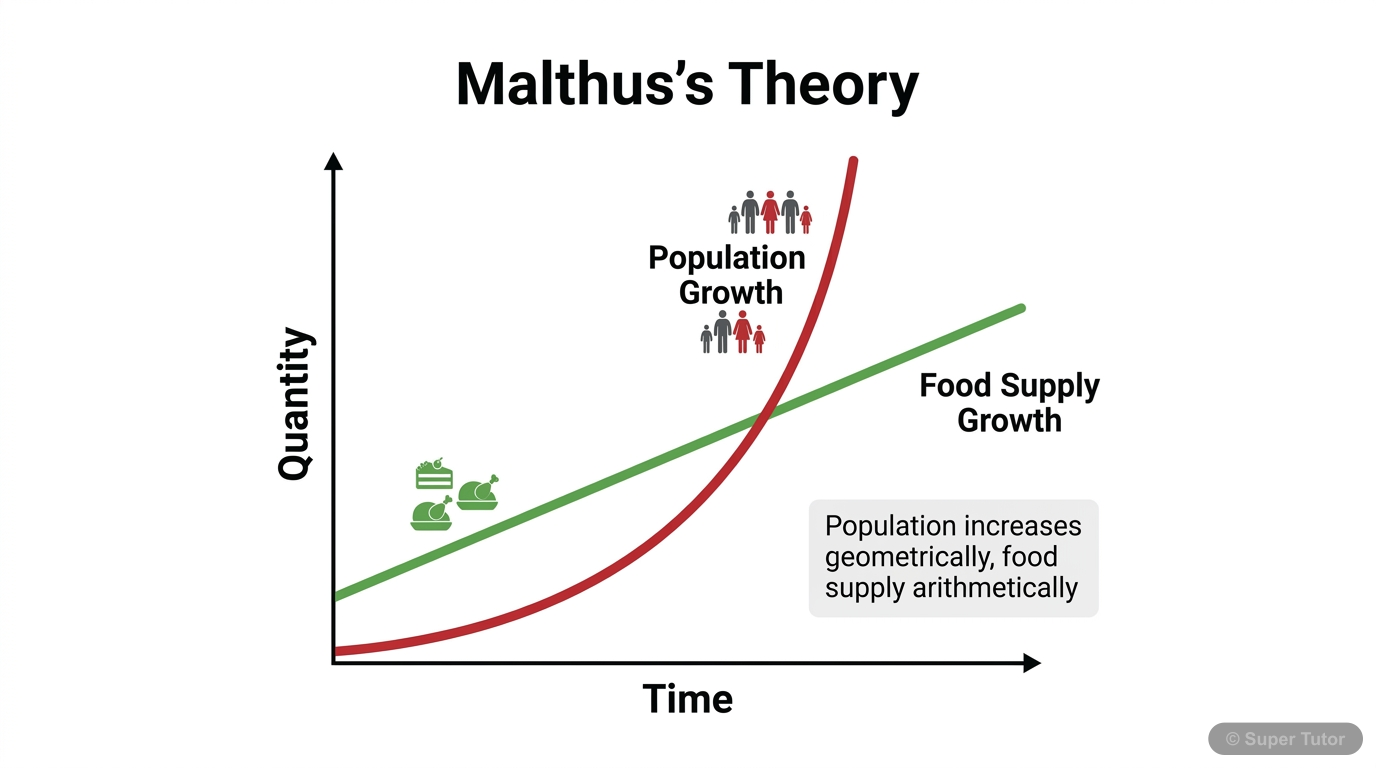
Learn better with visuals Super Tutor pairs illustrations like this with notes and quizzes for The Demographic Structure of the Indian Society.
The first 3 solutions are open to read. The other 3 are free with a Super Tutor account.
Exercise Questions — The Demographic Structure of the Indian Society
1Explain the basic argument of the theory of demographic transition. Why is the transition period associated with a 'population explosion'?Show solution
Given / Context: The theory of demographic transition describes how populations change over time as societies develop economically and socially.
Basic Argument of the Theory:
The theory of demographic transition states that every society passes through three broad stages of population change, moving from a pre-modern regime of high birth rates and high death rates to a post-modern regime of low birth rates and low death rates.
Stage 1 – Pre-industrial / Traditional Stage:
- Both birth rates and death rates are very high.
- Population growth is slow or stagnant because the two rates roughly cancel each other out.
- High death rates are caused by disease, famine, poor sanitation, and lack of medical care.
- High birth rates are maintained because children are seen as economic assets and there is no family planning.
Stage 2 – Transitional Stage (The 'Population Explosion' Stage):
- Death rates begin to fall rapidly due to improvements in medicine, sanitation, food supply, and public health.
- Birth rates, however, remain high because cultural norms, values, and family-planning practices change much more slowly.
- The gap between the (still high) birth rate and the (now falling) death rate widens enormously.
- This gap means that many more people are being born than are dying, leading to very rapid population growth — commonly called a 'population explosion'.
Stage 3 – Post-industrial / Modern Stage:
- Birth rates also begin to fall as education levels rise, women enter the workforce, urbanisation increases, and family planning becomes widespread.
- Eventually both rates are low and close together, so population growth slows down again.
Why is the transition period associated with a 'population explosion'?
During the transition period (Stage 2), death rates decline much faster than birth rates. This is because:
- Reducing death rates requires improvements in technology, medicine, and infrastructure — changes that can be introduced relatively quickly by governments and health agencies.
- Reducing birth rates requires changes in deeply held cultural values, gender norms, and reproductive behaviour — changes that take much longer to occur.
As a result, for a significant period of time, the birth rate remains high while the death rate has already fallen sharply. The difference between the two rates represents the rate of natural increase of the population. When this difference is very large, the population grows at an explosive rate. This is why the transition period is associated with a 'population explosion'.
Conclusion: The demographic transition theory thus explains that population explosion is not a permanent condition but a temporary phase that every developing society passes through on its way to lower, more stable population growth rates.
2Why did Malthus believe that catastrophic events like famines and epidemics that cause mass deaths were inevitable?Show solution
Given / Context: Thomas Robert Malthus (1766–1834) was a British economist and clergyman who wrote 'An Essay on the Principle of Population' (1798).
Malthus's Core Argument:
Malthus believed that catastrophic events such as famines and epidemics were inevitable because of a fundamental imbalance between the growth of population and the growth of food supply (means of subsistence).
The Two Key Propositions of Malthus:
- Population grows geometrically (exponentially): If unchecked, human population doubles at regular intervals — e.g., 1 → 2 → 4 → 8 → 16 and so on. This is because human beings have a natural tendency to reproduce.
- Food supply grows only arithmetically (linearly): Agricultural production can only be increased gradually — e.g., 1 → 2 → 3 → 4 → 5 and so on — because land is limited and there are limits to how much productivity can be increased.
The Inevitable Consequence:
Because population grows much faster than food supply, Malthus argued that sooner or later population would outstrip the available food. When this happened, nature would impose its own 'checks' to bring the population back into balance with food supply. These checks were of two types:
- Preventive checks: Delayed marriage, celibacy, and moral restraint — voluntary measures that reduce birth rates.
- Positive checks (Catastrophic checks): Famine, disease, epidemics, and war — events that dramatically increase the death rate and reduce the population.
Malthus believed that preventive checks were unlikely to be widely practised because human beings tend to follow their natural instincts. Therefore, positive checks — i.e., catastrophic events — were inevitable. They were nature's way of correcting the imbalance between population and food supply.
Criticism (for a complete answer):
Malthus's predictions did not fully come true because he underestimated the capacity of technological progress (Green Revolution, industrialisation) to increase food production enormously. He also did not foresee the voluntary decline in birth rates that accompanies development.
Conclusion: Malthus believed catastrophes were inevitable because he saw an unbridgeable mathematical gap between the exponential growth of population and the arithmetic growth of food supply, and he had little faith in voluntary restraint as a sufficient check.
3What is meant by 'birth rate' and 'death rate'? Explain why the birth rate is relatively slow to fall while the death rate declines much faster.Show solution
Definitions:
Birth Rate (Crude Birth Rate — CBR):
The birth rate is the number of live births per 1,000 persons in the population per year. It is expressed as:
Death Rate (Crude Death Rate — CDR):
The death rate is the number of deaths per 1,000 persons in the population per year. It is expressed as:
Why does the Death Rate decline much faster than the Birth Rate?
The death rate declines faster because reducing deaths requires primarily technological and infrastructural changes, which can be introduced relatively quickly:
- Medical advances: Vaccines, antibiotics, and modern medicines can be manufactured and distributed rapidly, dramatically reducing deaths from infectious diseases.
- Public health measures: Improvements in sanitation, clean drinking water, and sewage disposal can be implemented by governments in a short time.
- Better nutrition: Improved food distribution and agricultural productivity reduce deaths from malnutrition and famine.
- These changes do not require people to change their values or behaviour — they are largely external interventions.
Why is the Birth Rate slow to fall?
Reducing birth rates requires changes in deeply rooted cultural values, social norms, and individual behaviour, which take much longer:
- Cultural and religious norms: In many societies, having many children is considered a religious duty, a sign of prosperity, or a social obligation. These beliefs change very slowly.
- Son preference: Many families continue having children until they have a desired number of sons, keeping birth rates high.
- Children as economic assets: In agrarian and poor societies, children are seen as sources of labour and old-age security. Parents need to be convinced that fewer, better-educated children are more beneficial — a change in mindset that takes generations.
- Low status of women: Where women have little education, low social status, and no access to family planning, they have little control over their reproductive choices.
- Lack of access to contraception: Even when attitudes begin to change, lack of access to family planning services can keep birth rates high.
- Lag effect: Even after attitudes begin to change, the actual fall in birth rates takes time because it involves changes in marriage age, family size ideals, and contraceptive use across an entire population.
Conclusion: In summary, death rates fall quickly because they respond to external technological and medical interventions, while birth rates fall slowly because they are governed by internal cultural, social, and economic factors that are deeply embedded in society and resistant to rapid change. This difference in the speed of decline is precisely what causes the 'population explosion' during the demographic transition.
Free with a Super Tutor account
Free with a Super Tutor account
Free with a Super Tutor account
3 more solved questions in The Demographic Structure of the Indian Society
They are free with a Super Tutor account, along with practice quizzes and flashcards for this chapter. Free to start, no card needed.
Frequently Asked Questions
What are the important topics in The Demographic Structure of the Indian Society for Madhya Pradesh Board Class 12 Sociology?
Are these NCERT Solutions for The Demographic Structure of the Indian Society free?
How should I revise The Demographic Structure of the Indian Society for the Madhya Pradesh Board Class 12 board exam?
Sources & Official References
Content is aligned to the official syllabus. Refer to the board website for the latest curriculum.
More resources for The Demographic Structure of the Indian Society
Practice Quiz
Test yourself with a quick quiz
Important Questions
Exam-style questions with answers
Revision Notes
Key points for last-minute revision
Formula Sheet
The chapter's formulas in one place
Chapter Summary
Understand the chapter at a glance
Concept Maps
See how topics connect
Study Plan
Step-by-step plan for this chapter
Flashcards
Quick-fire cards for active recall
Syllabus
What topics to cover
For serious students
Get the full The Demographic Structure of the Indian Society chapter — start free.
Quizzes, flashcards, an AI doubt solver and a study plan for Madhya Pradesh Board Class 12 Sociology. Free to start, no card needed.