Suggestions for Project Work — NCERT Solutions
Madhya Pradesh Board · Class 12 · Sociology
NCERT Solutions for Suggestions for Project Work, Madhya Pradesh Board Class 12 Sociology: 39 textbook questions solved step by step.
Interactive on Super Tutor
Studying Suggestions for Project Work? Get the full interactive chapter.
Quizzes, flashcards, AI doubt-solver and a step-by-step study plan — built for NCERT solutions and more.
Free trial, no card needed.
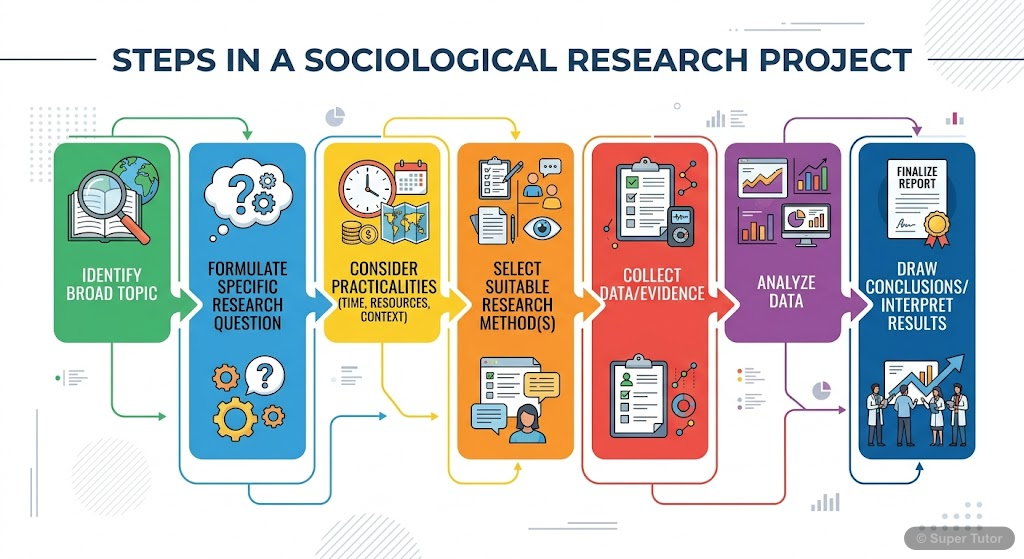
Learn better with visuals Super Tutor pairs illustrations like this with notes and quizzes for Suggestions for Project Work.
The first 20 solutions are open to read. The other 19 are free with a Super Tutor account.
1. Public Transport
1What part does it play in people’s lives?Show solution
Public transport plays an important role in people’s lives because it helps them travel for work, school, shopping, and other daily needs. It is especially important in towns and cities where many people depend on it regularly.
2Who needs it?Show solution
People who need to travel regularly and do not have private vehicles need public transport. The chapter asks this as a research question, and the answer would depend on the group studied.
3Why do they need it?Show solution
They need it for commuting, going to school or work, and reaching different places affordably. Public transport is useful because it connects people to the rest of the city or town.
4To what degree are different types of people dependent on public transport?Show solution
Different types of people are dependent on public transport to different degrees. Some may depend on it heavily every day, while others may use it rarely or not at all, depending on their access to private transport and their needs.
5What sorts of problems and issues are associated with public transport?Show solution
The chapter suggests looking at problems such as access, competition with other transport, changing forms over time, and social issues caused by unequal availability of public transport.
6How have forms of public transport been changing over time?Show solution
Forms of public transport have been changing over time. The chapter asks you to study how a mode like the tonga, rickshaw, train, or Metro has changed, what rivals it has faced, and what its future may be.
7Does differential access to public transport cause social problems?Show solution
Yes, unequal access to public transport can cause social problems. The chapter specifically asks whether differential access causes social problems, implying that it can.
8Are there groups who do not need public transport?Show solution
Yes. Some groups may not need public transport, for example people who have their own vehicles or whose movement needs are limited. The chapter asks you to identify such groups in your study.
9What is their attitude towards it?Show solution
Their attitude may vary: some may see public transport as unnecessary, while others may still value it as part of city life or for other people’s needs. The chapter treats this as a question for research, not a fixed fact.
10What are the changes this mode of transport has gone through?Show solution
The chapter suggests studying the history of a transport mode—for example, how it has developed, what changes it has undergone, and how its place in transport has shifted over time.
11Who have been its main rivals?Show solution
The chapter mentions that a transport mode may have rivals such as other forms of transport. For example, the text asks who have been the main rivals of a tonga, rickshaw, or train, but it does not name one fixed rival for all cases.
12Is the competition with rivals being lost or won?Show solution
The chapter does not give one fixed answer; it asks you to research whether competition is being lost or won for the transport mode you study. So the answer depends on the case chosen.
13For what reasons?Show solution
The reasons would include changes in technology, convenience, cost, speed, availability, and competition from newer transport modes. The chapter asks you to explain these reasons in relation to the particular case you study.
14What is the likely future of this mode of transport?Show solution
The likely future would depend on present conditions and how transport evolves. The chapter asks you to imagine the future in a coherent way, based on current trends and the role of the transport mode now.
15Will anyone miss it?Show solution
The chapter implies that some people may miss it, especially if it has been important in local life, but this would need to be studied for the particular mode of transport. So there is no universal single answer.
2. Role of Communication Media in Social Life
1How do people perceive the new communication media (like mobile phones, or internet) and their impact?Show solution
People may perceive new communication media in different ways. Some may value them for speed and convenience, while others may worry about their effects on habits, relationships, or older media. The chapter suggests studying these views through research.
2What can we learn through observation and inquiry about their place in people’s lives?Show solution
Through observation and inquiry, we can learn how media actually fit into people’s daily lives, including how often they use them, for what purposes, and whether behaviour matches what people say they do.
3What are some of the consequences of shift in format?Show solution
A shift in format may change how people receive information, which medium they prefer, and the importance of older media. The chapter gives the example of whether TV has reduced the importance of radio and newspapers or whether each still has its own niche.
4What are the reasons why people prefer one or the other format?Show solution
People may prefer one format over another because of convenience, content, habit, access, and usefulness for their needs. The chapter asks you to investigate these reasons rather than giving a single fixed explanation.
3. Household Appliances and Domestic Work
1How has work within the household changed over time?Show solution
Work within the household has changed over time because of the introduction of devices like stoves, mixies, washing machines, irons, ovens, and similar appliances. These can alter how household tasks are done and who does them.
Free with a Super Tutor account
Free with a Super Tutor account
Free with a Super Tutor account
Free with a Super Tutor account
Free with a Super Tutor account
Free with a Super Tutor account
Free with a Super Tutor account
Free with a Super Tutor account
4. the Use of Public Space
Free with a Super Tutor account
Free with a Super Tutor account
Free with a Super Tutor account
Free with a Super Tutor account
Free with a Super Tutor account
5. Changing Aspirations of Different Age Groups
Free with a Super Tutor account
Free with a Super Tutor account
6. the 'biography' of a Commodity
Free with a Super Tutor account
Free with a Super Tutor account
Free with a Super Tutor account
Free with a Super Tutor account
19 more solved questions in Suggestions for Project Work
They are free with a Super Tutor account, along with practice quizzes and flashcards for this chapter. Free to start, no card needed.
Frequently Asked Questions
What are the important topics in Suggestions for Project Work for Madhya Pradesh Board Class 12 Sociology?
Are these NCERT Solutions for Suggestions for Project Work free?
How should I revise Suggestions for Project Work for the Madhya Pradesh Board Class 12 board exam?
Sources & Official References
Content is aligned to the official syllabus. Refer to the board website for the latest curriculum.
More resources for Suggestions for Project Work
Practice Quiz
Test yourself with a quick quiz
Important Questions
Exam-style questions with answers
Revision Notes
Key points for last-minute revision
Chapter Summary
Understand the chapter at a glance
Concept Maps
See how topics connect
Study Plan
Step-by-step plan for this chapter
Flashcards
Quick-fire cards for active recall
Syllabus
What topics to cover
For serious students
Get the full Suggestions for Project Work chapter — start free.
Quizzes, flashcards, an AI doubt solver and a study plan for Madhya Pradesh Board Class 12 Sociology. Free to start, no card needed.