The Constitution and Social Change — NCERT Solutions
Madhya Pradesh Board · Class 12 · Sociology
NCERT Solutions for The Constitution and Social Change, Madhya Pradesh Board Class 12 Sociology: 6 textbook questions solved step by step.
Interactive on Super Tutor
Studying The Constitution and Social Change? Get the full interactive chapter.
Quizzes, flashcards, AI doubt-solver and a step-by-step study plan — built for NCERT solutions and more.
Free trial, no card needed.
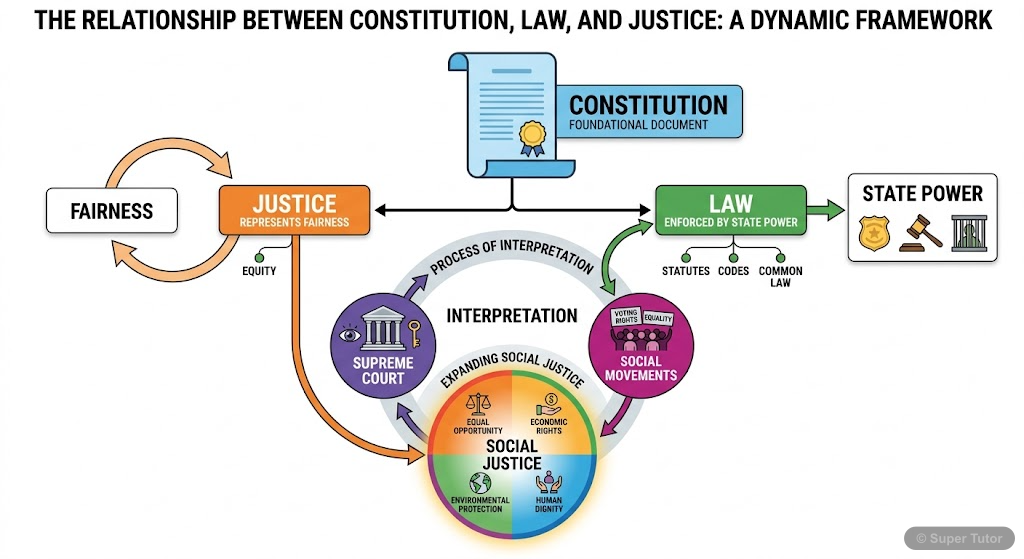
One of 11 illustrations for The Constitution and Social Change in Super Tutor — alongside flashcards, concept maps and practice questions.
The first 3 solutions are open to read. The other 3 are free with a Super Tutor account.
Exercise Questions
1Have you heard of Bal Panchayats and Mazdoor Kissan Sanghathan? If not, find out and write a note about them in about 200 words.Show solution
Given/Context: The question asks students to research and write about two grassroots organisations — Bal Panchayats and Mazdoor Kissan Sanghathan.
Note (approximately 200 words):
Bal Panchayats are child-led governance bodies, typically formed at the village or community level, where children (usually in the age group of 6–14 years) are given a platform to voice their concerns, participate in decision-making related to their welfare, and learn democratic processes from an early age. They function as a training ground for future democratic participation. Various NGOs and government schemes have promoted Bal Panchayats to address issues such as child labour, education, nutrition, and child rights. They empower children, especially girls and those from marginalised communities, to speak up and demand their rights.
Mazdoor Kissan Sanghathan (MKS) is a grassroots organisation that works for the rights and welfare of labourers (mazdoors) and farmers (kissans), particularly in rural and semi-urban areas. It organises workers and peasants to demand fair wages, land rights, access to government schemes, and protection from exploitation by landlords and contractors. It acts as a pressure group that mobilises the poor and marginalised sections to collectively bargain with the state and employers.
Significance: Both organisations illustrate how ordinary people — even children — can organise themselves to participate in democracy and bring about social change at the grassroots level. They demonstrate that democracy is not limited to elections but is a continuous, living process.
2The 73rd amendment has been monumental in bringing a voice to the people in the villages. Discuss.Show solution
Given: The 73rd Constitutional Amendment Act, 1992 (came into force in 1993) institutionalised the Panchayati Raj system in India.
Key Provisions of the 73rd Amendment:
- Three-tier structure: It made it mandatory for states to establish a three-tier Panchayati Raj system — at the village (Gram Panchayat), intermediate (Panchayat Samiti), and district (Zila Parishad) levels.
- Regular elections: It provided for regular elections to Panchayati Raj institutions every five years, ensuring democratic accountability at the local level.
- Reservation of seats: It reserved seats for Scheduled Castes (SCs), Scheduled Tribes (STs), and women (not less than one-third of total seats). This was a landmark step in ensuring representation of historically marginalised groups.
- Gram Sabha: It gave constitutional recognition to the Gram Sabha — a body of all voters in a village — as the foundation of the Panchayati Raj system, giving ordinary villagers a direct forum to participate in governance.
- Devolution of powers: It provided for the transfer of powers, responsibilities, and funds to Panchayats for the implementation of schemes related to economic development and social justice (29 subjects listed in the 11th Schedule).
How it brought voice to the people:
- Women's empowerment: Reservation of one-third seats for women has brought lakhs of women into formal political roles. Many women who were previously confined to domestic spaces have become Sarpanches and Panchayat members, making decisions about roads, water, schools, and health centres in their villages.
- Representation of marginalised groups: SC and ST reservations have ensured that communities that were historically excluded from power now have a constitutional right to participate in local governance.
- Decentralisation of power: By bringing governance closer to the people, the amendment reduced dependence on distant state and central governments for local needs.
- Accountability: Local elected representatives are directly answerable to the people who elected them, making governance more transparent and responsive.
Conclusion: The 73rd Amendment transformed the idea of democracy from a once-in-five-years voting exercise into an ongoing, participatory process at the village level. It is rightly considered monumental because it gave constitutional status to local self-governance and ensured that the voices of women, Dalits, Adivasis, and ordinary villagers could shape the decisions that directly affect their daily lives.
3Write an essay on the ways that the Indian Constitution touches peoples' everyday life, drawing upon different examples.Show solution
Introduction:
The Indian Constitution is not merely a legal document kept in the archives of Parliament. It is a living document that shapes the everyday lives of every citizen of India — from the moment they are born to the choices they make, the rights they can claim, and the institutions they interact with daily.
1. Fundamental Rights and Daily Life:
The Fundamental Rights (Part III, Articles 12–35) directly protect citizens in their everyday existence.
- Right to Equality (Article 14–18): A Dalit student cannot be denied admission to a government school on the basis of caste. A woman cannot be paid less than a man for the same work. These rights are invoked every day in courts and offices.
- Right to Freedom (Article 19–22): Citizens can freely move across the country, choose any profession, and express their opinions. A journalist writing a critical article, a trader moving goods from one state to another, or a student choosing to study in another city — all exercise these rights daily.
- Right against Exploitation (Article 23–24): The constitutional prohibition on bonded labour and child labour protects millions of vulnerable workers and children.
- Right to Education (Article 21A): The Right of Children to Free and Compulsory Education Act (2009), rooted in this article, ensures that every child between 6 and 14 years has the right to attend school.
2. Directive Principles of State Policy (DPSP):
Though not justiciable, the DPSPs guide the state in making laws and policies that affect everyday life:
- The National Rural Employment Guarantee Act (MGNREGA) is inspired by the directive to secure the right to work.
- The Public Distribution System (PDS) providing subsidised food grain is linked to the directive to raise the standard of living.
- The Minimum Wages Act protects workers' daily earnings.
3. Reservation and Social Justice:
The constitutional provisions for reservation (Articles 15, 16, 46) affect the everyday lives of millions of SC, ST, and OBC citizens by providing access to education, government jobs, and political representation that were historically denied to them.
4. Panchayati Raj and Local Governance (73rd Amendment):
As discussed, the 73rd Amendment brought governance to the village level. A woman Sarpanch deciding where a new hand-pump will be installed, or a Gram Sabha deciding how MGNREGA funds will be used — these are constitutional processes touching everyday rural life.
5. Freedom of Religion:
India is a secular state. Citizens can practise any religion, celebrate any festival, and build places of worship. This constitutional guarantee shapes the cultural and social fabric of daily life in a diverse country.
6. Right to Constitutional Remedies (Article 32):
When a citizen's rights are violated — for example, when a person is illegally detained, or when a factory pollutes a river affecting a village's water supply — they can approach the Supreme Court or High Court through writs like Habeas Corpus or Public Interest Litigation (PIL). This makes the Constitution an accessible tool for ordinary people.
7. Gender Justice:
Constitutional provisions have led to laws such as the Protection of Women from Domestic Violence Act, the Dowry Prohibition Act, and the Sexual Harassment of Women at Workplace Act — all of which directly protect women in their homes and workplaces every day.
Conclusion:
The Indian Constitution is not an abstract document. It is present in the classroom where a Dalit child sits alongside an upper-caste child, in the Gram Sabha where a woman Sarpanch presides, in the court where a bonded labourer seeks freedom, and in the ballot box where every adult — rich or poor, man or woman — has an equal vote. The Constitution is, in the truest sense, the foundation of everyday life in India.
Free with a Super Tutor account
Free with a Super Tutor account
Free with a Super Tutor account
3 more solved questions in The Constitution and Social Change
They are free with a Super Tutor account, along with practice quizzes and flashcards for this chapter. Free to start, no card needed.
Frequently Asked Questions
What are the important topics in The Constitution and Social Change for Madhya Pradesh Board Class 12 Sociology?
Are these NCERT Solutions for The Constitution and Social Change free?
How should I revise The Constitution and Social Change for the Madhya Pradesh Board Class 12 board exam?
Sources & Official References
Content is aligned to the official syllabus. Refer to the board website for the latest curriculum.
More resources for The Constitution and Social Change
Practice Quiz
Test yourself with a quick quiz
Important Questions
Exam-style questions with answers
Revision Notes
Key points for last-minute revision
Chapter Summary
Understand the chapter at a glance
Concept Maps
See how topics connect
Study Plan
Step-by-step plan for this chapter
Flashcards
Quick-fire cards for active recall
Syllabus
What topics to cover
For serious students
Get the full The Constitution and Social Change chapter — start free.
Quizzes, flashcards, an AI doubt solver and a study plan for Madhya Pradesh Board Class 12 Sociology. Free to start, no card needed.