Change and Development in Rural Society — NCERT Solutions
Madhya Pradesh Board · Class 12 · Sociology
NCERT Solutions for Change and Development in Rural Society, Madhya Pradesh Board Class 12 Sociology: 9 textbook questions solved step by step.
Interactive on Super Tutor
Studying Change and Development in Rural Society? Get the full interactive chapter.
Quizzes, flashcards, AI doubt-solver and a step-by-step study plan — built for NCERT solutions and more.
Free trial, no card needed.
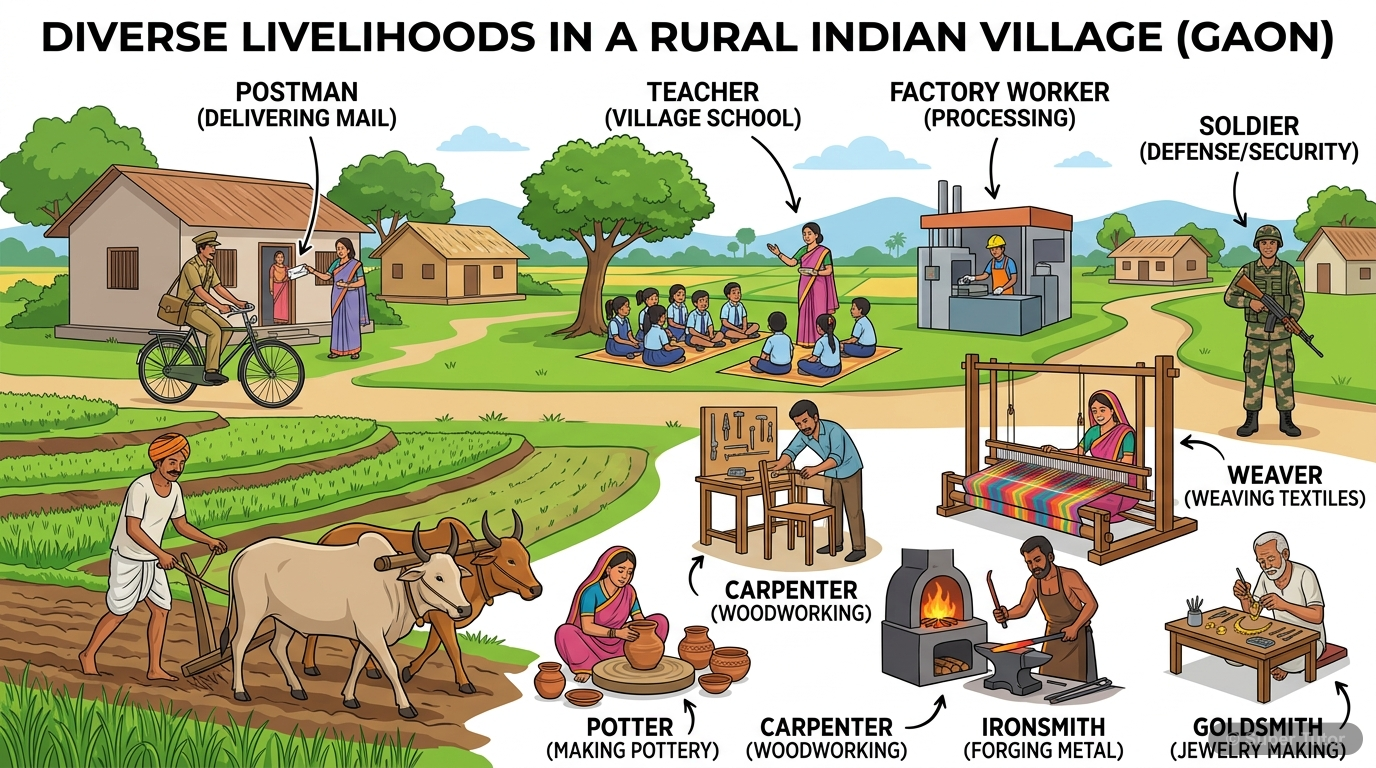
Learn better with visuals Super Tutor pairs illustrations like this with notes and quizzes for Change and Development in Rural Society.
The first 5 solutions are open to read. The other 4 are free with a Super Tutor account.
Questions
1iWhy do you think the maliks were able to use the power of the state to advance their own interests?Show solution
Given/Context: The passage states that the maliks (landlords/dominant landowners) were able to secure the intervention of various arms of the state to advance their interests due to their combined economic and caste-based social power.
Answer:
The maliks were able to use the power of the state to advance their own interests due to the following reasons:
- Economic Power: The maliks formed a dominant class that controlled land and capital. Economic dominance gave them the resources to influence local administration, police, and judiciary.
- Caste-based Social Power: As members of a dominant caste, the maliks enjoyed high social status. In rural India, dominant castes have historically controlled local institutions, panchayats, and administrative bodies.
- Political Connections: Their economic and social power translated into political influence. They could elect their own representatives or influence elected officials, thereby shaping policy and law enforcement in their favour.
- Nexus between Class and State: The state apparatus at the local level — police, revenue officials, courts — was often staffed by or sympathetic to the dominant caste/class. This made it easy for the maliks to get favourable treatment.
- Lack of Counter-power among Labourers: The landless labourers were economically dependent on the maliks, lacked organisation, and had little access to legal or political resources, making it difficult for them to challenge the maliks' misuse of state power.
Conclusion: Thus, the combination of economic dominance, caste privilege, and political connections enabled the maliks to use the state machinery to protect and advance their class interests at the expense of the labouring underclass.
1iiWhy did labourers have harsh working conditions?Show solution
Given/Context: The passage mentions that harsh working conditions in Aghanbigha were an outcome of the combined effect of the economic power of the maliks as a class and their overwhelming power as members of a dominant caste.
Answer:
Labourers had harsh working conditions due to the following reasons:
- Economic Dependence: Landless agricultural labourers had no land of their own and were entirely dependent on the maliks for employment and sometimes even for food, shelter, and credit. This dependence gave the maliks enormous power to dictate terms of work.
- Caste Hierarchy: The labourers typically belonged to lower castes or Scheduled Castes. The caste system legitimised their subordination and made it socially acceptable to treat them poorly.
- Bonded/Attached Labour: Many labourers were tied to their employers through debt bondage (bonded labour). Once indebted, they had no freedom to seek better employment elsewhere.
- Absence of Legal Protection: Although laws existed to protect labourers (e.g., Minimum Wages Act, Bonded Labour System Abolition Act), the maliks' control over the state machinery meant these laws were rarely enforced.
- Lack of Collective Bargaining: Labourers lacked strong trade unions or collective organisations in rural areas, leaving them with no means to negotiate better wages or conditions.
- Political Marginalisation: As the passage notes, political factors widened the gulf between the dominant class and the underclass, meaning labourers had no political voice to demand better conditions.
Conclusion: The harsh working conditions were therefore a direct result of the structural inequalities of class and caste, reinforced by the maliks' ability to manipulate state power in their favour.
2What measures do you think the government has taken, or should take, to protect the rights of landless agricultural labourers and migrant workers?Show solution
Introduction: Landless agricultural labourers and migrant workers are among the most vulnerable sections of Indian society. They face exploitation, low wages, poor living conditions, and lack of social security. Both legislative measures and welfare schemes are needed to protect their rights.
Measures Already Taken by the Government:
- Minimum Wages Act, 1948: Fixes minimum wages for agricultural and other workers to prevent exploitation.
- Bonded Labour System (Abolition) Act, 1976: Abolishes bonded labour and provides for rehabilitation of freed bonded labourers.
- Mahatma Gandhi National Rural Employment Guarantee Act (MGNREGA), 2005: Guarantees 100 days of wage employment per year to rural households, reducing distress migration.
- Inter-State Migrant Workmen Act, 1979: Regulates employment of inter-state migrant workers and provides for their welfare including wages, displacement allowance, and suitable accommodation.
- Contract Labour (Regulation and Abolition) Act, 1970: Regulates conditions of contract labour and provides for their welfare.
- National Food Security Act, 2013: Ensures subsidised food grains to the poor, including agricultural labourers.
- Pradhan Mantri Awas Yojana and other housing schemes for the rural poor.
- Pradhan Mantri Jan Dhan Yojana: Financial inclusion of the poor, including migrant workers.
Measures the Government Should Take:
- Strict Enforcement of Existing Laws: Laws protecting labourers must be strictly enforced. Corrupt officials who collude with employers should be penalised.
- Portability of Benefits: Social security benefits (ration cards, health insurance, MGNREGA wages) should be portable so migrant workers can access them in the states they migrate to.
- Registration of Migrant Workers: A national database of migrant workers should be created to track their movement and ensure they receive entitlements.
- Education and Skill Development: Providing education and vocational training to children of agricultural labourers to improve their long-term prospects.
- Land Reforms: Redistribution of surplus land to the landless would reduce their dependence on landlords.
- Strengthening Trade Unions: Encouraging the formation of agricultural labour unions to give workers collective bargaining power.
- Social Security Net: Universal social security covering health, accident insurance, and old-age pension for all informal workers.
Conclusion: While the government has enacted several laws and schemes, effective implementation remains the key challenge. A combination of strict enforcement, social security, and empowerment of labourers is essential to protect their rights.
3There are direct linkages between the situation of agricultural workers and their lack of upward socio-economic mobility. Name some of them.Show solution
Introduction: Agricultural workers — particularly landless labourers — face a cycle of poverty and deprivation that severely limits their ability to improve their socio-economic status. Several structural factors create a direct link between their situation and their lack of upward mobility.
Direct Linkages:
- Landlessness: Without land, agricultural labourers have no productive asset. They cannot accumulate wealth, access credit easily, or gain economic independence. Land ownership is the primary source of rural wealth and status.
- Low and Irregular Wages: Agricultural work is seasonal, meaning labourers earn wages only during sowing and harvesting seasons. Low and irregular income prevents savings and investment in education or business.
- Debt and Bonded Labour: Labourers often borrow from landlords or moneylenders at high interest rates. Debt traps them in a cycle of bondage, making it impossible to accumulate capital or seek better opportunities.
- Caste Discrimination: Most agricultural labourers belong to Scheduled Castes or Other Backward Classes. Caste-based discrimination limits their access to education, better employment, and social networks that could facilitate upward mobility.
- Lack of Education: Poverty forces children of agricultural labourers to work instead of attending school. Without education, they cannot access non-agricultural, better-paying jobs.
- Poor Health and Nutrition: Low income leads to poor nutrition and inadequate healthcare. Poor health reduces productivity and earning capacity, further entrenching poverty.
- Lack of Access to Credit: Banks and formal financial institutions are reluctant to lend to the landless poor who have no collateral. This prevents them from starting small businesses or investing in skill development.
- Seasonal and Circular Migration: Migrant workers move from place to place in search of work, which disrupts their children's education and prevents them from building stable social networks or accessing government welfare schemes.
- Absence of Social Security: Without health insurance, pension, or unemployment benefits, any crisis (illness, drought, death of earning member) pushes the family deeper into poverty.
- Political Marginalisation: Lacking economic resources and social capital, agricultural labourers have little political voice to demand better wages, land rights, or public services.
Conclusion: These factors are deeply interconnected and mutually reinforcing, creating a vicious cycle that makes upward socio-economic mobility extremely difficult for agricultural workers without significant structural intervention.
4What are the different factors that have enabled certain groups to transform themselves into new wealthy, entrepreneurial, dominant classes? Can you think of an example of this transformation in your state?Show solution
Introduction: In post-independence India, particularly after the Green Revolution and economic liberalisation, certain agrarian groups have successfully transformed themselves from traditional peasant communities into new wealthy, entrepreneurial, and politically dominant classes. Several factors have facilitated this transformation.
Factors Enabling Transformation:
- Land Ownership and Land Reforms: Groups that already owned medium to large landholdings benefited most from land reforms. While zamindari was abolished, rich peasants and middle-level landowners consolidated their holdings and gained from the redistribution.
- Green Revolution Technology: The introduction of High Yielding Variety (HYV) seeds, chemical fertilisers, pesticides, and irrigation (especially in Punjab, Haryana, and western Uttar Pradesh) dramatically increased agricultural productivity. Groups with sufficient land and capital to adopt these technologies became prosperous.
- Access to Institutional Credit: Richer peasants had collateral (land) and social connections to access bank loans and government credit at subsidised rates, enabling them to invest in modern agricultural inputs and machinery.
- Government Subsidies and Support Prices: Minimum Support Prices (MSP) for crops like wheat and rice, along with subsidies on fertilisers, electricity, and water, disproportionately benefited larger landowners who produced more surplus.
- Diversification into Non-Agricultural Activities: Surplus income from agriculture was invested in transport (trucks, tractors), trade, agro-processing industries, and later in urban real estate and businesses. This diversification created a new entrepreneurial class.
- Political Mobilisation: Dominant peasant castes (e.g., Jats in Punjab/Haryana, Patidars/Patels in Gujarat, Reddys and Kammas in Andhra Pradesh, Marathas in Maharashtra) organised politically to demand favourable agricultural policies, reservations, and state patronage.
- Education: Investment in children's education allowed the next generation to enter professions, government services, and business, further consolidating the family's socio-economic position.
- Caste Networks: Caste-based social networks provided access to markets, labour, credit, and political connections, giving certain groups a competitive advantage.
Example (Illustrative — students may use their own state):
- Punjab/Haryana — Jat Farmers: The Jat community in Punjab and Haryana is a classic example. Originally peasant cultivators, they benefited enormously from the Green Revolution. Surplus agricultural income was invested in tractors, tube wells, and later in transport businesses and urban real estate. Their political organisation (through parties and farmer unions) ensured continued state support. Today, many Jat families are wealthy landowners, businesspersons, and professionals.
- Gujarat — Patidar Community: The Patidar (Patel) community transformed from prosperous farmers into a dominant entrepreneurial class through investment in trade, industry, and migration (both internal and international).
Conclusion: The transformation of certain groups into new dominant classes was not accidental but resulted from a combination of pre-existing advantages (land, caste networks), state policies (Green Revolution, subsidies), and strategic investment of agricultural surplus into non-agricultural enterprises.
Free with a Super Tutor account
Free with a Super Tutor account
Free with a Super Tutor account
Free with a Super Tutor account
4 more solved questions in Change and Development in Rural Society
They are free with a Super Tutor account, along with practice quizzes and flashcards for this chapter. Free to start, no card needed.
Frequently Asked Questions
What are the important topics in Change and Development in Rural Society for Madhya Pradesh Board Class 12 Sociology?
Are these NCERT Solutions for Change and Development in Rural Society free?
How should I revise Change and Development in Rural Society for the Madhya Pradesh Board Class 12 board exam?
Sources & Official References
Content is aligned to the official syllabus. Refer to the board website for the latest curriculum.
More resources for Change and Development in Rural Society
Practice Quiz
Test yourself with a quick quiz
Important Questions
Exam-style questions with answers
Revision Notes
Key points for last-minute revision
Chapter Summary
Understand the chapter at a glance
Concept Maps
See how topics connect
Study Plan
Step-by-step plan for this chapter
Flashcards
Quick-fire cards for active recall
Syllabus
What topics to cover
For serious students
Get the full Change and Development in Rural Society chapter — start free.
Quizzes, flashcards, an AI doubt solver and a study plan for Madhya Pradesh Board Class 12 Sociology. Free to start, no card needed.