Secants, Tangents And Their Properties — Flashcards
NIOS · Class 10 · Maths
26 flashcards for Secants, Tangents And Their Properties (NIOS Class 10 Maths) to test yourself on key terms and facts.
Interactive on Super Tutor
Studying Secants, Tangents And Their Properties? Get the full interactive chapter.
Quizzes, flashcards, AI doubt-solver and a step-by-step study plan — built for flashcards and more.
Free trial, no card needed.
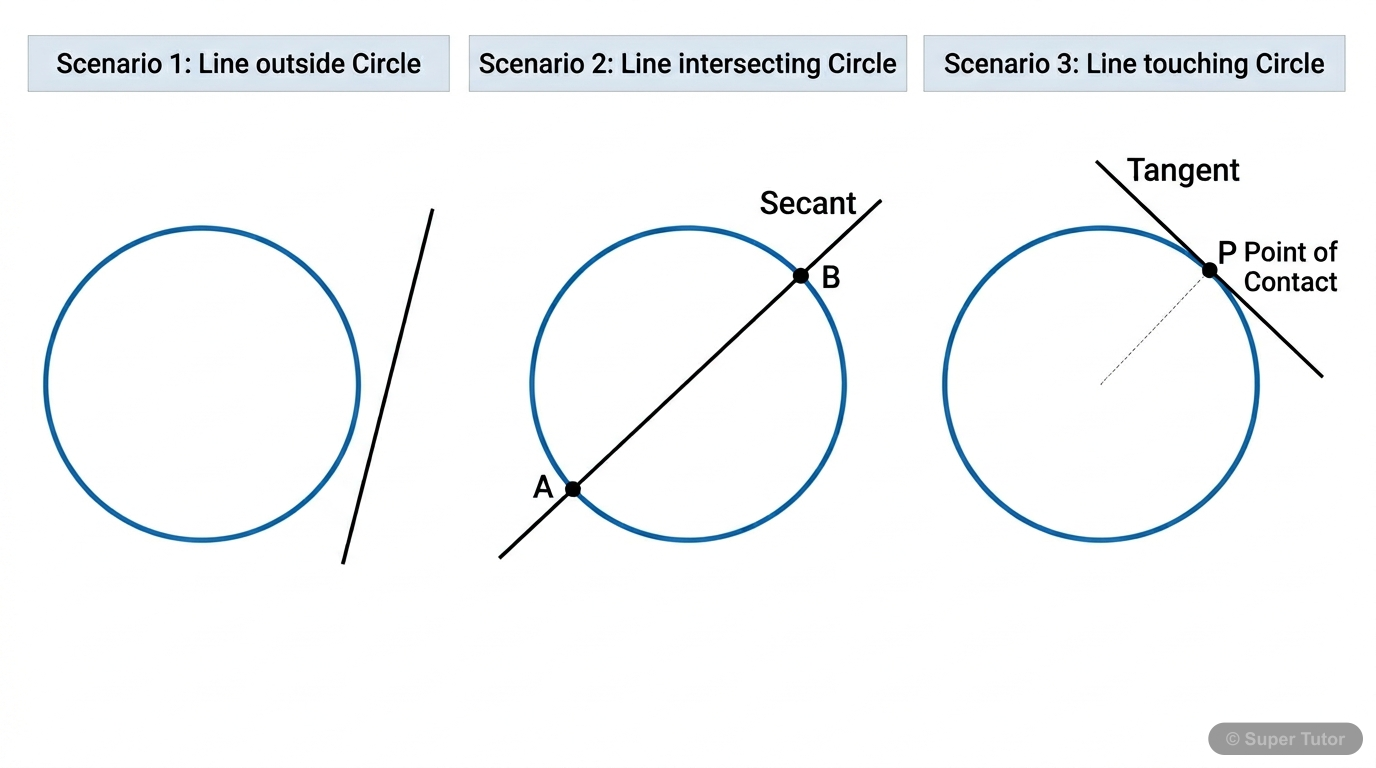
One of 9 illustrations for Secants, Tangents And Their Properties in Super Tutor — alongside flashcards, concept maps and practice questions.
A line touches a circle at exactly one point P. What is it called, and what is P called?
Answer
Step 1: A line touching a circle at exactly one point is a tangent. Step 2: The touching point is the point of contact. Answer: The line is a tangent, and P is the point of contact.
A line cuts a circle at two distinct points A and B. What is it called?
Answer
Step 1: A line intersecting a circle in two distinct points is a secant. Step 2: Since it meets the circle at A and B, it is not a tangent. Answer: The line is a secant.
A point P lies outside a circle. How many tangents can be drawn from P to the circle?
Answer
Step 1: A point outside the circle allows two tangents. Step 2: These two tangents are equal in length. Answer: Two tangents can be drawn from an external point.
A point P lies on a circle. How many tangents can be drawn from P?
Answer
Step 1: A point on the circle gives only one tangent. Step 2: Any other line through P cuts the circle again. Answer: Only one tangent can be drawn.
A point P lies inside a circle. How many tangents can be drawn from P?
Answer
Step 1: A point inside the circle does not allow a tangent. Step 2: Any line through P meets the circle at two points. Answer: No tangent can be drawn.
Why is the radius through the point of contact perpendicular to the tangent?
Answer
Step 1: From the centre O to the tangent line, the shortest distance is the perpendicular. Step 2: The radius through the point of contact gives that shortest distance. Step 3: Therefore the radius is…
Find the length of tangent PT if OP = 5 cm and radius OT = 3 cm.
Answer
Step 1: Use OP^2 = OT^2 + PT^2. Step 2: Substitute values: 5^2 = 3^2 + PT^2. Step 3: 25 = 9 + PT^2. Step 4: PT^2 = 16. Step 5: PT = 4 cm. Answer: PT = 4 cm.
Find the length of each tangent from P if OP = 25 cm and radius = 7 cm.
Answer
Step 1: Use OP^2 = OT^2 + PT^2. Step 2: Substitute values: 25^2 = 7^2 + PT^2. Step 3: 625 = 49 + PT^2. Step 4: PT^2 = 576. Step 5: PT = 24 cm. Step 6: The two tangents from an external point are equal…
+18 more flashcards
Practise AllFrequently Asked Questions
What are the important topics in Secants, Tangents And Their Properties for NIOS Class 10 Maths?
How many flashcards are available for Secants, Tangents And Their Properties?
How should I revise Secants, Tangents And Their Properties for the NIOS Class 10 board exam?
Sources & Official References
Content is aligned to the official syllabus. Refer to the board website for the latest curriculum.
More resources for Secants, Tangents And Their Properties
Practice Quiz
Test yourself with a quick quiz
Important Questions
Exam-style questions with answers
Revision Notes
Key points for last-minute revision
Formula Sheet
The chapter's formulas in one place
Chapter Summary
Understand the chapter at a glance
Concept Maps
See how topics connect
Study Plan
Step-by-step plan for this chapter
Syllabus
What topics to cover
For serious students
Get the full Secants, Tangents And Their Properties chapter — start free.
Quizzes, flashcards, an AI doubt solver and a study plan for NIOS Class 10 Maths. Free to start, no card needed.