Quadrilaterals — Flashcards
NIOS · Class 10 · Maths
25 flashcards for Quadrilaterals (NIOS Class 10 Maths) to test yourself on key terms and facts. Sample: "Solve: The three angles of a quadrilateral"
Interactive on Super Tutor
Studying Quadrilaterals? Get the full interactive chapter.
Quizzes, flashcards, AI doubt-solver and a step-by-step study plan — built for flashcards and more.
Free trial, no card needed.
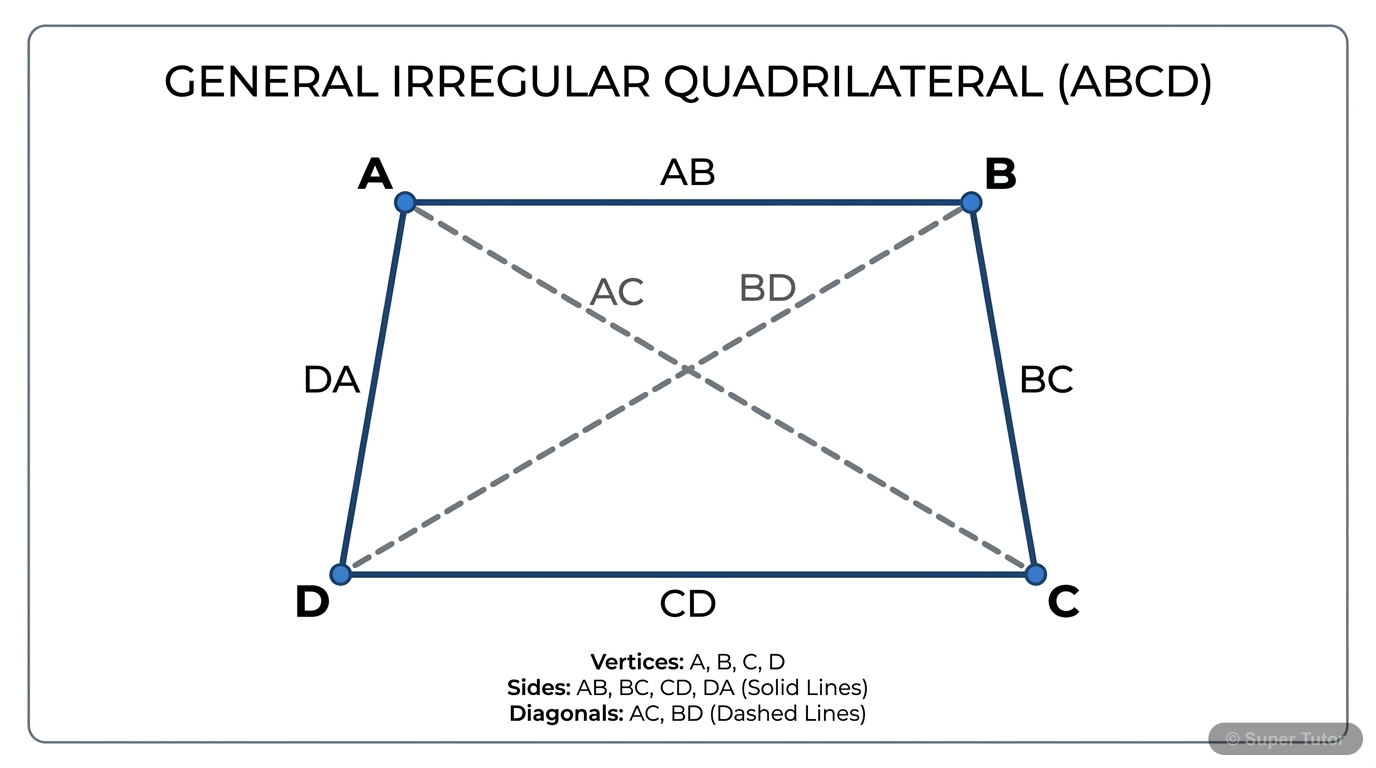
One of 10 illustrations for Quadrilaterals in Super Tutor — alongside flashcards, concept maps and practice questions.
Solve: The three angles of a quadrilateral are 100°, 50°, and 70°. Find the fourth angle.
Answer
Step 1: Use the angle sum of a quadrilateral: 360°. Step 2: Add the given angles: 100° + 50° + 70° = 220°. Step 3: Subtract from 360°: 360° - 220° = 140°. Answer: The fourth angle is 140°.
Solve: The angles of a quadrilateral are in the ratio 5:7:7:11. Find all four angles.
Answer
Step 1: Let the angles be 5x, 7x, 7x, and 11x. Step 2: Use the angle sum of a quadrilateral: 5x + 7x + 7x + 11x = 360°. Step 3: Combine terms: 30x = 360°. Step 4: Solve: x = 12°. Step 5: Find each ang…
Solve: In parallelogram ABCD, angle A = 80°. Find angles B, C, and D.
Answer
Step 1: In a parallelogram, opposite angles are equal. So, angle C = angle A = 80°. Step 2: Adjacent angles of a parallelogram are supplementary. So, angle B = 180° - 80° = 100°. Step 3: Opposite angl…
Solve: In a parallelogram, one pair of opposite angles measures 105° each. Find the other pair of angles.
Answer
Step 1: Opposite angles in a parallelogram are equal. Step 2: Adjacent angles are supplementary. So, each adjacent angle = 180° - 105° = 75°. Step 3: The other opposite angle is also 75°. Answer: The …
Why does a quadrilateral with equal opposite sides become a parallelogram?
Answer
Reason: A quadrilateral is a parallelogram if its opposite sides are equal. If one pair of opposite sides is equal and the other pair is also equal, the shape fits the converse property of a parallelo…
Solve: In a rhombus, two adjacent angles are in the ratio 4:5. Find all angles.
Answer
Step 1: Adjacent angles of a rhombus are supplementary. Step 2: Let the angles be 4x and 5x. Step 3: 4x + 5x = 180°. Step 4: 9x = 180° so x = 20°. Step 5: The angles are 4x = 80° and 5x = 100°. Step 6…
Solve: In a rhombus ABCD, angle ADC = 120°. Find angle A.
Answer
Step 1: Opposite angles of a rhombus are equal. So angle A = angle C. Step 2: Adjacent angles in a rhombus are supplementary. So angle A + angle D = 180°. Step 3: angle A + 120° = 180°. Step 4: angle …
Solve: One diagonal of a rhombus is equal to one side. Find the angles of the rhombus.
Answer
Step 1: Let the rhombus be ABCD and let diagonal BD = side AB. Step 2: In triangle ABD, AB = AD = BD because all sides of a rhombus are equal and BD is also equal to a side. Step 3: So triangle ABD is…
+17 more flashcards
Practise AllFrequently Asked Questions
What are the important topics in Quadrilaterals for NIOS Class 10 Maths?
How many flashcards are available for Quadrilaterals?
How should I revise Quadrilaterals for the NIOS Class 10 board exam?
Sources & Official References
Content is aligned to the official syllabus. Refer to the board website for the latest curriculum.
More resources for Quadrilaterals
Practice Quiz
Test yourself with a quick quiz
Important Questions
Exam-style questions with answers
Revision Notes
Key points for last-minute revision
Formula Sheet
The chapter's formulas in one place
Chapter Summary
Understand the chapter at a glance
Concept Maps
See how topics connect
Study Plan
Step-by-step plan for this chapter
Syllabus
What topics to cover
For serious students
Get the full Quadrilaterals chapter — start free.
Quizzes, flashcards, an AI doubt solver and a study plan for NIOS Class 10 Maths. Free to start, no card needed.