Climate — Important Questions
NIOS · Class 10 · Social Studies
89 important questions from Climate for NIOS Class 10 Social Studies, with answers. Includes multiple choice and true false questions.
Interactive on Super Tutor
Studying Climate? Get the full interactive chapter.
Quizzes, flashcards, AI doubt-solver and a step-by-step study plan — built for important questions and more.
Free trial, no card needed.
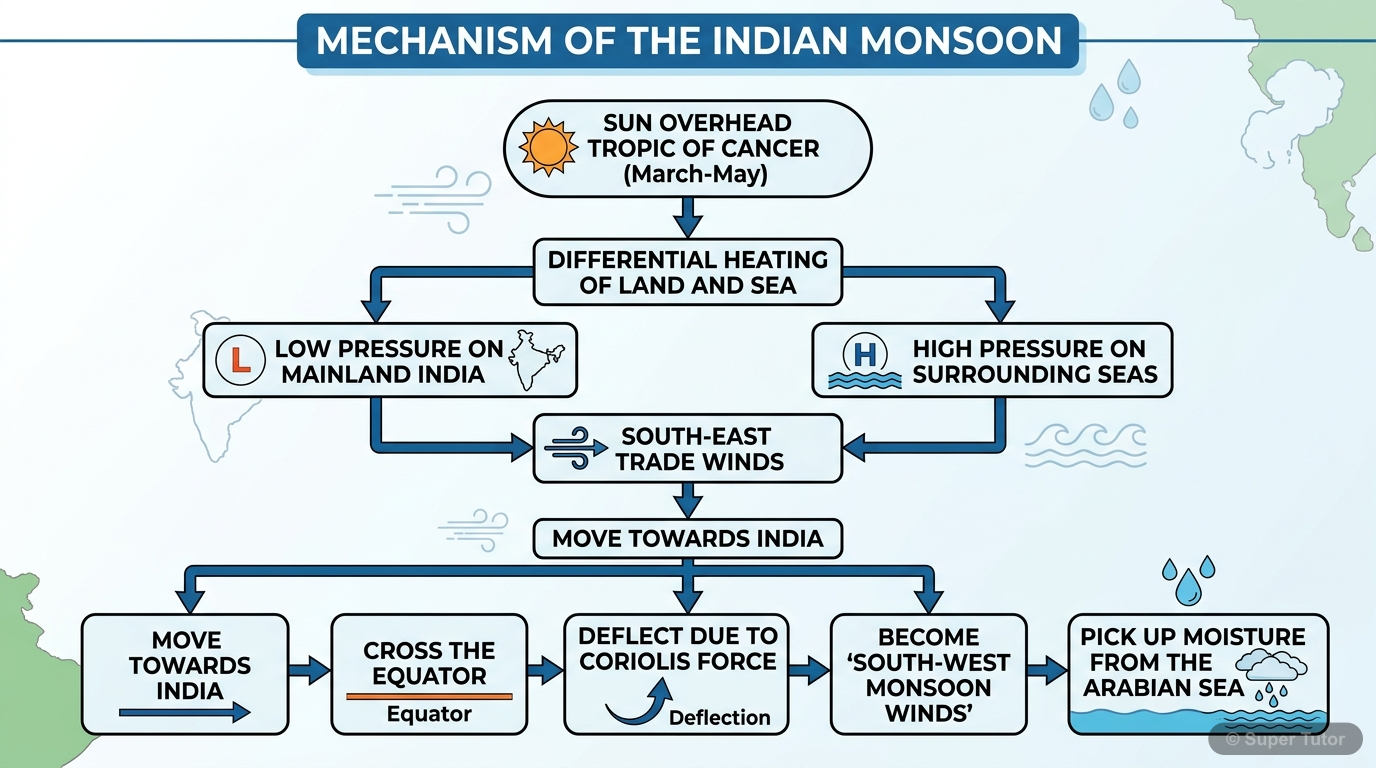
One of 7 illustrations for Climate in Super Tutor — alongside flashcards, concept maps and practice questions.
Important Questions from Climate
Which mountain range protects India from cold winds of Central Asia?
Show answer
Himalayan Range
The Himalayan mountain range, with an average height of 6000 meters, acts as a natural barrier protecting India from the cold winds of Central Asia. Without this protection, India would experience much colder winters similar to Central Asian countries at similar latitudes. The Himalayas also play a crucial role in the monsoon system by blocking the South-West monsoon winds and forcing them to release moisture over the Indian subcontinent. This dual role makes the Himalayas essential for India's climate - they keep out cold air in winter and trap monsoon moisture in summer.
What are the hot and dry winds called that blow over North Indian plains during summer?
Show answer
Loo
The hot and dry winds that blow over North Indian plains during summer are called 'Loo'. These winds are extremely hot and can cause heat stroke or sun stroke if someone is exposed to them for long periods. They blow during the day when temperatures can reach 45-47°C in states like Rajasthan, Punjab, and Haryana. The 'Loo' is different from 'Kaal Baisakhi' which are thunderstorms in West Bengal, and from trade winds which are global wind patterns. These local hot winds are a characteristic feature of the hot weather season in northern India.
Which state in India receives the South-West monsoon first?
Show answer
Kerala
Kerala receives the South-West monsoon first, usually in the first week of June. This is because Kerala is located on the southwestern coast of India, directly in the path of moisture-laden winds coming from the Arabian Sea. The monsoon's arrival in Kerala is marked by heavy rainfall with thunder and lightning, known as the 'burst of monsoon'. From Kerala, the monsoon progresses northwards and eastwards, reaching Mumbai by June 10th and covering the entire country by July 15th. Kerala's position makes it the gateway for monsoons entering the Indian subcontinent.
During which season do farmers grow Rabi crops?
Show answer
Winter season
Rabi crops are grown during the winter season (December to February) and harvested in spring (March-April). These crops include wheat, barley, peas, gram, and mustard. They benefit from the cool, dry weather of winter and the light rainfall from western disturbances. Rabi crops are different from Kharif crops which are grown during the monsoon season. The winter season provides ideal conditions for these crops - moderate temperatures, clear skies, and adequate soil moisture from previous monsoon rains. This seasonal agriculture pattern is closely linked to India's climate cycle.
+85 more questions on Climate (NIOS Class 10 Social Studies)
Practise AllFrequently Asked Questions
What are the important topics in Climate for NIOS Class 10 Social Studies?
How many important questions are there in Climate?
Sources & Official References
Content is aligned to the official syllabus. Refer to the board website for the latest curriculum.
More resources for Climate
For serious students
Get the full Climate chapter — start free.
Quizzes, flashcards, an AI doubt solver and a study plan for NIOS Class 10 Social Studies. Free to start, no card needed.