India – A Welfare State — Important Questions
NIOS · Class 10 · Social Studies
78 important questions from India – A Welfare State for NIOS Class 10 Social Studies, with answers. Includes multiple choice and true false questions.
Interactive on Super Tutor
Studying India – A Welfare State? Get the full interactive chapter.
Quizzes, flashcards, AI doubt-solver and a step-by-step study plan — built for important questions and more.
Free trial, no card needed.
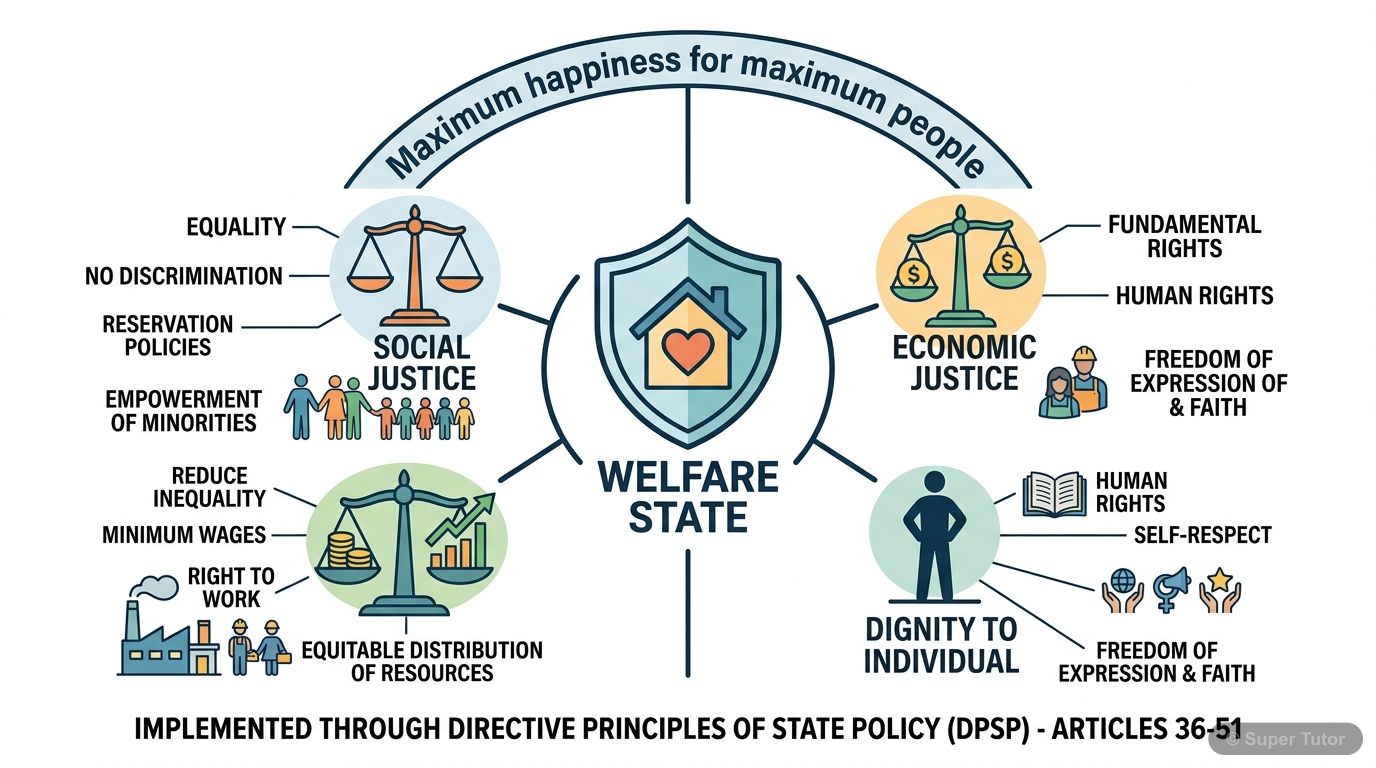
One of 2 illustrations for India – A Welfare State in Super Tutor — alongside flashcards, concept maps and practice questions.
Important Questions from India – A Welfare State
Which principle reflects Gandhian thought among the Directive Principles?
Show answer
Organization of village panchayats
The organization of village panchayats reflects Gandhian thought, particularly his belief in 'Gram Swaraj' or village self-rule. Gandhi believed that true democracy should start from the village level with local self-governance. Option A relates to international relations principles, option C is a miscellaneous principle about institutional separation, and option D is an environmental principle added later through constitutional amendment. These don't directly reflect Gandhi's core philosophy of grassroots democracy.
What does 'equal pay for equal work' principle aim to achieve?
Show answer
Gender equality in wages
The 'equal pay for equal work' principle specifically aims to eliminate gender-based wage discrimination, ensuring that men and women receive the same compensation for performing the same work. This promotes gender equality in the workplace and economic empowerment of women. Option A is too general and doesn't capture the specific equality aspect. Option C is about working hours, not wages. Option D misrepresents the principle as it's about fair compensation, not government control over all wages.
Which constitutional amendment made education a fundamental right?
Show answer
86th Amendment
The 86th Constitutional Amendment (2002) made free and compulsory education for children aged 6-14 years a fundamental right under Article 21A. This amendment was a significant step in implementing the Directive Principle about education. The 42nd Amendment dealt with environmental protection and other issues. The 73rd Amendment established Panchayati Raj institutions, and the 74th Amendment dealt with urban local bodies, making options A, C, and D incorrect.
What is the primary purpose of MGNREGA?
Show answer
Providing rural employment guarantee
MGNREGA (Mahatma Gandhi National Rural Employment Guarantee Act) primarily aims to provide employment guarantee to rural households, ensuring at least 100 days of employment per year. This implements the Directive Principle of securing right to work for citizens. Option A is incorrect as MGNREGA focuses on rural, not urban areas. Option C is too narrow as it's about overall rural employment, not just highways. Option D is incorrect as it's about employment guarantee, not industrial promotion.
+74 more questions on India – A Welfare State (NIOS Class 10 Social Studies)
Practise AllFrequently Asked Questions
What are the important topics in India – A Welfare State for NIOS Class 10 Social Studies?
How many important questions are there in India – A Welfare State?
Sources & Official References
Content is aligned to the official syllabus. Refer to the board website for the latest curriculum.
More resources for India – A Welfare State
For serious students
Get the full India – A Welfare State chapter — start free.
Quizzes, flashcards, an AI doubt solver and a study plan for NIOS Class 10 Social Studies. Free to start, no card needed.