Agriculture In India — Chapter Summary
NIOS · Class 10 · Social Studies
Summary of Agriculture In India for NIOS Class 10 Social Studies. Part of the NIOS Class 10 Social Studies syllabus.
Interactive on Super Tutor
Studying Agriculture In India? Get the full interactive chapter.
Quizzes, flashcards, AI doubt-solver and a step-by-step study plan — built for chapter summary and more.
Free trial, no card needed.
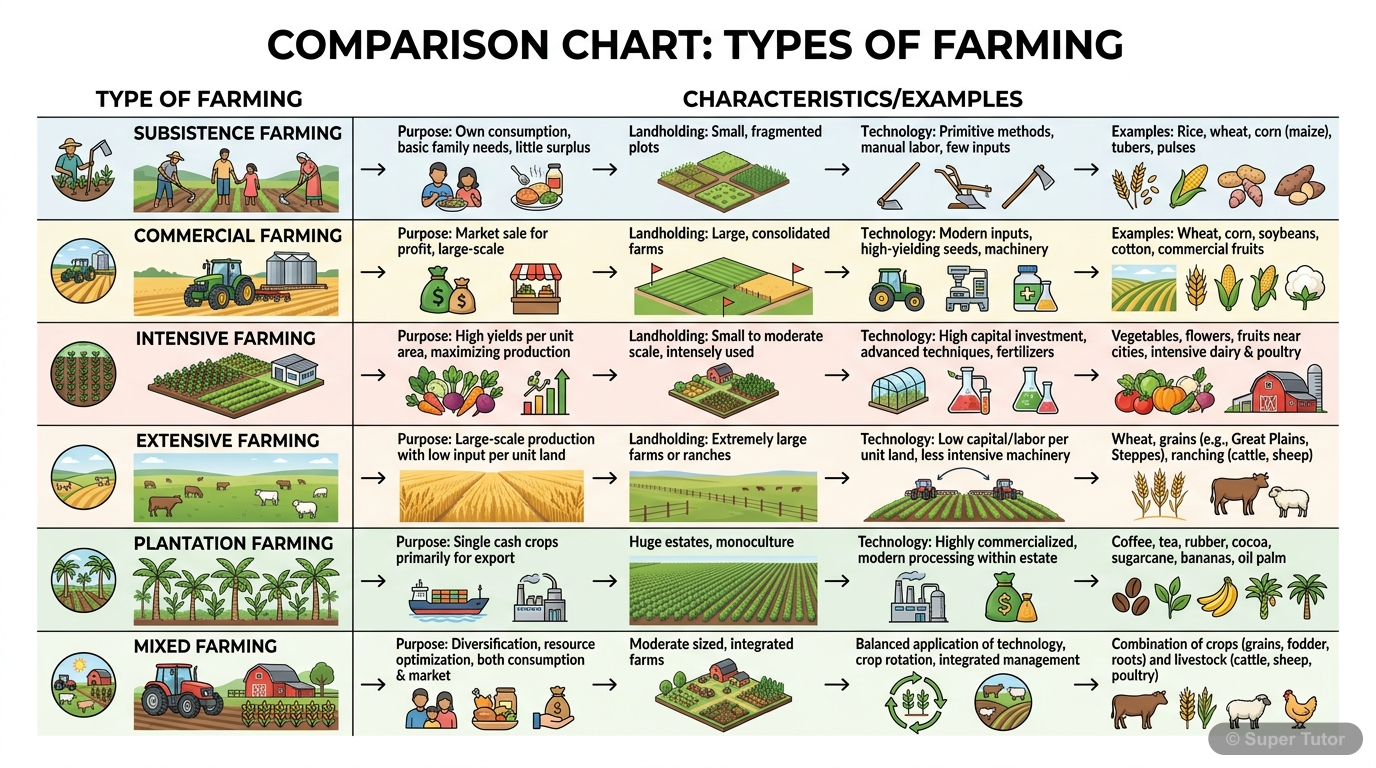
Learn better with visuals Super Tutor pairs illustrations like this with notes and quizzes for Agriculture In India.
Overview
Agriculture is the backbone of the Indian economy and the main livelihood source for about 70% of India’s population. India has favourable conditions for farming, such as fertile plains, varied climate, different soil types, long growing seasons, and improving use of science and technology. Indian a
Key Concepts
Subsistence farming is done mainly
Subsistence farming is done mainly for family use, so most of the produce is consumed by the farmer’s household. It usually has small landholdings, si
Extensive farming uses a large area
Extensive farming uses a large area of land but gives low output per unit of land. Intensive farming gives high output per unit of land from a smaller
Plantation farming is an artificial
Plantation farming is an artificial and established form of farming in which a single cash crop is grown on a large estate for sale. Tea, coffee, rubb
The Green Revolution was a major
The Green Revolution was a major technological breakthrough in India based on high-yielding variety seeds, assured irrigation, and chemical fertiliser
The White Revolution means a remarkable
The White Revolution means a remarkable increase in milk production and the creation of a national milk grid. The Blue Revolution means a big rise in
Learning Objectives
- Understand the main types of farming in India
- Identify the salient features of Indian agriculture
- Recognise the major food crops, cash crops, plantation crops, and horticultural crops
- Relate crops with suitable climate, rainfall, and soil conditions
- Understand the role of Green Revolution and other agricultural revolutions
Frequently Asked Questions
What are the important topics in Agriculture In India for NIOS Class 10 Social Studies?
How should I revise Agriculture In India for the NIOS Class 10 board exam?
Sources & Official References
Content is aligned to the official syllabus. Refer to the board website for the latest curriculum.
More resources for Agriculture In India
For serious students
Get the full Agriculture In India chapter — start free.
Quizzes, flashcards, an AI doubt solver and a study plan for NIOS Class 10 Social Studies. Free to start, no card needed.