Chapter 10 of 14
NCERT Solutions

Consumer Education and Protection

CBSE · Class 12 · Home Science

NCERT Solutions for Consumer Education and Protection — CBSE Class 12 Home Science.

5 concepts

Interactive on Super Tutor

Studying Consumer Education and Protection? Get the full interactive chapter.

Quizzes, flashcards, AI doubt-solver and a step-by-step study plan — built for ncert solutions and more.

1,000+ Class 12 students started this chapter today

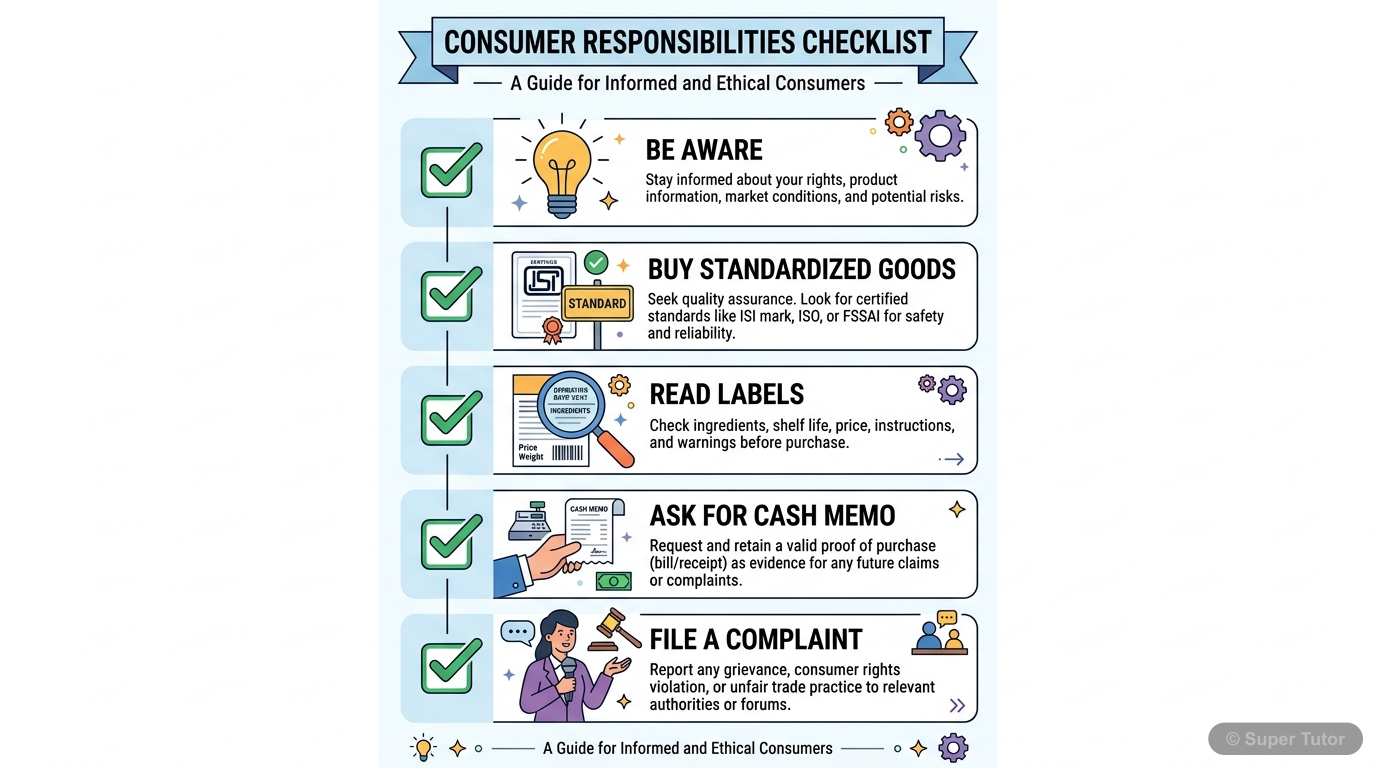
An infographic presenting a checklist of key responsibilities consumers should uphold while purchasing, using, and consuming goods and services.
Super Tutor

Learn better with visuals Super Tutor has hundreds of illustrations like this across every chapter — all free to try.

Get started
16 Questions Solved · 3 Sections

REVIEW QUESTIONS — Consumer Education and Protection

1aExplain the term 'Consumer' in 2–3 lines.Show solution
Given: We need to define the term 'Consumer'.

Answer:
A consumer is any person who buys goods or avails services for personal use, in exchange for money or any other consideration. A consumer does not buy goods for resale or for commercial purposes. Under the Consumer Protection Act, a consumer is one who purchases goods or hires services for a price paid or promised.

Example: A person who buys a packet of biscuits from a shop for personal consumption is a consumer.
1bExplain the term 'Consumer Rights' in 2–3 lines.Show solution
Given: We need to define 'Consumer Rights'.

Answer:
Consumer Rights are the legal entitlements given to consumers to protect them from exploitation, unfair trade practices, and unsafe products. These rights empower consumers to seek redressal, get accurate information, and make free choices in the marketplace.

The six consumer rights recognised in India (based on the Consumer Protection Act) include the right to safety, right to information, right to choose, right to be heard, right to redressal, and right to consumer education.
1cExplain the term 'Consumer Responsibilities' in 2–3 lines.Show solution
Given: We need to define 'Consumer Responsibilities'.

Answer:
Consumer Responsibilities are the duties that a consumer must fulfil to be a wise and informed buyer. These include being aware of one's rights, checking quality marks and expiry dates before purchasing, demanding proper bills and receipts, avoiding wasteful consumption, and filing complaints when cheated.

A responsible consumer not only protects himself/herself but also contributes to a fair and honest marketplace.
1dExplain the term 'Consumer Protection Act' in 2–3 lines.Show solution
Given: We need to define the 'Consumer Protection Act'.

Answer:
The Consumer Protection Act is a legislation enacted by the Government of India (originally in 1986, updated in 2019) to safeguard the interests of consumers against defective goods, deficient services, unfair trade practices, and exploitation.

It provides a three-tier quasi-judicial machinery — District Commission, State Commission, and National Commission — for speedy and inexpensive redressal of consumer grievances.
1eExplain the term 'Consumer Problems' in 2–3 lines.Show solution
Given: We need to define 'Consumer Problems'.

Answer:
Consumer Problems refer to the difficulties and challenges faced by consumers in the marketplace. These include adulteration of food products, sale of substandard or defective goods, misleading advertisements, overcharging, short weighing/measuring, and lack of after-sales service.

Consumer problems arise due to lack of awareness, illiteracy, and unethical trade practices followed by some sellers and manufacturers.
2aList any three consumer rights.Show solution
Any three Consumer Rights are:

1. Right to Safety — The right to be protected against goods and services that are hazardous to life and property.
2. Right to Information — The right to be informed about the quality, quantity, potency, purity, standard, and price of goods or services so as to protect the consumer against unfair trade practices.
3. Right to Choose — The right to have access to a variety of goods and services at competitive prices, so that the consumer can make a free and informed choice.
2bList any three consumer responsibilities.Show solution
Any three Consumer Responsibilities are:

1. Be Aware — A consumer should gather complete information about the product or service before purchasing it.
2. Insist on a Bill/Receipt — A consumer should always ask for a cash memo or receipt as proof of purchase to facilitate redressal if needed.
3. Check for Quality Marks — A consumer should look for standardisation marks such as ISI, Agmark, Hallmark, etc., before buying a product to ensure its quality and safety.
2cList any five consumer problems.Show solution
Any five Consumer Problems are:

1. Adulteration — Mixing of inferior or harmful substances in food and other products.
2. Substandard Goods — Sale of goods that do not meet the prescribed quality standards.
3. Misleading Advertisements — False or exaggerated claims made by manufacturers about their products.
4. Overcharging — Charging prices higher than the Maximum Retail Price (MRP) printed on the product.
5. Short Weight and Measure — Giving less quantity than what is paid for by the consumer.
2dList any three standardisation marks.Show solution
Any three Standardisation Marks are:

1. ISI Mark (BIS Mark) — Given by the Bureau of Indian Standards (BIS) for industrial and manufactured products such as electrical appliances, cement, etc.
2. Agmark — Given by the Directorate of Marketing and Inspection for agricultural and food products such as ghee, honey, wheat, etc.
3. Hallmark — Given by BIS for gold and silver jewellery to certify the purity of the metal.
3State true or false:
a. ISI mark is given by BIS.
b. Agmark is meant for agricultural products.
c. Right to safety is not a consumer right.
d. VOICE is the name of a consumer organisation.
Show solution
a. ISI mark is given by BIS.
True.
The ISI (Indian Standards Institute) mark is awarded by the Bureau of Indian Standards (BIS) to products that conform to the national quality standards.

b. Agmark is meant for agricultural products.
True.
Agmark is a certification mark given by the Directorate of Marketing and Inspection, Government of India, for agricultural and allied products like ghee, honey, spices, etc.

c. Right to safety is not a consumer right.
False.
The Right to Safety is indeed one of the six important consumer rights. It protects consumers from goods and services that are hazardous to life and property.

d. VOICE is the name of a consumer organisation.
True.
VOICE (Voluntary Organisation in Interest of Consumer Education) is a well-known consumer organisation in India that works for consumer awareness and protection.
4Discuss in brief the basic concepts of consumer education and protection.Show solution
Introduction:
Consumer education and protection are essential in today's market economy where consumers face numerous challenges such as adulteration, misleading advertisements, and substandard goods.

1. Who is a Consumer?
A consumer is any person who buys goods or avails services for personal use. The Consumer Protection Act, 2019 provides a broad definition to include all such individuals.

2. Consumer Rights:
The six key consumer rights are:
- Right to Safety
- Right to Information
- Right to Choose
- Right to be Heard
- Right to Redressal
- Right to Consumer Education

These rights empower consumers to protect themselves from exploitation.

3. Consumer Responsibilities:
Along with rights, consumers have responsibilities such as being aware, checking quality marks, demanding bills, avoiding wasteful consumption, and filing complaints when necessary.

4. Consumer Problems:
Common problems include adulteration, overcharging, short weighing, defective goods, and misleading advertisements.

5. Consumer Protection Act:
The Consumer Protection Act (originally 1986, revised 2019) provides a three-tier redressal system:
- District Consumer Commission — for claims up to ₹1 crore
- State Consumer Commission — for claims between ₹1 crore and ₹10 crore
- National Consumer Commission — for claims above ₹10 crore

6. Standardisation Marks:
Marks like ISI (BIS), Agmark, Hallmark, FPO, and Eco Mark help consumers identify quality products and make informed choices.

7. Consumer Organisations:
Organisations like VOICE, CERC (Consumer Education and Research Centre), and others spread consumer awareness and assist in redressal.

Conclusion:
Consumer education enables individuals to make informed decisions, while consumer protection laws ensure that their rights are upheld. Together, they create a fair and transparent marketplace for all.

PRACTICAL 1 — Develop Leaflet/Pamphlet for Consumer Education and Protection

Practical 1Develop a leaflet/pamphlet for Consumer Education and Protection on any one of the following topics: (a) Consumer Protection Act, (b) Consumer Rights, (c) Consumer Responsibilities, (d) Standardisation Marks, (e) Consumer Problems/Redressal.Show solution
Theme: Consumer Education and Protection
Sample Topic Selected: Consumer Rights

---

STEPS TO DEVELOP THE LEAFLET/PAMPHLET:

Step 1 — Collect Relevant Information:
Gather information from textbooks, government websites (e.g., consumerhelpline.gov.in), and consumer organisation publications on Consumer Rights.

Step 2 — Plan the Structure:
Decide on the format — a tri-fold leaflet (six panels) is recommended as it provides adequate space for heading, subheadings, body text, and pictures.

Step 3 — Design the Content:

- Heading (Panel 1 — Front Cover):
'KNOW YOUR RIGHTS AS A CONSUMER'
*(Bold, large font to catch the eye immediately)*

- Introduction (Panel 2):
'Are you being cheated in the market? Do you know you have legal rights as a consumer? Read on to find out!'

- Body — Six Consumer Rights (Panels 3 & 4):
1. Right to Safety — Protection from hazardous goods.
2. Right to Information — Know the quality, price, and ingredients.
3. Right to Choose — Access to a variety of goods at fair prices.
4. Right to be Heard — Your complaints will be considered.
5. Right to Redressal — Seek compensation for defective goods/services.
6. Right to Consumer Education — Right to be an informed consumer.

- Subheadings: Use subheadings like 'What can you do?', 'Where to complain?' to guide the reader.

- Conclusion/Application (Panel 5):
'If you face any consumer problem, contact your nearest District Consumer Commission or call the National Consumer Helpline: 1800-11-4000 (Toll Free).'

- Back Panel (Panel 6):
Name of school, group members, date, and a simple illustration or logo.

Step 4 — Use Simple Language:
Write in simple English or local language so that the target audience (general public) can easily understand the message.

Step 5 — Add Visuals:
Include simple pictures or icons representing each right (e.g., a shield for Right to Safety, a magnifying glass for Right to Information).

Step 6 — Get Approval:
Submit the draft to the teacher-in-charge for review and approval before printing.

Step 7 — Print and Distribute:
Get the leaflet printed or photocopied and distribute it during awareness camps in the local community.

---

Purpose Achieved:
- Students learn to compile information in limited space.
- Simple language ensures the message reaches the target group.
- The leaflet creates awareness about consumer rights in the community.

Additional Activities

Activity 4Read newspaper regularly and keep a cutting of a news article on any case reported under the Consumer Protection Act for purposes of redressal. Discuss it in the class.Show solution
Objective: To understand real-life application of the Consumer Protection Act through newspaper reports.

How to conduct this activity:

1. Read newspapers daily — Look for news articles in newspapers (e.g., The Hindu, Times of India, Hindustan Times) related to consumer complaints, court orders by Consumer Commissions, or cases of fraud/adulteration.

2. Identify a relevant article — For example, an article about a consumer winning a case against an airline for delayed baggage, or a case against a builder for not delivering a flat on time.

3. Cut and paste the article in your practical file/notebook.

4. Analyse the case by noting:
- Who is the consumer and who is the opposite party?
- What was the consumer problem/complaint?
- Which Consumer Commission heard the case (District/State/National)?
- What relief/compensation was granted?
- Which consumer right was violated?

5. Class Discussion: Present the case to classmates and discuss:
- How could the problem have been avoided?
- What does this case teach us as consumers?

Learning Outcome: Students understand that the Consumer Protection Act is a practical and effective tool for seeking justice, and that consumers can and do win cases against large companies.
Activity 5Collect labels/packages of any ten commodities of daily use (like spices, biscuits, bulbs, sugar, sauce, jam, etc.) and see which standardisation marks are found on them. Discuss these in the class.Show solution
Objective: To identify standardisation marks on everyday products and understand their significance.

How to conduct this activity:

1. Collect 10 labels/packages of daily use items such as:
- Spices (e.g., turmeric, chilli powder)
- Biscuits
- Electric bulbs/LED lights
- Sugar
- Sauce/ketchup
- Jam
- Ghee
- Honey
- Cooking oil
- Electrical wire/switch

2. Examine each label carefully and note the standardisation marks present.

Common Standardisation Marks to look for:

| Mark | Full Form | Given by | Products |
|------|-----------|----------|----------|
| ISI/BIS Mark | Bureau of Indian Standards | BIS | Electrical goods, cement, steel |
| Agmark | Agricultural Mark | Directorate of Marketing & Inspection | Ghee, honey, spices, wheat |
| Hallmark | — | BIS | Gold/silver jewellery |
| FPO Mark | Fruit Products Order | Ministry of Food Processing | Jams, sauces, juices |
| Eco Mark | — | BIS | Eco-friendly products |
| FSSAI Mark | Food Safety & Standards Authority of India | FSSAI | All packaged food items |

3. Record your observations in a table in your practical file.

4. Class Discussion: Discuss which products carry which marks, why some products may not have any mark, and what risks consumers face when buying products without standardisation marks.

Learning Outcome: Students learn to identify quality marks and understand their importance in making safe and informed purchasing decisions.
Activity 6Visit the websites of your state university and other major Indian universities and find out the subjects on offer at the undergraduate degree, diploma and certificate programmes. Make a detailed listing and discuss in the class.Show solution
Objective: To explore undergraduate career opportunities related to Consumer Studies and Home Science.

How to conduct this activity:

1. Visit websites of universities such as:
- Delhi University (www.du.ac.in)
- IGNOU (www.ignou.ac.in)
- Lady Irwin College, New Delhi
- SNDT Women's University, Mumbai
- Your own State University

2. Search for undergraduate programmes in Home Science, Resource Management, Consumer Studies, or related fields.

3. Make a detailed list of:
- Name of the programme (B.Sc. Home Science, B.Sc. Resource Management, etc.)
- Duration
- Subjects offered (especially those related to consumer education)
- Eligibility criteria

Sample listing:

| University | Programme | Duration | Relevant Subject |
|------------|-----------|----------|------------------|
| Delhi University | B.Sc. Home Science | 3 years | Consumer Studies, Resource Management |
| IGNOU | B.Sc. (Home Science) | 3 years | Consumer Education |
| SNDT University | B.Sc. Home Science | 3 years | Family Resource Management |

4. Discuss in class: Which programmes interest you? What career options do these open up in consumer protection and education?

Learning Outcome: Students become aware of higher education opportunities in the field of Consumer Studies and Home Science.
Activity 7Visit the websites of your state university and other major Indian universities and find out post-graduate diploma and degree courses in the area of Consumer Studies. Make notes and discuss in the class.Show solution
Objective: To explore postgraduate career opportunities in Consumer Studies.

How to conduct this activity:

1. Visit websites of major universities and look for postgraduate programmes.

2. Search specifically for:
- PG Diploma in Consumer Education
- PG Diploma in Management of Voluntary Organisations
- PG Diploma in Consumer Services
- M.Sc. Home Science
- M.Sc. Resource Management and Design Application
- M.Sc. Family Resource Management
- MBA with specialisation in Marketing

3. Note the following details for each programme:
- Name of university and programme
- Duration (1 year / 2 years)
- Eligibility (e.g., graduation in Home Science or related field)
- Subjects covered related to consumer issues
- Career prospects after the programme

Sample listing:

| University | Programme | Duration | Eligibility |
|------------|-----------|----------|-------------|
| IGNOU | PG Diploma in Consumer Education | 1 year | Any graduate |
| Delhi University | M.Sc. Home Science | 2 years | B.Sc. Home Science |
| SNDT University | M.Sc. Resource Management | 2 years | B.Sc. Home Science |
| Various B-Schools | MBA (Marketing) | 2 years | Any graduate + entrance test |

4. Discuss in class: How do these programmes prepare students for careers in consumer empowerment, protection, and behaviour? What additional skills (legal training, writing, financial management) would be helpful?

Learning Outcome: Students gain awareness of postgraduate options and understand how higher education in this field leads to careers in consumer activism, financial management, insurance, journalism, and consumer testing laboratories.

Stuck on a step?

Ask Super Tutor AI to explain any solution on this page in a simpler way — free, 24x7.

Ask a Doubt Free

Frequently Asked Questions

What are the important topics in Consumer Education and Protection for CBSE Class 12 Home Science?
Key topics in Consumer Education and Protection include Consumer Education and Protection Overview, Consumer Education and Protection Overview, Consumer Education and Protection Overview. These are the concepts CBSE Class 12 examiners draw on most — study them first, then practise related questions.
How to score full marks in Consumer Education and Protection — CBSE Class 12 Home Science?
Start by understanding all key concepts. Practise previous year questions from this chapter. Revise formulas and definitions regularly. Use flashcards for quick revision before the exam.
Where can I get free NCERT Solutions for Consumer Education and Protection Class 12 Home Science?
This page has free step-by-step NCERT Solutions for every exercise question in Consumer Education and Protection (CBSE Class 12 Home Science) — written the way examiners award marks: given, formula, working, answer.

Sources & Official References

Content is aligned to the official syllabus. Refer to the board website for the latest curriculum.

For serious students

Get the full Consumer Education and Protection chapter — for free.

Quizzes, flashcards, AI doubt-solver and a step-by-step study plan for CBSE Class 12 Home Science.