Chapter 14 of 14
NCERT Solutions

Corporate Communication and Public Relations

CBSE · Class 12 · Home Science

NCERT Solutions for Corporate Communication and Public Relations — CBSE Class 12 Home Science.

5 concepts

Interactive on Super Tutor

Studying Corporate Communication and Public Relations? Get the full interactive chapter.

Quizzes, flashcards, AI doubt-solver and a step-by-step study plan — built for ncert solutions and more.

1,000+ Class 12 students started this chapter today

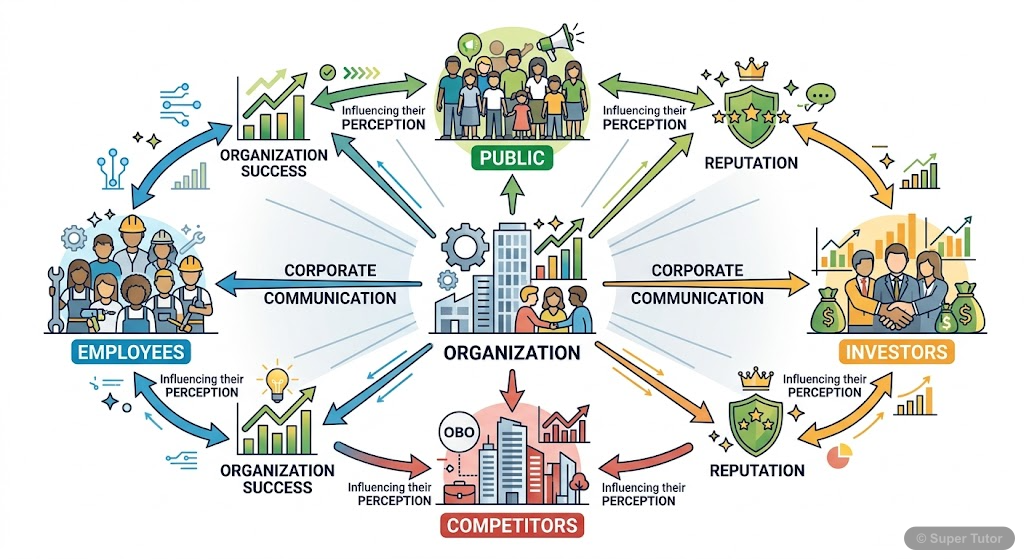
An infographic illustrating how corporate communication shapes the perception of various stakeholders (public, employees, investors, competitors) and its impact on an organization's success and reputa
Super Tutor

Learn better with visuals Super Tutor has hundreds of illustrations like this across every chapter — all free to try.

Get started
11 Questions Solved · 2 Sections

Review Questions — Corporate Communication and Public Relations (Class 12 Home Science Part 2)

1What is the significance of corporate communication in today's times?Show solution
Given/Concept: Corporate communication refers to the set of activities involved in managing and orchestrating all internal and external communications aimed at creating a favourable point of view among stakeholders on which a company depends.

Significance of Corporate Communication Today:

1. Image Building: It helps an organisation build and maintain a positive image and reputation in the eyes of the public, clients, investors, and employees.

2. Brand Identity: Consistent communication across all channels strengthens brand identity and differentiates the organisation from competitors.

3. Crisis Management: Effective corporate communication helps manage crises by providing timely, accurate, and transparent information to all stakeholders, thereby minimising damage.

4. Employee Engagement: Internal communication keeps employees informed, motivated, and aligned with the organisation's goals and values, improving productivity.

5. Stakeholder Relations: It builds and sustains trust with all stakeholders — customers, investors, government bodies, media, and the community.

6. Impact of ICT: With the advent of Information and Communication Technology (ICT), corporate communication has become faster, wider in reach, and more interactive through social media, websites, emails, and digital platforms.

7. Globalisation: In a globalised economy, organisations operate across borders; corporate communication bridges cultural and geographical gaps.

8. Competitive Advantage: Organisations with strong communication strategies are better positioned to attract talent, retain customers, and gain investor confidence.

Conclusion: In today's fast-paced, information-driven world, corporate communication is not merely a support function but a strategic tool essential for the survival and growth of any organisation.
2Enumerate functions of corporate communication.Show solution
Given/Concept: Corporate communication encompasses all communication activities of an organisation, both internal and external. Its functions can be broadly enumerated as follows:

Functions of Corporate Communication:

1. Media Relations: Managing relationships with journalists and media houses; issuing press releases and responding to media queries to ensure accurate and positive coverage.

2. Public Relations (PR): Creating and maintaining a favourable public image through planned and sustained communication efforts.

3. Internal Communication: Disseminating information within the organisation — policies, updates, achievements — to keep employees informed and motivated.

4. External Communication: Communicating with customers, suppliers, investors, government, and the general public to build trust and goodwill.

5. Crisis Communication: Developing strategies to communicate effectively during emergencies or negative events to protect the organisation's reputation.

6. Advertising and Promotion: Coordinating advertising campaigns to promote products, services, or the organisation's image.

7. Corporate Social Responsibility (CSR) Communication: Communicating the organisation's social and environmental initiatives to build goodwill.

8. Investor Relations: Providing financial information and updates to shareholders and potential investors.

9. Government/Regulatory Relations (Lobbying): Communicating with government bodies and regulatory authorities on matters of policy and compliance.

10. Brand Management: Ensuring all communications reflect and reinforce the brand identity consistently.

11. Employee Communication: Conducting training, newsletters, town halls, and feedback mechanisms to maintain a healthy organisational culture.

Conclusion: These functions together ensure that the organisation speaks with one coherent voice to all its audiences, building credibility and long-term relationships.
3Compare internal and external communication.Show solution
Given/Concept: Communication within an organisation can be classified as internal (within the organisation) or external (with outside stakeholders). A comparison is presented below:

| Basis | Internal Communication | External Communication |
|---|---|---|
| Definition | Communication that takes place within the organisation among its members | Communication between the organisation and outside parties |
| Audience | Employees, managers, departments, teams | Customers, media, government, investors, suppliers, public |
| Purpose | To coordinate activities, motivate staff, share policies, resolve conflicts | To build image, attract customers, manage public perception, comply with regulations |
| Channels Used | Memos, emails, intranet, meetings, notice boards, newsletters | Press releases, advertisements, websites, social media, annual reports |
| Nature | More informal and direct; can be two-way | More formal and carefully crafted; often one-way or structured |
| Control | Relatively easier to control and monitor | Harder to control; subject to public scrutiny |
| Examples | HR policy circular, team meeting, performance appraisal | Press conference, TV advertisement, CSR report |
| Impact | Affects employee morale, productivity, and organisational culture | Affects brand image, customer loyalty, and public trust |

Conclusion: Both forms of communication are equally important. Internal communication ensures smooth functioning of the organisation, while external communication shapes its public image and market position. Effective corporate communication integrates both seamlessly.
4Describe the single most factor that has revolutionised the scope of communication.Show solution
Given/Concept: Among all the developments in the field of communication, one single factor stands out as the most transformative.

The Single Most Factor: Information and Communication Technology (ICT)

ICT — encompassing the internet, mobile technology, social media, digital platforms, and satellite communication — has revolutionised the scope of communication in the following ways:

1. Speed: Messages that once took days or weeks to reach their destination now travel across the globe in seconds through emails, instant messaging, and social media.

2. Reach: ICT has made it possible to communicate with millions of people simultaneously, breaking geographical barriers. A single tweet or post can reach a global audience instantly.

3. Interactivity: Unlike traditional one-way communication (e.g., newspapers, TV), ICT enables two-way, real-time interaction between organisations and their audiences through social media, live chats, and webinars.

4. Cost-Effectiveness: Digital communication is far cheaper than print or broadcast media, making it accessible even to small organisations.

5. Multimedia Integration: ICT allows the combination of text, audio, video, and graphics, making communication more engaging and effective.

6. Data and Analytics: Organisations can now track the impact of their communication in real time using digital analytics, enabling them to refine their strategies.

7. 24×7 Availability: Digital platforms operate round the clock, allowing organisations to communicate with stakeholders at any time.

Example: A company facing a crisis can immediately issue a statement on its website and social media handles, reaching millions of stakeholders within minutes — something impossible before the ICT revolution.

Conclusion: ICT has not merely changed the tools of communication; it has fundamentally transformed the nature, speed, reach, and impact of communication, making it the single most revolutionary factor in the field.
5Enlist verbal and non-verbal skills and briefly explain with examples any three from each category.Show solution
Given/Concept: Communication skills are broadly classified into verbal (using words/language) and non-verbal (using body language, gestures, appearance, etc.).

---

Verbal Communication Skills:

1. Listening Skills
2. Presentation Skills
3. Negotiation Skills
4. Accent Neutralisation
5. Interpersonal Skills (verbal aspect)
6. Rapport Establishment Skills (verbal aspect)

Explanation of any three Verbal Skills:

(i) Listening Skills:
Listening is an active process of receiving, interpreting, and responding to messages. It is different from merely hearing.
- Example: A PR professional attentively listening to a client's concerns without interrupting, then paraphrasing to confirm understanding — this builds trust and ensures accurate communication.
- Good listeners ask clarifying questions and give feedback, making the speaker feel valued.

(ii) Presentation Skills:
The ability to convey information clearly and confidently to an audience, using structured content, appropriate language, and supporting visuals.
- Example: A corporate communication manager presenting the company's annual performance to investors using a well-structured PowerPoint, clear data, and confident delivery ensures the message is credible and persuasive.

(iii) Negotiation Skills:
The ability to reach a mutually acceptable agreement through discussion, compromise, and persuasion.
- Example: A PR executive negotiating with a media house for favourable coverage of a product launch — using facts, empathy, and flexibility to arrive at a win-win arrangement.

---

Non-Verbal Communication Skills:

1. Body Language (posture, gestures)
2. Eye Contact
3. Facial Expressions
4. Proxemics (use of space)
5. Paralanguage (tone, pitch, pace)
6. Appearance and Grooming

Explanation of any three Non-Verbal Skills:

(i) Body Language:
Posture, gestures, and movements convey attitudes and emotions without words.
- Example: A manager who sits upright, leans slightly forward, and nods while listening signals engagement and respect to the speaker. Slouching or crossed arms, on the other hand, signals disinterest or defensiveness.

(ii) Eye Contact:
Maintaining appropriate eye contact conveys confidence, sincerity, and attentiveness.
- Example: A spokesperson at a press conference who maintains steady eye contact with journalists appears credible and trustworthy, whereas avoiding eye contact may suggest dishonesty or nervousness.

(iii) Facial Expressions:
The face is the most expressive part of the body and can convey a wide range of emotions — happiness, concern, surprise, anger — often more powerfully than words.
- Example: A customer service representative who greets a dissatisfied customer with a warm, empathetic smile and a concerned expression can de-escalate tension even before speaking a word.

Conclusion: Both verbal and non-verbal skills are essential for effective communication. In professional settings, they must be aligned — what one says verbally should be reinforced by non-verbal cues for the message to be credible and impactful.
6Explain the meaning and significance of Public Relations today.Show solution
Given/Concept: Public Relations (PR) is a strategic communication process that builds mutually beneficial relationships between organisations and their publics.

---

Meaning of Public Relations:

Public Relations is the planned and sustained effort to establish and maintain goodwill and mutual understanding between an organisation and its various publics (stakeholders) — including customers, employees, investors, media, government, and the community at large.

Unlike advertising (which is paid and controlled), PR works through earned media and credibility. It involves:
- Crafting and disseminating messages through media
- Managing the organisation's reputation
- Responding to public concerns
- Building long-term relationships

---

Significance of Public Relations Today:

1. Reputation Management: In the age of social media, a single negative story can go viral. PR professionals proactively manage and protect the organisation's reputation.

2. Crisis Management: PR is the first line of defence during a crisis. Timely, transparent, and empathetic communication can prevent irreparable damage to an organisation's image.

3. Building Trust and Credibility: Unlike advertisements (which audiences know are paid), PR coverage in media is perceived as more credible and trustworthy.

4. Stakeholder Engagement: PR ensures that all stakeholders — employees, investors, customers, government — are kept informed and engaged, fostering loyalty.

5. Media Relations: PR professionals build relationships with journalists and editors to ensure fair and accurate coverage of the organisation.

6. Community Relations: Organisations use PR to demonstrate their commitment to social responsibility, building goodwill in the community.

7. Support to Marketing: PR complements advertising and marketing by generating buzz, endorsements, and editorial coverage that reinforce the brand message.

8. Digital PR: With the rise of the internet and social media, PR now operates 24×7, requiring real-time monitoring and response.

Conclusion: In today's hyper-connected, information-saturated world, Public Relations is not a luxury but a necessity for any organisation that wishes to build lasting relationships, manage its reputation, and communicate its values effectively to the world.
7In your opinion which two areas of PR work are important? Why?Show solution
Given/Concept: PR encompasses several areas of work including media relations, crisis communication, community relations, employee relations, government relations, and event management. Based on their impact and relevance in today's context, the following two areas are most important:

---

Area 1: Media Relations

Why it is important:

Media relations involves building and maintaining positive relationships with journalists, editors, and media organisations to ensure accurate, fair, and favourable coverage of the organisation.

- Reach and Influence: Media — both traditional (newspapers, TV) and digital (online news, social media) — has enormous reach. A well-placed news story or press release can reach millions of people.
- Credibility: Media coverage is perceived as more credible than paid advertising. A positive news story about a company's achievement or CSR initiative builds genuine public trust.
- Crisis Control: During a crisis, media relations professionals can ensure that the organisation's side of the story is heard, preventing misinformation from spreading.
- Example: When a company launches a new product, a well-crafted press release sent to relevant media can generate extensive free coverage, far more cost-effective than advertising.

---

Area 2: Crisis Communication

Why it is important:

Crisis communication involves preparing for, managing, and communicating during unexpected negative events that threaten the organisation's reputation or operations.

- Protecting Reputation: In the age of social media, crises escalate rapidly. A well-prepared crisis communication plan can contain damage and restore confidence quickly.
- Stakeholder Assurance: During a crisis, stakeholders — customers, investors, employees — need timely and accurate information. Silence or poor communication worsens the situation.
- Long-term Survival: Organisations that handle crises well (e.g., transparent communication, accepting responsibility, corrective action) often emerge stronger and more trusted.
- Example: When a food company faces a product contamination scare, immediate, honest communication — recalling the product, explaining the steps taken — can save the brand, whereas denial or delay can destroy it permanently.

Conclusion: Media relations and crisis communication are the two most critical areas of PR work because they directly determine how the public perceives an organisation — both in normal times and during adversity. Together, they form the backbone of an effective PR strategy.
8What are the principles of PR work?Show solution
Given/Concept: The principles of PR work provide the ethical and strategic foundation for all public relations activities. These principles guide PR professionals in building honest, effective, and sustainable relationships with their publics.

Principles of PR Work *(based on the Page Principles and general PR ethics)*:

1. Tell the Truth:
Always communicate honestly and accurately. Provide an accurate picture of the organisation's character, values, and actions. Deception, even if temporarily beneficial, ultimately destroys credibility.

2. Prove it with Action:
Public perception of an organisation is determined more by what it does than by what it says. Actions must back up words. PR is not just about communication — it is about ensuring the organisation behaves in ways consistent with its stated values.

3. Listen to the Customer/Public:
PR professionals must actively listen to the concerns, opinions, and needs of their various publics. Communication must be two-way. Understanding public sentiment is essential for crafting relevant and effective messages.

4. Manage for Tomorrow:
PR decisions must consider long-term consequences, not just immediate gains. Short-term tactics that damage long-term reputation must be avoided.

5. Conduct PR as if the Whole Company Depends on It:
PR is not a peripheral activity — it is central to the organisation's success. Every employee is, in a sense, a PR representative of the organisation.

6. Realise a Company's True Character is Expressed by its People:
The behaviour of employees at all levels shapes public perception. PR must work in tandem with HR and management to foster a culture consistent with the organisation's values.

7. Remain Calm, Patient, and Good-Humoured:
PR professionals must maintain composure, especially during crises. Panic, aggression, or defensiveness in communication worsens situations.

8. Transparency and Accountability:
Organisations must be open about their activities and willing to be held accountable for their actions. This builds long-term trust.

9. Consistency:
All communications — internal and external, across all media — must be consistent in message, tone, and values to build a coherent and trustworthy image.

10. Ethical Practice:
PR work must adhere to professional codes of ethics, avoiding manipulation, misrepresentation, or exploitation of any stakeholder group.

Conclusion: These principles ensure that PR work is not merely a tool for spin or image management, but a genuine effort to build honest, mutually beneficial relationships between organisations and their publics.
9What is the relationship between corporate communication, PR and Media?Show solution
Given/Concept: Corporate communication, Public Relations (PR), and Media are three closely interlinked elements that together shape how an organisation is perceived by the world.

---

Corporate Communication:
This is the overarching function that manages all communication activities of an organisation — both internal (with employees) and external (with all outside stakeholders). It sets the overall communication strategy, tone, and messaging of the organisation.

Public Relations (PR):
PR is a key component of corporate communication. It specifically focuses on managing the organisation's relationships with its various publics — customers, investors, community, government, and media — to build goodwill and a positive reputation. PR is the strategic arm of corporate communication that deals with perception management.

Media:
Media (print, broadcast, digital, social) is the primary channel through which both corporate communication and PR messages reach the public. It acts as the bridge between the organisation and its audiences.

---

The Relationship:

1. Corporate Communication sets the strategy; PR executes it with the public; Media carries the message:
Corporate communication defines what the organisation wants to say and to whom. PR professionals craft the specific messages and choose the appropriate media channels. The media then disseminates these messages to the target audiences.

2. PR is the organisation's interface with the Media:
PR professionals build and maintain relationships with journalists, editors, and media houses. They issue press releases, organise press conferences, and respond to media queries — all on behalf of the organisation's corporate communication strategy.

3. Media shapes Public Perception; PR manages it:
Media coverage — positive or negative — directly influences how the public perceives an organisation. PR professionals monitor media coverage, respond to negative stories, and proactively generate positive coverage to manage public perception.

4. Interdependence:
- Organisations need media to reach their audiences.
- Media needs organisations as sources of news and information.
- PR professionals facilitate this mutually beneficial relationship.

5. Digital Media has transformed all three:
With social media and digital platforms, the boundaries between corporate communication, PR, and media have blurred. Organisations now communicate directly with their audiences (bypassing traditional media), while also engaging with digital media influencers and online journalists.

Conclusion: Corporate communication, PR, and media form an integrated ecosystem. Corporate communication provides the strategic framework; PR builds and manages relationships, especially with the media; and the media serves as the vehicle that carries the organisation's message to the world. Together, they determine the organisation's reputation and public image.

Assignment

IPrepare a Case-Study of a PR agency based on the following points:
1. Description of the situation in the client's company
2. Formulate objectives to resolve the situation.
3. Study the plan of action to achieve the objectives: (a) Target group orientation (b) Message selection (c) Media selection (d) Creativity and innovation (e) Resource assessment (f) Man-power review
4. Understand implementation of the plan and the results thereafter.
Show solution
Note to Students: This is a practical assignment requiring original fieldwork or research. Below is a model case-study framework that you can adapt based on your own research or visit to a PR agency.

---

MODEL CASE STUDY: PR Campaign for a Food & Beverage Company

*(Hypothetical example for reference)*

---

Client: FreshBite Foods Pvt. Ltd. — a mid-sized packaged food company.

PR Agency: ClearVoice Communications

---

1. Description of the Situation:

FreshBite Foods faced a reputational crisis when a consumer complaint on social media alleged that one of their snack products contained a foreign object. The post went viral, receiving over 50,000 shares within 48 hours. Sales dropped by 30% in the following week. Retail partners began pulling the product from shelves. The company's management was in panic, and employees were demoralised. The media began running negative stories without waiting for the company's response.

The core problem: Loss of consumer trust, negative media coverage, and declining sales due to a product safety allegation.

---

2. Objectives Formulated by the PR Agency:

- Short-term (0–2 weeks): Contain the crisis; issue a clear, honest public statement; recall the affected batch as a precautionary measure.
- Medium-term (1–3 months): Rebuild consumer trust through transparent communication about quality control measures.
- Long-term (3–12 months): Restore brand image; regain lost market share; position FreshBite as a responsible, quality-conscious brand.

---

3. Plan of Action:

(a) Target Group Orientation:
- Primary audience: Existing consumers, especially mothers and health-conscious buyers aged 25–45.
- Secondary audience: Retail partners, distributors, and investors.
- Tertiary audience: Media and general public.
- Each group required a different message and channel.

(b) Message Selection:
- For consumers: *"Your safety is our priority. We have voluntarily recalled Batch No. XYZ and are conducting a thorough investigation. FreshBite has a 15-year record of quality and safety."*
- For retail partners: Detailed briefing on the recall process and compensation policy.
- For media: A factual press release with the CEO's statement, quality certifications, and corrective steps.
- Tone: Honest, empathetic, responsible — never defensive or dismissive.

(c) Media Selection:
- Social Media (Instagram, Twitter, Facebook): Immediate response to the viral post; regular updates.
- Press Release: Sent to all major national and regional newspapers and news portals.
- Press Conference: CEO and Quality Head addressed media directly.
- Company Website: Dedicated crisis page with FAQs and recall information.
- Consumer Helpline: Toll-free number activated for consumer queries.

(d) Creativity and Innovation:
- Launched a "FreshBite Promise" campaign — a video series showing the company's manufacturing process, quality checks, and employee testimonials to rebuild transparency.
- Partnered with food safety experts and nutritionists for credible third-party endorsement.
- Organised factory visits for selected journalists and food bloggers.

(e) Resource Assessment:
- Budget allocated: ₹25 lakhs for the 3-month crisis communication campaign.
- Tools required: Social media monitoring software, video production equipment, press release distribution service, consumer helpline infrastructure.
- Timeline: Crisis response within 24 hours; full campaign over 3 months.

(f) Man-power Review:
- Crisis Team: 1 PR Director, 2 Senior PR Executives, 1 Social Media Manager, 1 Content Writer, 1 Media Relations Officer.
- Client Side: CEO, Quality Head, Legal Advisor, and Marketing Manager as key spokespersons.
- External Support: Hired a food safety consultant for credibility.

---

4. Implementation and Results:

Implementation:
- Within 24 hours: Press release issued; social media response posted; recall announced.
- Week 2: Press conference held; CEO's video statement released on all digital platforms.
- Month 1: "FreshBite Promise" campaign launched; factory visits conducted.
- Month 2–3: Positive media coverage began appearing; retail partners reinstated the product.

Results:
- Negative social media mentions reduced by 80% within 3 weeks.
- Sales recovered to 85% of pre-crisis levels within 2 months.
- Three major food magazines ran positive feature stories on FreshBite's quality processes.
- Consumer trust index (measured through online surveys) improved by 40% over 3 months.
- The campaign won a regional PR excellence award for crisis communication.

Learning:
The case demonstrated that honest, swift, and empathetic communication — backed by genuine corrective action — is the most effective PR strategy during a crisis. The integration of digital and traditional media, combined with third-party credibility, was key to the campaign's success.

---

Note: Students should conduct an actual interview or research on a real PR agency and replace the above hypothetical data with real findings for submission.
IIPresent a case-study from a book/magazine or any other source.Show solution
Note to Students: This assignment requires you to independently source a real case study from a book, magazine, journal, or credible online source related to PR or corporate communication. Below is a model presentation format with a well-known real-world example for reference.

---

CASE STUDY: Johnson & Johnson — The Tylenol Crisis (1982)
*(Source: Widely documented in PR textbooks and Harvard Business School case studies)*

---

Background / Situation:

In September 1982, seven people in Chicago died after taking Tylenol capsules (a pain-relief medicine by Johnson & Johnson) that had been laced with cyanide by an unknown criminal. The news spread rapidly, causing nationwide panic. Tylenol held 35% of the US over-the-counter pain reliever market at the time. Analysts predicted the brand would never recover.

---

The PR Challenge:

- Protect public safety immediately.
- Manage massive negative media coverage.
- Decide whether to recall 31 million bottles of Tylenol (at a cost of over $100 million).
- Restore consumer confidence in the brand.

---

PR Strategy and Actions Taken:

1. Immediate Recall: J&J immediately recalled all Tylenol products nationwide — a decision that prioritised public safety over profit. This was unprecedented at the time.

2. Transparent Communication: The company's CEO, James Burke, appeared on television and in press conferences, communicating openly and honestly about the situation and the steps being taken.

3. Cooperation with Authorities: J&J worked closely with the FBI, FDA, and Chicago police, demonstrating responsibility and transparency.

4. Consumer Hotline: A 24-hour consumer hotline was established to address public concerns.

5. Tamper-Proof Packaging: J&J pioneered the introduction of triple-seal tamper-resistant packaging — a new industry standard — and communicated this innovation widely.

6. Relaunch Campaign: Tylenol was relaunched with the new packaging, supported by a major PR and advertising campaign emphasising safety.

---

Results:

- Within 5 months of the crisis, Tylenol had recovered 70% of its market share.
- Within a year, it had fully recovered to its pre-crisis position.
- J&J's handling of the crisis is now considered the gold standard of crisis communication in PR history.
- The case is cited in virtually every PR and business ethics textbook worldwide.

---

Key Learnings:

1. Public safety must always come before profit — this decision, though costly, saved the brand.
2. Transparency and honesty in communication build long-term trust.
3. Swift action prevents a crisis from spiralling out of control.
4. Turning a crisis into an opportunity — the tamper-proof packaging innovation turned a negative event into a positive brand differentiator.
5. Leadership communication — the CEO's visible, empathetic, and honest communication was central to the recovery.

---

Conclusion:

The Tylenol crisis of 1982 remains the most celebrated example of effective crisis PR. It demonstrates that when an organisation places ethics and public welfare at the centre of its communication strategy, it can not only survive a crisis but emerge stronger and more trusted than before.

---

Note: Students are encouraged to find their own case study from Indian or international sources — newspapers like *The Hindu Business Line*, magazines like *PR Week*, or books like *Effective Public Relations* by Cutlip, Center & Broom — and present it using the above format.

Stuck on a step?

Ask Super Tutor AI to explain any solution on this page in a simpler way — free, 24x7.

Ask a Doubt Free

Frequently Asked Questions

What are the important topics in Corporate Communication and Public Relations for CBSE Class 12 Home Science?
Key topics in Corporate Communication and Public Relations include Corporate Communication and PR Overview, Corporate Communication and Public Relations - Complete Overview, Corporate Communication and Public Relations Overview. These are the concepts CBSE Class 12 examiners draw on most — study them first, then practise related questions.
How to score full marks in Corporate Communication and Public Relations — CBSE Class 12 Home Science?
Start by understanding all key concepts. Practise previous year questions from this chapter. Revise formulas and definitions regularly. Use flashcards for quick revision before the exam.
Where can I get free NCERT Solutions for Corporate Communication and Public Relations Class 12 Home Science?
This page has free step-by-step NCERT Solutions for every exercise question in Corporate Communication and Public Relations (CBSE Class 12 Home Science) — written the way examiners award marks: given, formula, working, answer.

Sources & Official References

Content is aligned to the official syllabus. Refer to the board website for the latest curriculum.

For serious students

Get the full Corporate Communication and Public Relations chapter — for free.

Quizzes, flashcards, AI doubt-solver and a step-by-step study plan for CBSE Class 12 Home Science.