Fashion Design and Merchandising
CBSE · Class 12 · Home Science
NCERT Solutions for Fashion Design and Merchandising — CBSE Class 12 Home Science.
Interactive on Super Tutor
Studying Fashion Design and Merchandising? Get the full interactive chapter.
Quizzes, flashcards, AI doubt-solver and a step-by-step study plan — built for ncert solutions and more.
1,000+ Class 12 students started this chapter today

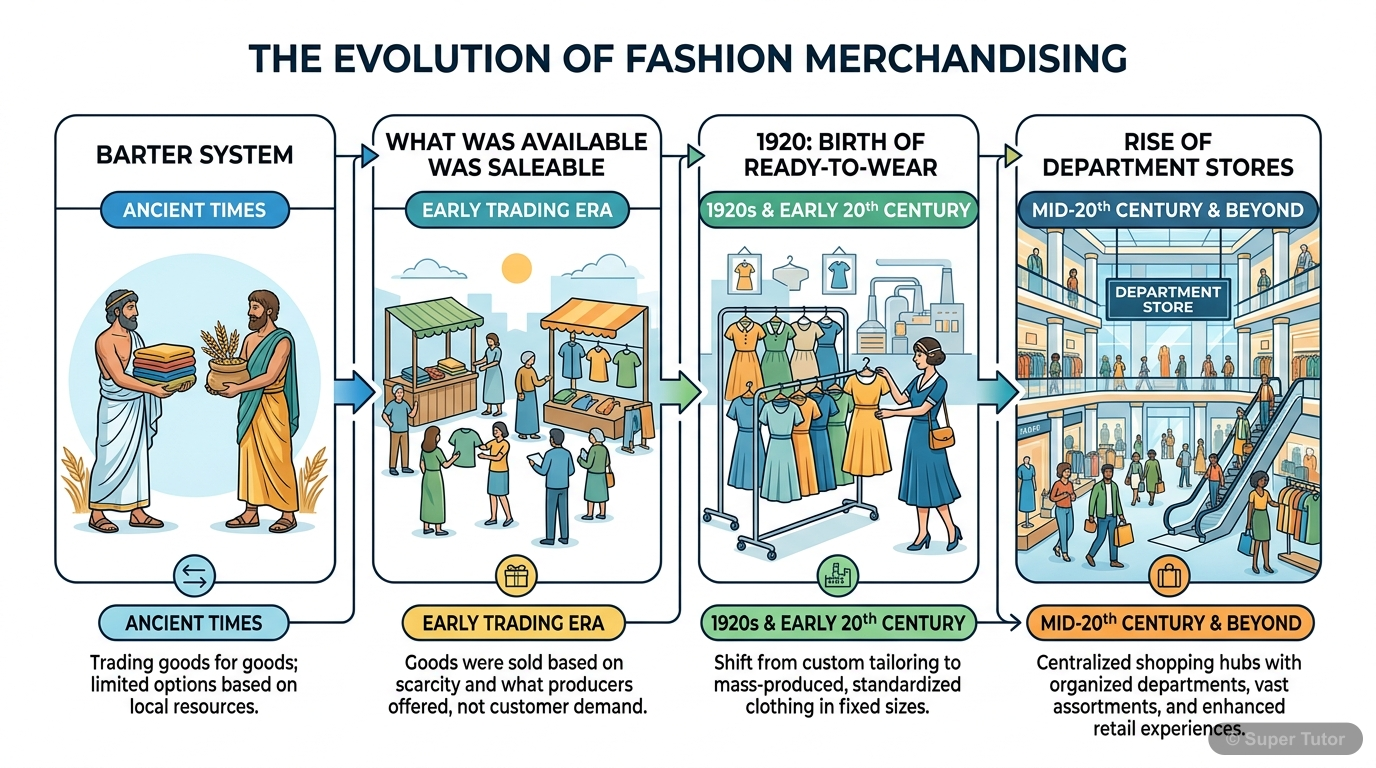
Learn better with visuals Super Tutor has hundreds of illustrations like this across every chapter — all free to try.
Get startedReview Questions — Fashion Design and Merchandising (Unit IV: Fabric and Apparel)
1Outline the major developments in fashion.Show solution
Answer:
The major developments in fashion can be outlined as follows:
1. Ancient and Medieval Period:
- Clothing was primarily functional — for protection and modesty.
- Fabrics like linen, wool, and silk were used by different civilisations (Egyptian, Greek, Roman).
- Clothing indicated social status and rank.
2. Renaissance Period (14th–17th Century):
- Fashion became an art form in Europe.
- Elaborate garments with embroidery, lace, and rich fabrics became popular among royalty and nobility.
- Tailoring as a craft developed significantly.
3. Industrial Revolution (18th–19th Century):
- Invention of the sewing machine (Elias Howe, 1846) revolutionised garment production.
- Mass production of clothing began, making fashion accessible to the middle class.
- Ready-to-wear (RTW) clothing emerged.
4. Birth of Haute Couture (Mid-19th Century):
- Charles Frederick Worth (Paris) is considered the father of haute couture.
- Designer-led fashion houses (couture houses) began creating exclusive, custom-made garments.
- Paris became the fashion capital of the world.
5. Early 20th Century:
- Coco Chanel introduced comfortable, practical clothing for women — jersey fabrics, trousers, and the 'little black dress'.
- Christian Dior's 'New Look' (1947) brought back femininity with nipped waists and full skirts.
6. Post-World War II and the Rise of Ready-to-Wear:
- Mass production expanded; department stores and retail chains grew.
- American sportswear and casual dressing became globally influential.
7. 1960s–1980s — Youth Culture and Designer Labels:
- Youth-driven fashion (mini skirts by Mary Quant), hippie styles, and punk fashion emerged.
- Designer labels (Armani, Versace, Calvin Klein) gained prominence.
- Fashion weeks in Paris, Milan, New York, and London became established.
8. Late 20th–21st Century — Globalisation and Technology:
- Fast fashion brands (Zara, H&M) made trend-driven clothing affordable and quickly available.
- E-commerce and social media transformed how fashion is marketed and consumed.
- Sustainable and ethical fashion emerged as a major concern.
- Indian fashion industry grew with designers like Ritu Kumar, Manish Malhotra, and Tarun Tahiliani gaining international recognition.
Conclusion: Fashion has evolved from a purely functional necessity to a global multi-billion-dollar industry reflecting culture, identity, technology, and economics.
2Identify and explain the various stages of fashion cycle.Show solution
Concept: The Fashion Cycle refers to the rise, widespread popularity, and eventual decline of a particular style or trend. It is often represented as a bell-shaped curve.
Stages of the Fashion Cycle:
Stage 1: Introduction Stage
- A new style is introduced by fashion designers, usually through haute couture or designer collections shown at fashion weeks.
- The style is worn by fashion leaders, celebrities, and innovators.
- Prices are very high; availability is limited.
- Only a small, fashion-forward segment of consumers adopts it.
Stage 2: Rise / Growth Stage
- The style gains acceptance and popularity.
- Fashion followers and the early majority begin to adopt it.
- Manufacturers produce the style at moderate prices.
- The style appears in fashion magazines, retail stores, and media.
Stage 3: Peak / Culmination Stage
- The fashion reaches its highest point of popularity.
- It is mass-produced and widely available at various price points.
- A large number of consumers are wearing the style.
- This is the stage of maximum sales and visibility.
Stage 4: Decline Stage
- Consumer interest begins to wane.
- The style is seen as 'old' or 'overdone'.
- Prices are reduced; the style appears in discount stores and sale racks.
- Fashion-forward consumers have already moved on to newer styles.
Stage 5: Obsolescence / Rejection Stage
- The fashion is completely out of style.
- Consumers refuse to wear it even at very low prices.
- The style may eventually be revived in a modified form in the future.
Special Fashion Cycles:
- Fad: A very short fashion cycle — rises and falls very quickly (e.g., a novelty accessory).
- Classic: A style that never goes completely out of fashion (e.g., the white shirt, the trench coat). It has a long, flat cycle.
- Trend: A general direction in which fashion is moving over a longer period.
Conclusion: Understanding the fashion cycle helps designers, merchandisers, and retailers plan production, buying, and marketing strategies effectively.
3What do you understand by the term fashion merchandising?Show solution
Definition:
Fashion Merchandising is the planning, buying, and selling of fashion products at the right time, in the right place, in the right quantities, and at the right price to meet the needs and desires of the target consumer.
It bridges the gap between the fashion designer/manufacturer and the end consumer.
Key Aspects of Fashion Merchandising:
1. Planning: Forecasting fashion trends, analysing consumer demand, and planning what merchandise to stock for a particular season.
2. Buying: Selecting and purchasing the right merchandise from manufacturers, designers, or wholesalers based on consumer preferences and budget.
3. Selling: Presenting and promoting merchandise effectively in retail stores or online platforms to maximise sales.
4. Pricing: Setting appropriate prices that are competitive, cover costs, and are acceptable to the target market.
5. Promotion: Using advertising, visual merchandising, social media, and other tools to attract consumers.
6. Inventory Management: Ensuring the right quantity of stock is available — avoiding both overstock and stockouts.
Role of a Fashion Merchandiser:
- Conducts market research and trend analysis.
- Liaises between designers, manufacturers, and retailers.
- Works with buying houses, export houses, and retail organisations.
- Understands the target market and consumer motivation.
Conclusion: Fashion merchandising is a dynamic field that combines creativity with business acumen. It ensures that the right fashion products reach the right consumers at the right time, making it a critical function in the fashion industry.
4Describe various levels of merchandising.Show solution
Answer:
Merchandising operates at several levels within the fashion industry, from the production stage to the final consumer. The major levels are:
Level 1: Manufacturer/Producer Level (Primary Level)
- At this level, raw materials (fibres, yarns, fabrics) are produced and converted into finished garments.
- Merchandising involves planning production quantities, selecting fabrics and trims, and ensuring quality standards.
- Textile mills, yarn manufacturers, and garment factories operate at this level.
- Export houses and buying houses play an important role here by sourcing orders from international buyers.
Level 2: Wholesale Level (Secondary Level)
- Wholesalers purchase large quantities of merchandise from manufacturers and sell them to retailers.
- Merchandising at this level involves buying in bulk, warehousing, and distributing to various retail outlets.
- Buying houses and agencies act as intermediaries, helping retailers source merchandise from manufacturers.
Level 3: Retail Level (Tertiary Level)
- This is the level closest to the consumer.
- Retailers (department stores, boutiques, chain stores, online stores) buy merchandise and sell it directly to consumers.
- Retail merchandising involves:
- Assortment planning — deciding what styles, sizes, and colours to stock.
- Visual merchandising — attractive display of products in stores.
- Pricing and promotions — sales, discounts, and offers.
- Inventory control — managing stock levels.
Level 4: Export/International Level
- Export houses source garments from Indian manufacturers and sell them to international buyers.
- Merchandising at this level involves understanding international fashion trends, quality standards, and compliance with export regulations.
- Buying houses/agencies represent foreign buyers in India and help them source merchandise.
Market Segmentation in Merchandising:
Merchandising also operates across different market segments:
- Haute Couture / Designer Level — exclusive, high-priced merchandise.
- Bridge Level — between designer and mass market.
- Mass Market / Ready-to-Wear — affordable, mass-produced merchandise.
Conclusion: Each level of merchandising has its own functions and responsibilities, and together they form a complete supply chain that brings fashion products from the designer's concept to the consumer's wardrobe.
5'To interpret consumer demand one should understand target market and customer motivations'. Elaborate.Show solution
Explanation:
1. Target Market:
A target market is a specific group of consumers at whom a product or service is aimed. It is defined by characteristics such as:
- Demographics: Age, gender, income, education, occupation, family size.
- Geographics: Region, city, climate.
- Psychographics: Lifestyle, values, interests, personality.
- Behavioural factors: Purchase habits, brand loyalty, usage rate.
For example, a brand selling school uniforms targets children aged 5–16 and their parents, while a luxury fashion brand targets high-income adults.
Why Target Market Matters:
- It helps designers and merchandisers create products that are relevant and appealing to a specific group.
- It prevents wastage of resources on consumers who are unlikely to buy the product.
- It guides decisions on pricing, promotion, distribution, and product design.
2. Market Segmentation:
The process of dividing the total market into distinct groups (segments) with similar needs and characteristics is called market segmentation. It enables more precise targeting and effective merchandising.
3. Customer Motivations:
Customer motivations are the reasons why consumers buy fashion products. These include:
- Functional Motivation: Need for clothing for protection, comfort, or a specific purpose (e.g., workwear, sportswear).
- Psychological Motivation: Desire for self-expression, confidence, and identity through clothing.
- Social Motivation: Desire to conform to peer groups, social norms, or to gain social acceptance and status.
- Aesthetic Motivation: Appreciation of beauty, design, and style.
- Economic Motivation: Seeking value for money, discounts, and affordability.
- Cultural/Traditional Motivation: Wearing clothing that reflects cultural identity or traditions.
4. Interpreting Consumer Demand:
By understanding the target market and motivations, a merchandiser can:
- Forecast which styles, colours, and price points will sell well.
- Plan the right assortment of merchandise for each season.
- Design effective marketing and promotional campaigns.
- Ensure customer satisfaction and brand loyalty.
Conclusion: A thorough understanding of the target market and consumer motivations is the foundation of successful fashion merchandising. It ensures that the right products are created and made available to the right consumers, thereby maximising sales and customer satisfaction.
6Enumerate the knowledge and skills that a fashion designer and merchandiser must possess.Show solution
Answer:
A fashion designer and merchandiser must possess a combination of creative, technical, and business skills. These can be enumerated as follows:
A. Knowledge Required:
1. Knowledge of Fabrics and Textiles:
- Properties of different fibres, yarns, and fabrics.
- Fabric construction, finishing, and care.
- Suitability of fabrics for different garments and end uses.
2. Knowledge of Fashion History and Trends:
- Understanding of historical fashion developments.
- Ability to forecast and interpret current and future fashion trends.
3. Knowledge of Garment Construction:
- Pattern making, draping, cutting, and stitching techniques.
- Understanding of garment fit, silhouette, and construction details.
4. Knowledge of Colour and Design Principles:
- Colour theory, colour combinations, and colour forecasting.
- Elements and principles of design (line, shape, texture, proportion, balance, etc.).
5. Knowledge of the Fashion Industry:
- Understanding of the supply chain — from fibre to retail.
- Knowledge of buying houses, export houses, retail organisations, and market segmentation.
6. Knowledge of Consumer Behaviour:
- Understanding target markets, consumer motivations, and buying patterns.
7. Knowledge of Business and Marketing:
- Pricing strategies, merchandising planning, inventory management.
- Advertising, promotion, and visual merchandising.
B. Skills Required:
1. Sketching and Illustration Skills:
- Ability to draw fashion figures (croquis) and communicate design ideas visually.
2. Technical Skills:
- Pattern making, draping, sewing, and garment construction.
- Use of CAD (Computer-Aided Design) software for design and pattern making.
3. Creativity and Innovation:
- Ability to generate original design ideas and adapt trends creatively.
4. Communication Skills:
- Ability to present ideas clearly to clients, buyers, and team members.
- Written and verbal communication for business correspondence.
5. Analytical and Research Skills:
- Market research, trend analysis, and consumer research.
6. Organisational and Management Skills:
- Time management, project planning, and team coordination.
7. Negotiation and Buying Skills:
- Ability to negotiate prices and terms with suppliers and manufacturers.
8. Digital and Technology Skills:
- Proficiency in design software, e-commerce platforms, and social media.
Conclusion: A successful fashion designer and merchandiser must be both creative and business-minded, combining artistic talent with practical knowledge of the industry, consumer behaviour, and market dynamics.
7What advice would you give to your friend who wants to pursue fashion designing and merchandising as a career?Show solution
Answer:
If my friend wants to pursue fashion designing and merchandising as a career, I would give the following advice:
1. Build a Strong Foundation:
- Develop a keen interest in fashion, art, and design from an early age.
- Practice sketching, drawing, and observing fashion trends regularly.
- Study subjects like Home Science, Fine Arts, and Design at the school level.
2. Pursue the Right Education:
- Enrol in a recognised fashion design or fashion merchandising programme after Class 12.
- Reputed institutions in India include:
- NIFT (National Institute of Fashion Technology) — entrance through NIFT entrance exam.
- NID (National Institute of Design).
- Pearl Academy, INIFD, Symbiosis Institute of Design, and other private institutes.
- Courses available: B.Des (Fashion Design), B.Sc. in Fashion Merchandising, Diploma in Fashion Design, etc.
3. Develop Core Skills:
- Learn pattern making, draping, garment construction, and stitching.
- Develop proficiency in design software such as Adobe Illustrator, Photoshop, and CAD tools.
- Improve sketching and illustration skills — practice drawing fashion figures (croquis).
- Learn about fabrics, textiles, and garment construction in detail.
4. Stay Updated with Fashion Trends:
- Follow fashion weeks (Paris, Milan, New York, India Fashion Week).
- Read fashion magazines (Vogue, Elle, Harper's Bazaar) and follow fashion blogs and social media.
- Understand both Indian and international fashion markets.
5. Gain Practical Experience:
- Do internships with fashion designers, garment export houses, buying agencies, or retail organisations.
- Participate in fashion shows, design competitions, and exhibitions.
- Build a strong portfolio showcasing your best design work.
6. Understand the Business Side:
- Learn about fashion merchandising, retail management, marketing, and consumer behaviour.
- Understand how buying houses, export houses, and retail organisations function.
- Develop negotiation, communication, and management skills.
7. Career Opportunities:
After completing education and gaining experience, one can work as:
- Fashion Designer (apparel, accessories, textiles)
- Fashion Merchandiser
- Buyer for retail chains or export houses
- Visual Merchandiser
- Fashion Stylist
- Fashion Journalist or Blogger
- Entrepreneur (own boutique or fashion label)
8. Personal Qualities to Cultivate:
- Creativity, passion, and originality.
- Hard work, perseverance, and attention to detail.
- Networking and relationship-building skills.
- Adaptability to changing trends and market demands.
Conclusion: Fashion designing and merchandising is a rewarding and exciting career for those with creativity and business acumen. With the right education, skills, practical experience, and passion, one can build a successful and fulfilling career in this dynamic industry.
Practical 1 — Developing a Female Fashion Figure
Practical 1Theme: Developing a female fashion figure. Task: To learn sketching of a fashion figure and proportions. Purpose: To understand the proportions of different parts of the body to create a croquis (fashion figure). Describe the steps and proportions used to construct a fashion croquis.Show solution
Materials Required: Sketch file and pencils.
Key Concepts:
- A croquis (French word meaning 'rough sketch' or 'outline') is a fashion figure used to communicate design ideas for apparel.
- The head is used as the unit of measurement.
- A fashion figure has 8½ to 10 heads as its full height.
- Multiples of the head measurement are used to determine the proportions of different body parts.
---
Proportions of the Croquis:
| Body Feature | Proportion |
|---|---|
| Shoulders | Widest part |
| Waist | Smallest/narrowest part |
| Hips | In between shoulders and waist |
| Upper body (head to end of torso) | Approximately ½ of total height |
| Lower body (end of torso to ankle) | Approximately ½ of total height |
---
Guidelines Used:
*Horizontal Guidelines:*
- Shoulderline
- Bustline
- Waistline
- Hip plane
- End of torso
*Vertical Guidelines:*
- Centre front
- Armhole
- Princess line
---
Step-by-Step Procedure:
Step 1: Draw a central (vertical) line measuring 10 heads, where 1 head = 1 inch. This is the Centre Front Line.
Step 2: Divide the central line into 10 equal parts (each part = 1 head unit).
Step 3: Mark the following body levels at the indicated head measurements:
| Level | Head Measurement |
|---|---|
| Eye line | ½ head |
| Shoulder line | 1½ heads |
| Bust line | Just below 2 heads |
| Waist line | Just below 3 heads |
| Hip plane | 3½ heads |
| End of torso | Slightly above 4½ heads |
| Knees | 6½ heads |
| Ankles | At or just above 9 heads |
Step 4: Using a pencil, join the marked levels to develop the body form, following the natural curves of the figure:
- Shoulders are the widest.
- Waist curves inward (narrowest).
- Hips are slightly wider than the waist but narrower than the shoulders.
- Legs taper from thigh to ankle.
Step 5: Refine the sketch to create a smooth, elegant fashion figure.
Step 6: The croquis is now ready to be used as a base for showing design ideas — garments, drapes, prints, and accessories can be drawn over it.
Step 7: Practice at least 5 croquis with different head measurements (e.g., 8½ heads, 9 heads, 10 heads) to understand how proportions change with different fashion looks.
---
Observation:
- As the number of heads increases (e.g., from 8½ to 10), the figure appears taller and more elongated, which is the idealised fashion figure look.
- The head-to-body ratio in a real human is approximately 7–7½ heads, while the fashion figure is exaggerated to 8½–10 heads for aesthetic effect.
Conclusion:
The croquis is an essential tool for fashion designers. By understanding and applying correct proportions using the head as a unit of measurement, a designer can create accurate and visually appealing fashion figures on which design ideas can be effectively communicated and presented.
Stuck on a step?
Ask Super Tutor AI to explain any solution on this page in a simpler way — free, 24x7.
Ask a Doubt FreeFrequently Asked Questions
What are the important topics in Fashion Design and Merchandising for CBSE Class 12 Home Science?
How to score full marks in Fashion Design and Merchandising — CBSE Class 12 Home Science?
Where can I get free NCERT Solutions for Fashion Design and Merchandising Class 12 Home Science?
Sources & Official References
- NCERT Official — ncert.nic.in
- CBSE Academic — cbseacademic.nic.in
- CBSE Official — cbse.gov.in
- National Education Policy 2020 — education.gov.in
Content is aligned to the official syllabus. Refer to the board website for the latest curriculum.
More resources for Fashion Design and Merchandising
Important Questions
Practice with board exam-style questions
Syllabus
What topics to cover
Revision Notes
Key points for last-minute revision
Study Plan
Step-by-step plan to ace this chapter
Flashcards
Quick-fire cards for active recall
Formula Sheet
All formulas in one place
Chapter Summary
Understand the chapter at a glance
Practice Quiz
Test yourself with a quick quiz
Concept Maps
See how topics connect visually
For serious students
Get the full Fashion Design and Merchandising chapter — for free.
Quizzes, flashcards, AI doubt-solver and a step-by-step study plan for CBSE Class 12 Home Science.