Chapter 2 of 14
NCERT Solutions

Design for Fabric and Apparel

CBSE · Class 12 · Home Science

NCERT Solutions for Design for Fabric and Apparel — CBSE Class 12 Home Science.

5 concepts

Interactive on Super Tutor

Studying Design for Fabric and Apparel? Get the full interactive chapter.

Quizzes, flashcards, AI doubt-solver and a step-by-step study plan — built for ncert solutions and more.

1,000+ Class 12 students started this chapter today

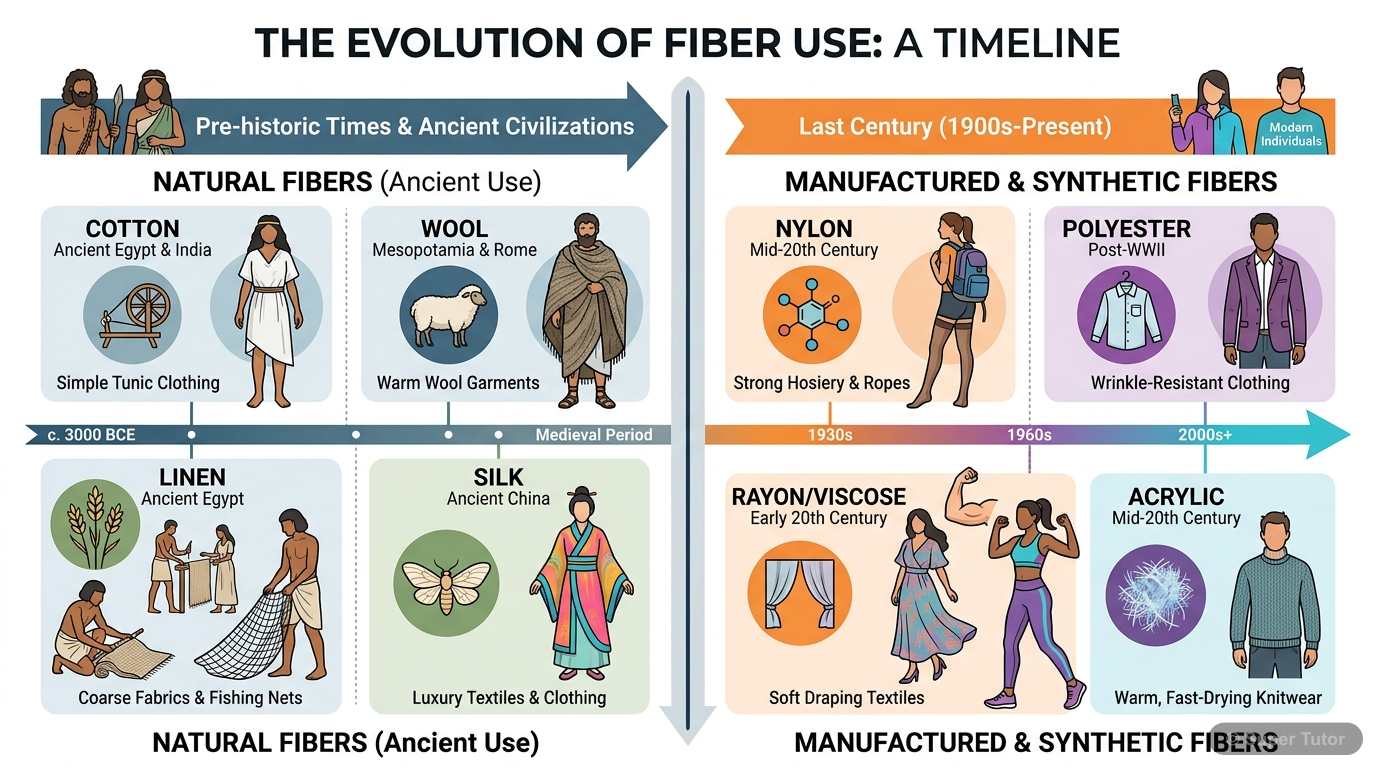
A timeline showing the historical use of natural fibers (cotton, wool, linen, silk) from prehistoric times, followed by the introduction of manufactured and synthetic fibers in the last century.
Super Tutor

This is just one of 25+ visuals inside Super Tutor's Design for Fabric and Apparel chapter

Explore the full set
9 Questions Solved · 4 Sections

Review Questions — Design for Fabric and Apparel

1What do you understand by the term 'design'?Show solution
Given/Concept: The term 'design' is central to the study of fabric and apparel.

Answer:
Design refers to a plan or arrangement of elements — such as line, shape, colour, texture, and pattern — that are combined in an organised and purposeful way to create a visually pleasing and functional product.

In the context of fabric and apparel, design can be of two types:
1. Structural Design: The design that is built into the fabric during its construction (weaving, knitting, etc.), e.g., woven patterns, checks, stripes formed by the interlacing of yarns.
2. Applied Design: The design that is applied onto the surface of an already constructed fabric, e.g., printing, embroidery, dyeing (tie and dye, batik).

A good design is one that is harmonious, balanced, and suited to the purpose for which the article is made.
2What are the factors that affect the texture of a fabric during its manufacture?Show solution
Given/Concept: Texture is one of the important elements of design. It refers to the surface quality of a fabric — how it looks and feels.

Factors that affect texture during manufacture:

1. Type of Fibre Used: Natural fibres (cotton, silk, wool, linen) and synthetic fibres (polyester, nylon) each give a different surface feel and appearance. For example, silk gives a smooth, lustrous texture while wool gives a rough, warm texture.

2. Yarn Construction: The way fibres are spun into yarn affects texture. Tightly twisted yarns produce smooth, firm fabrics, while loosely twisted yarns produce soft, fluffy fabrics.

3. Method of Fabric Construction (Weave): The type of weave — plain, twill, satin — determines the surface texture. A satin weave produces a smooth, shiny surface, while a twill weave produces a diagonal, slightly rough surface.

4. Finishing Processes: Processes such as calendering (pressing), napping, embossing, or mercerising alter the texture of the finished fabric. For example, napping raises the fibres to give a soft, fuzzy surface.

5. Thickness and Count of Yarn: Coarser yarns produce heavier, rougher textures, while finer yarns produce lighter, smoother textures.

Conclusion: All these factors together determine whether the final fabric will be smooth or rough, dull or shiny, stiff or soft.
3How does the application of colour during the different stages of fabric manufacture affect the design in fabric?Show solution
Given/Concept: Colour can be applied at different stages of fabric manufacture — at the fibre stage, yarn stage, fabric stage, or garment stage. Each stage produces a different design effect.

Stages of Colour Application and their Effect on Design:

1. Fibre/Stock Dyeing (Colour applied to fibres before spinning):
- Fibres of different colours are blended before spinning.
- This produces a heathered or tweedy effect in the final fabric.
- The colour is very even and penetrates deeply, giving excellent colour fastness.
- Example: Heather tweed.

2. Yarn Dyeing (Colour applied to yarn before weaving/knitting):
- Yarns of different colours are woven or knitted together.
- This allows the creation of structural designs such as checks, stripes, plaids, and tartans directly in the fabric.
- Example: Madras checks, gingham.

3. Piece Dyeing (Colour applied to the woven/knitted fabric):
- The entire fabric is dyed in one colour after construction.
- This produces a solid, uniform colour throughout the fabric.
- It is the most economical method for producing plain-coloured fabrics.

4. Garment/Product Dyeing (Colour applied after the garment is made):
- The finished garment is dyed.
- This allows flexibility in colour selection at the last stage.
- However, different components (e.g., thread, buttons) may absorb dye differently, creating uneven effects.

Conclusion: The stage at which colour is applied determines the type of design effect — from structural woven patterns (yarn dyeing) to surface patterns (piece dyeing and printing) — and also affects the depth, evenness, and fastness of colour.
4What are the different types of lines and shapes? How do they create different effects and moods?Show solution
Given/Concept: Line and shape/form are fundamental elements of design. They create visual effects and psychological moods in fabric and apparel.

Types of Lines and their Effects:

| Type of Line | Effect/Mood Created |
|---|---|
| Vertical Lines | Give an impression of height and slimness; create a dignified, formal, and strong feeling. |
| Horizontal Lines | Give an impression of width and shortness; create a calm, restful, and stable feeling. |
| Diagonal Lines | Give a sense of movement and action; create a dynamic, energetic, and exciting feeling. |
| Curved Lines | Give a soft, graceful, and feminine feeling; suggest movement and flow. |
| Zigzag Lines | Create a feeling of excitement, nervousness, or agitation. |

Types of Shapes/Forms and their Effects:

1. Geometric Shapes (squares, triangles, circles, rectangles): Give a formal, structured, and precise appearance. Squares and rectangles suggest stability; triangles suggest dynamic energy; circles suggest softness and continuity.

2. Natural/Organic Shapes (flowers, leaves, animals): Give a soft, informal, and decorative appearance. They are widely used in printed and embroidered fabrics.

3. Abstract Shapes: Derived from natural forms but simplified or distorted. They give a modern, artistic, and creative appearance.

Effect on Dress Design:
- Vertical lines in a dress make the wearer appear taller and slimmer.
- Horizontal lines make the wearer appear broader.
- Large shapes make the wearer appear larger; small shapes are more flattering to most figures.

Conclusion: The careful selection and placement of lines and shapes in fabric and apparel design can create specific visual illusions and emotional responses in the viewer.
5How do you achieve rhythm and harmony in dress?Show solution
Given/Concept: Rhythm and harmony are two important principles of design that contribute to the overall beauty and unity of a dress.

Achieving Rhythm in Dress:

Rhythm is the principle that creates a sense of movement and continuity in a design. It leads the eye smoothly from one part of the design to another. Rhythm in dress can be achieved by:

1. Repetition: Repeating a design element (colour, line, shape, or texture) at regular intervals. For example, a repeated floral motif on a fabric creates rhythm.
2. Gradation: Gradually increasing or decreasing the size, colour value, or intensity of a design element. For example, a gradation from light to dark colour creates a flowing rhythm.
3. Radiation: Lines or shapes that radiate from a central point, like the folds of a gathered skirt or a sunburst pattern.
4. Transition: Using curved lines to carry the eye smoothly from one area to another, such as a curved neckline or flowing hemline.
5. Contrast: Alternating opposing elements (e.g., light and dark, thick and thin) at regular intervals to create a lively rhythm.

Achieving Harmony in Dress:

Harmony is the principle that creates a sense of unity and agreement among all the elements of a design. It means that all parts of the dress look as if they belong together. Harmony in dress can be achieved by:

1. Harmony of Colour: Using colours that are related on the colour wheel (analogous colours) or a monochromatic colour scheme. For example, a dress in shades of blue and green creates colour harmony.
2. Harmony of Texture: Combining fabrics of similar or compatible textures. For example, pairing a silk blouse with a satin skirt creates textural harmony.
3. Harmony of Line: Using lines that are consistent in character throughout the garment. For example, using all curved lines in the design of a soft, feminine dress.
4. Harmony of Proportion: Ensuring that the different parts of the dress (bodice, skirt, sleeves) are in pleasing proportion to each other and to the wearer's figure.

Conclusion: Rhythm gives life and movement to a dress, while harmony gives it unity and a sense of completeness. Together, they make a dress aesthetically pleasing and well-designed.

Practical 1 — Tie and Dye

P1.1What is the concept of Tie and Dye? Explain the principle behind it.Show solution
Concept:
Tie and Dye is a form of resist dyeing, which is one of the oldest methods of designing fabric with colour.

Principle:
The principle is based on physical resistance to dye penetration. Certain areas of the fabric are tightly tied, bound, knotted, folded, or sewn with thread before the fabric is dipped into dye. The tied/resisted areas do not absorb the dye and retain the original colour of the fabric, while the untied areas absorb the dye and take on the new colour. This contrast between the dyed and undyed areas creates the pattern.

Traditional Indian Examples:
- Bandhani/Bandhej: Pattern of innumerable dots, created by tying tiny portions of fabric.
- Laheria: Pattern of diagonal stripes.
- Chunari: A type of tie-dyed fabric.

These are traditionally produced in Gujarat and Rajasthan.
P1.2Describe the different techniques of Tie and Dye.Show solution
The main techniques of Tie and Dye are:

1. Knotting:
- One of the easiest and quickest methods.
- Knots are tied in the fabric in several ways depending on the size, shape, and grain of the fabric.
- Best results are achieved on fine fabric.
- Creates shaded circular patterns.

2. Marbling:
- Can be achieved in two ways:
- The fabric is gathered and turned into a ball and tied in all directions until it becomes a solid mass.
- The fabric is twisted and coiled lengthwise and tied.
- Gives variegated and irregular cloud-like effects.
- Generally dyed in light colours; may be repeated in two or more colours to create a multicoloured background.

3. Binding:
- Certain parts of the fabric are bound very tightly with thread before dyeing.
- Binding can be done in the form of a dot, a band, a line, criss-cross, or spiral.
- Creates designs like stripes (straight or diagonal — lehria), circles or spots (bandhej).

4. Tritik or Sewing:
- The fabric is sewn with a needle using simple tacking stitches along a definite pattern.
- A strong thread with a large knot is used; the cloth is gathered closely and finished with a knot to hold the gathers.
- Creates pleasing bands of dotted textures of various shapes.

5. Folding:
- The fabric is folded in different forms — pleats, squares, triangles.
- Folds are held together by binding with thread or clipping with clips.
- Creates symmetrical stripes, bands, squares, etc.
- Best effects are achieved on thick materials.
- These patterns can later be used as background for block printing and embroidery.

Note before tying: The fabric should be washed in hot soapy water so that the dye is absorbed evenly.

Practical 2 — Batik

P2.1What is Batik? Explain the principle and process of Batik.Show solution
Concept:
Batik is a form of resist printing in which the resist is obtained by applying wax on the fabric in a design pattern.

Principle:
Wax is applied to the areas of the fabric that are NOT to be dyed. When the fabric is dipped in dye (at cold temperature, below 35C35^{\circ}\text{C}, to prevent melting of wax), the waxed areas resist the dye and retain the original colour, while the unwaxed areas absorb the dye. The characteristic beauty of batik is the crackle effect — cracks that form in the wax during dyeing allow colour to seep through, creating fine lines of colour.

Process of Batik:

Step 1 — Preparation of Fabric:
- Make the fabric completely free from dirt and grease.
- Stretch it on a frame for ease in drawing the design and applying wax.

Step 2 — Preparation of Wax:
- Two types of wax are used:
- Paraffin wax: Light, easily removed; produces more cracks.
- Beeswax: Darker, more adhesive; produces fewer cracks.
- Both are mixed in varied proportions to control the crackle effect.
- Melt the wax in a small container.

Step 3 — Application of Wax:
- Tools: Brushes with natural hair bristles (not nylon).
- Techniques of wax application:
1. Painting: Painting the design area with wax.
2. Outlining: Painting only the outline of the motif with wax.
3. Dry Brushing: Using a flat brush free of excess wax, carried along design lines to give a shaded effect.
4. Scratching: Covering fabric with wax and scratching design lines with the back of a pin or brush.
- The wax must penetrate both sides of the fabric; apply on both face and back if necessary.

Step 4 — Dyeing:
- Dye the fabric using ice colours or batik colours applied at temperatures below 35C35^{\circ}\text{C}.
- Multiple colour effects are obtained by subsequent wax application, removal, and re-dyeing.

Step 5 — Removal of Wax:
- Dry the fabric after dyeing.
- Fold, pack in a waterproof packet, and freeze it.
- Remove and crush the frozen wax to reduce it to dust.
- Remove remaining wax by hot pressing between layers of absorbent paper.
- Finally, soap at boil to remove all traces of wax.

Result: A fabric with beautiful, colourful designs with characteristic fine crackle lines.

Practical 3 — Block Printing

P3.1What is Block Printing? Explain the concept and process of block printing.Show solution
Concept:
Block printing is one of the oldest methods for applying design onto fabric. It is a form of direct printing in which a carved block is used to stamp a design onto the fabric.

Principle:
A separate block is required for each different colour in the finished design. The design area on the block is raised (in relief), and the background area (not to be printed) is carved away. The raised design area picks up the dye paste and transfers it onto the fabric when pressed.

Construction of Blocks:
- Majority of blocks are made of wood.
- Metal may be used to reinforce delicate parts of the design.
- Blocks may have:
- Single motif patterns
- Border patterns
- All-over patterns

Process of Block Printing:

Step 1 — Preparation of Fabric:
- Lay the fabric flat on a padded table covered with a protective sheet.
- Attach the fabric firmly to the table to prevent movement during printing.

Step 2 — Preparation of Colour:
- Fabric printing colours and wooden block printing colours are available in the market.
- Pour the dye paste into a printing tray with a sponge base to ensure even application.

Step 3 — Printing:
- Lightly press the block onto the dye paste in the tray so that the raised design area is evenly coated with colour.
- Press the block firmly onto the fabric surface with sufficient pressure to force the colour into the fabric.
- Repeat the process to create the pattern across the fabric.

Step 4 — Multicolour Printing:
- When using multicoloured designs:
- Start with the outline block in the darkest colour.
- Then print with the filling blocks in lighter colours.

Step 5 — Finishing:
- Leave the fabric to dry.
- Later, hot press it from the wrong side to fix the colour.

Result: A fabric with clear, repeated printed patterns in one or more colours.

Stuck on a step?

Ask Super Tutor AI to explain any solution on this page in a simpler way — free, 24x7.

Ask a Doubt Free

Frequently Asked Questions

What are the important topics in Design for Fabric and Apparel for CBSE Class 12 Home Science?
Key topics in Design for Fabric and Apparel include Design for Fabric and Apparel - Complete Overview, Elements and Principles of Design Overview, Design Fundamentals Overview. These are the concepts CBSE Class 12 examiners draw on most — study them first, then practise related questions.
How to score full marks in Design for Fabric and Apparel — CBSE Class 12 Home Science?
Start by understanding all key concepts. Practise previous year questions from this chapter. Revise formulas and definitions regularly. Use flashcards for quick revision before the exam.
Where can I get free NCERT Solutions for Design for Fabric and Apparel Class 12 Home Science?
This page has free step-by-step NCERT Solutions for every exercise question in Design for Fabric and Apparel (CBSE Class 12 Home Science) — written the way examiners award marks: given, formula, working, answer.

Sources & Official References

Content is aligned to the official syllabus. Refer to the board website for the latest curriculum.

For serious students

Get the full Design for Fabric and Apparel chapter — for free.

Quizzes, flashcards, AI doubt-solver and a step-by-step study plan for CBSE Class 12 Home Science.