Chapter 7 of 14
NCERT Solutions

Food Processing and Technology

CBSE · Class 12 · Home Science

NCERT Solutions for Food Processing and Technology — CBSE Class 12 Home Science.

5 concepts

Interactive on Super Tutor

Studying Food Processing and Technology? Get the full interactive chapter.

Quizzes, flashcards, AI doubt-solver and a step-by-step study plan — built for ncert solutions and more.

1,000+ Class 12 students started this chapter today

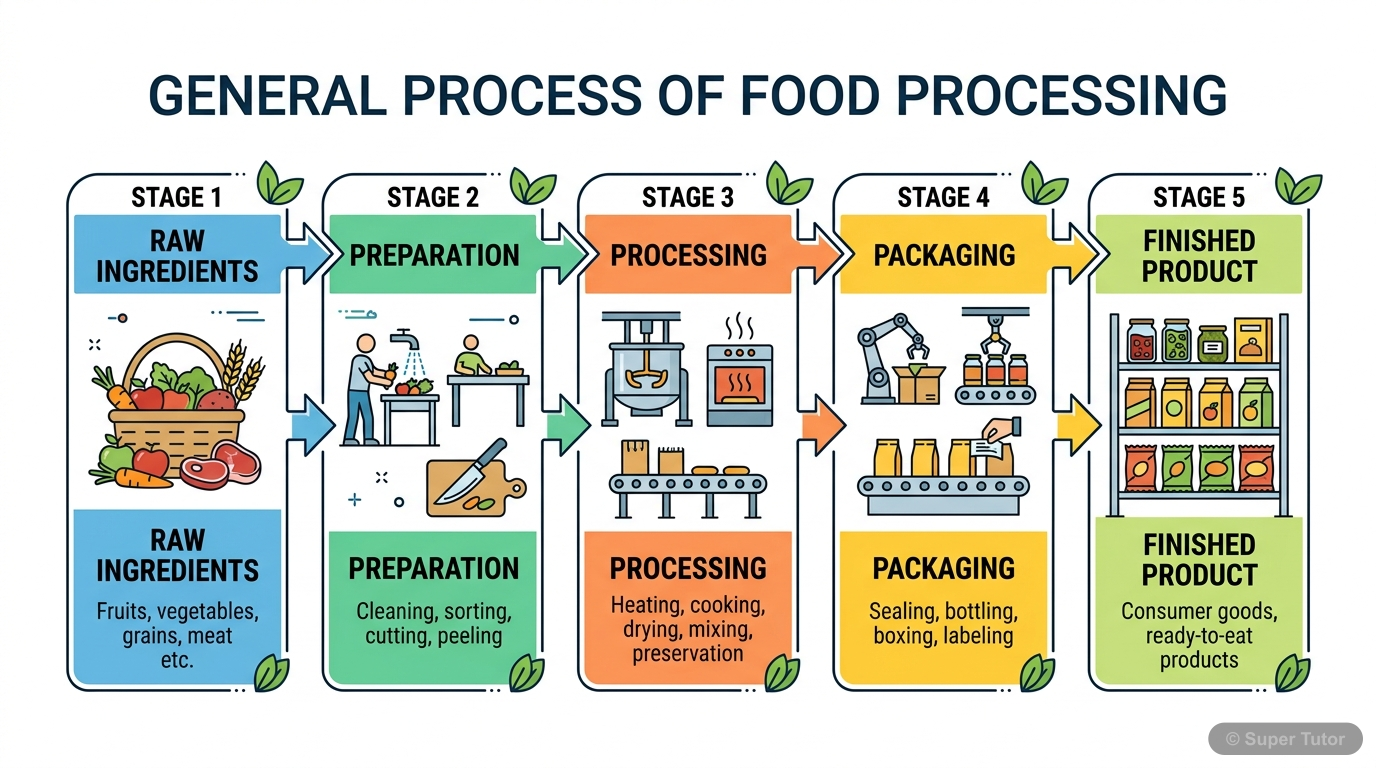
A flowchart illustrating the general steps involved in food processing, from raw ingredients to finished products, highlighting key transformations.
Super Tutor

This is just one of 10+ visuals inside Super Tutor's Food Processing and Technology chapter

Explore the full set
10 Questions Solved · 2 Sections

REVIEW QUESTIONS — Food Processing and Technology

1Explain the following terms: (A) Food Science (B) Food Processing (C) Food Technology (D) Food Manufacturing and (E) Food SpoilageShow solution
Given: Five key terms related to the food industry are to be explained.

(A) Food Science:
Food Science is the study of the physical, chemical, and biological nature of food. It involves understanding the composition of food, the changes that occur during processing, storage, and cooking, and the factors that affect food quality, safety, and nutritional value. It draws knowledge from chemistry, microbiology, biochemistry, and engineering.

(B) Food Processing:
Food Processing refers to the set of methods and techniques used to transform raw ingredients into food or to transform food into other forms for consumption. It includes operations such as cleaning, sorting, grading, cutting, cooking, fermenting, freezing, canning, drying, and packaging. The primary aim is to make food safe, palatable, and convenient for consumers while extending its shelf life.

(C) Food Technology:
Food Technology is the application of food science to the selection, preservation, processing, packaging, distribution, and use of safe, nutritious, and wholesome food. It bridges the gap between food science (knowledge) and food manufacturing (practice). A food technologist applies scientific principles to develop new food products, improve existing ones, and ensure food safety and quality.

(D) Food Manufacturing:
Food Manufacturing refers to the large-scale production of food products using industrial processes, machinery, and technology. It involves converting raw agricultural produce into finished food products that are ready for sale and consumption. Examples include the manufacture of bread, biscuits, canned vegetables, bottled beverages, and packaged dairy products. It emphasises standardisation, quality control, and cost efficiency.

(E) Food Spoilage:
Food Spoilage is the process by which food deteriorates to the point where it is no longer suitable or safe for human consumption. It results in undesirable changes in the colour, texture, flavour, odour, and nutritional value of food. Food spoilage is caused by microorganisms (bacteria, moulds, yeasts), enzymes present in the food itself, physical factors (light, heat, moisture), and chemical reactions (oxidation, rancidity). Spoiled food may cause foodborne illnesses if consumed.
2Explain briefly the significance of Food Technology. How has it affected the life of modern housewives, specially working women?Show solution
Significance of Food Technology:

Food Technology is significant for the following reasons:

1. Food Preservation and Reduced Wastage: It helps preserve surplus food produced during harvest seasons, thereby reducing post-harvest losses and food wastage.
2. Food Safety: It ensures that food is free from harmful microorganisms, toxins, and contaminants, making it safe for consumption.
3. Nutritional Enhancement: Food technologists develop fortified and enriched foods (e.g., iodised salt, vitamin-D fortified milk) to address nutritional deficiencies in the population.
4. Convenience and Variety: It provides consumers with a wide variety of ready-to-eat, ready-to-cook, and convenience foods, saving time and effort.
5. Economic Growth: The food processing industry contributes significantly to the national economy, generates employment, and boosts exports.
6. Year-round Availability: Seasonal foods can be made available throughout the year through preservation techniques like canning, freezing, and dehydration.
7. Product Development: It leads to the development of new food products catering to diverse tastes, dietary needs, and health requirements.

Effect on the Life of Modern Housewives, Especially Working Women:

Food technology has brought about a revolution in the kitchen and daily life of modern women:

- Time Saving: Ready-to-eat meals, instant mixes (e.g., instant noodles, idli mix, soup packets), and pre-cut vegetables save considerable cooking time, which is crucial for working women who have limited time after office hours.
- Convenience: Packaged and processed foods such as canned vegetables, frozen foods, and packaged dairy products reduce the effort required for meal preparation.
- Reduced Dependence on Fresh Produce Daily: Preserved and packaged foods reduce the need to visit the market every day, as these products have a longer shelf life.
- Nutritional Awareness: Labelling on packaged foods helps women make informed dietary choices for their families.
- Variety in Diet: A wide range of processed foods from different cuisines is available, allowing families to enjoy diverse meals without extensive cooking skills.
- Hygiene and Safety: Commercially processed foods are produced under hygienic conditions, reducing the risk of foodborne diseases.

In summary, food technology has made the life of modern working women more manageable by reducing the time and effort spent on food preparation without compromising on nutrition and taste.
3List some of the old methods of food preservation followed at home giving examples and their viability in present times.Show solution
Old/Traditional Methods of Food Preservation Followed at Home:

| Method | Examples | Principle Involved |
|---|---|---|
| Drying/Sun Drying | Dried chillies, papad, dried fish, amchur (dry mango powder), dried fenugreek leaves (kasuri methi) | Removal of moisture inhibits microbial growth |
| Salting | Pickles (achar), salted fish, salted meat | High salt concentration draws out moisture and inhibits microbial growth |
| Use of Sugar | Jams, jellies, murrabba, marmalades, candied fruits | High sugar concentration reduces water activity, preventing microbial growth |
| Use of Oil and Spices | Pickles (mango, lime, mixed vegetable) | Oil creates an anaerobic environment; spices have antimicrobial properties |
| Fermentation | Idli, dosa batter, kanji, pickled vegetables, yoghurt (curd) | Lactic acid produced during fermentation lowers pH and inhibits spoilage organisms |
| Use of Vinegar (Acidification) | Pickles, chutneys | Acidic environment inhibits microbial growth |
| Smoking | Smoked fish, smoked meat | Smoke contains antimicrobial compounds; also dries the food |
| Cooling/Use of Cool Storage | Storing vegetables in cool, dark places (underground cellars) | Low temperature slows down microbial activity and enzymatic reactions |
| Use of Ash or Lime | Preservation of eggs in lime water | Creates an alkaline environment unfavourable for microorganisms |

Viability in Present Times:

- Many of these traditional methods are still widely practised at home and remain highly viable. For example, making pickles, jams, murrabba, papad, and curd is still common in Indian households.
- These methods are economical, do not require sophisticated equipment, and often produce products with unique flavours that commercially processed foods cannot replicate.
- With growing interest in natural, chemical-free, and traditionally prepared foods, these methods are gaining renewed popularity.
- However, they may not always ensure complete safety or very long shelf life compared to modern industrial preservation methods.
- Traditional methods are being combined with modern techniques (e.g., vacuum sealing of home-made pickles) to improve safety and shelf life.
- They are also viable as small-scale entrepreneurial activities, especially for women.
4Give a brief account of development of food preservation to its present status.Show solution
Development of Food Preservation — A Brief Historical Account:

1. Early/Primitive Methods (Prehistoric Times):
The earliest methods of food preservation were discovered by accident or through observation of nature. Primitive humans used:
- Sun drying and wind drying of meat, fish, and fruits.
- Smoking of meat and fish over fire.
- Salting using naturally occurring salt deposits.
- Fermentation — naturally occurring process observed in fruits and grains.

2. Ancient Civilisations:
- Egyptians used salt and spices to preserve food and even mummify bodies.
- Romans and Greeks used honey, vinegar, and oil for preservation.
- In India, the use of spices, oil, and salt for making pickles and chutneys has been practised for thousands of years.
- Drying of grains, pulses, and vegetables was common across all ancient civilisations.

3. Medieval Period:
- Use of sugar for making jams, jellies, and candied fruits became widespread.
- Smoking and curing of meat and fish were refined.
- Fermented products like cheese, wine, and beer were developed.

4. 18th–19th Century — Scientific Discoveries:
- 1795: Nicolas Appert (France) discovered the principle of canning — heating food in sealed containers to destroy microorganisms. This was a landmark discovery.
- 1810: Peter Durand patented the use of tin cans for food preservation.
- 1860s: Louis Pasteur discovered the role of microorganisms in food spoilage and developed pasteurisation — heating food to a specific temperature to kill harmful microorganisms without significantly altering its quality.
- 1875: Mechanical refrigeration was developed, making cold storage commercially viable.

5. 20th Century — Industrial Era:
- Freezing technology was developed; Clarence Birdseye pioneered quick-freezing of foods in the 1920s.
- Dehydration techniques were improved for use during World War II to supply food to soldiers.
- Spray drying was developed for milk powder and other products.
- Irradiation of food was explored as a preservation method.
- Chemical preservatives (e.g., sodium benzoate, potassium sorbate) were introduced.
- Vacuum packaging and modified atmosphere packaging (MAP) were developed.

6. Present Status — Modern Food Preservation:
- Today, food preservation is a highly scientific and technologically advanced field.
- Modern methods include Ultra High Temperature (UHT) processing (for long-life milk), aseptic packaging, freeze-drying (lyophilisation), high-pressure processing (HPP), pulsed electric field technology, and nanotechnology in packaging.
- There is a growing emphasis on minimal processing to retain maximum nutritional value and natural flavour.
- Active and intelligent packaging systems that can monitor freshness and extend shelf life are being developed.
- Food preservation is now guided by strict food safety regulations and standards (e.g., FSSAI in India, FDA in USA).
- The focus has shifted towards health and wellness, with preservation methods that retain nutrients and avoid harmful additives.

Thus, food preservation has evolved from simple sun-drying and salting to sophisticated industrial and biotechnological processes, ensuring food safety, quality, and availability for a global population.
5As a prospective food technologist what knowledge and skills does the industry require you to have?Show solution
Knowledge and Skills Required by a Prospective Food Technologist:

The food processing industry is a multidisciplinary field. A food technologist needs to possess both theoretical knowledge and practical skills.

A. Academic/Theoretical Knowledge:

1. Food Science and Chemistry: Understanding the chemical composition of food (carbohydrates, proteins, fats, vitamins, minerals, water), chemical reactions during processing (Maillard reaction, oxidation, enzymatic browning), and the effect of processing on nutrients.
2. Food Microbiology: Knowledge of microorganisms (bacteria, moulds, yeasts) that cause food spoilage and foodborne diseases, as well as beneficial microorganisms used in fermentation.
3. Nutrition: Understanding the nutritional requirements of different population groups and how processing affects nutritional value.
4. Food Engineering and Processing Technology: Knowledge of unit operations such as heat treatment, evaporation, drying, freezing, filtration, and mixing; understanding of food processing machinery and equipment.
5. Food Safety and Quality Control: Knowledge of food safety standards, regulations (FSSAI, ISO, HACCP — Hazard Analysis and Critical Control Points), quality testing methods, and food laws.
6. Packaging Technology: Knowledge of different packaging materials, their properties, and their suitability for different food products.
7. Food Product Development: Understanding of consumer preferences, market trends, and the process of developing new food products.
8. Biochemistry and Biotechnology: Understanding of enzymatic reactions, fermentation, and the use of biotechnology in food production.

B. Practical Skills:

1. Laboratory Skills: Ability to conduct chemical, microbiological, and sensory analysis of food products.
2. Processing Skills: Hands-on experience with food processing equipment and operations.
3. Quality Assurance Skills: Ability to implement and monitor quality control procedures.
4. Problem-Solving Skills: Ability to identify and resolve issues related to food quality, safety, and processing.
5. Communication Skills: Ability to write technical reports, communicate with team members, and present findings.
6. Management and Entrepreneurial Skills: Understanding of production management, costing, marketing, and business development.
7. Computer Skills: Use of software for data analysis, process control, and documentation.
8. Research and Development Skills: Ability to design experiments, analyse data, and develop innovative food products.

C. Personal Attributes:
- Attention to detail and hygiene consciousness.
- Creativity and innovation for product development.
- Teamwork and leadership abilities.
- Adaptability to new technologies and changing consumer demands.

In summary, a food technologist must be a well-rounded professional with a strong scientific foundation, practical expertise, and the ability to apply knowledge to real-world food industry challenges.
6Keeping the concept of health and wellness in mind, explain with examples how food scientists are trying to enhance the food values in processed and packaged foods.Show solution
Enhancing Food Values in Processed and Packaged Foods — Health and Wellness Perspective:

With increasing consumer awareness about health and nutrition, food scientists are making significant efforts to enhance the nutritional value of processed and packaged foods. This is done through various strategies:

1. Fortification:
Fortification involves adding one or more essential nutrients to a food product that may not naturally contain them, or adding them in amounts greater than what is naturally present, to improve the nutritional quality of the food supply.
- Examples:
- Iodised Salt: Iodine is added to common salt to prevent iodine deficiency disorders (goitre).
- Vitamin D and Calcium fortified milk: To prevent rickets and osteoporosis.
- Iron and Folic Acid fortified flour (atta): To combat anaemia, especially in women and children.
- Vitamin A fortified vanaspati/cooking oil: To prevent Vitamin A deficiency and night blindness.

2. Enrichment:
Enrichment refers to adding back nutrients that were lost during processing.
- Example: Polished rice loses B vitamins during milling; enriched rice has these vitamins added back. Similarly, refined flour (maida) is enriched with B vitamins.

3. Reduction of Harmful Ingredients:
- Reduced Sugar Products: Sugar-free or low-sugar jams, biscuits, and beverages using artificial sweeteners (e.g., stevia, aspartame) for diabetic and weight-conscious consumers.
- Low-Fat and Fat-Free Products: Skimmed milk, low-fat yoghurt, reduced-fat cheese for heart-healthy diets.
- Low-Sodium Products: Reduced-salt snacks and soups for hypertensive consumers.
- Trans-Fat Free Products: Reformulation of bakery products and snacks to eliminate harmful trans fats.

4. Addition of Functional Ingredients:
Functional foods are those that provide health benefits beyond basic nutrition.
- Probiotics: Live beneficial bacteria added to yoghurt, fermented milk drinks (e.g., Yakult) to improve gut health and immunity.
- Prebiotics: Dietary fibres (e.g., inulin) added to biscuits and cereals to promote the growth of beneficial gut bacteria.
- Omega-3 Fatty Acids: Added to eggs, milk, and bread to support heart and brain health.
- Antioxidants: Natural antioxidants like Vitamin C, Vitamin E, and beta-carotene are added to prevent oxidative damage in the body.

5. Use of Whole Grains and High-Fibre Ingredients:
- Whole wheat bread, multigrain biscuits, and high-fibre breakfast cereals are developed to increase dietary fibre intake, which aids digestion and reduces the risk of lifestyle diseases.

6. Minimally Processed Foods:
- Food scientists are developing minimally processed foods (e.g., fresh-cut fruits and vegetables in modified atmosphere packaging) that retain maximum natural nutrients, colour, and flavour.

7. Natural Colours and Flavours:
- Replacing artificial colours and flavours with natural alternatives (e.g., turmeric for yellow colour, beetroot extract for red colour) to make products healthier.

8. Nutraceuticals and Herbal Additions:
- Adding herbal extracts (e.g., tulsi, ashwagandha, amla) to beverages, health drinks, and snacks to provide therapeutic benefits.

Conclusion:
Food scientists are continuously innovating to make processed and packaged foods not just convenient and safe, but also nutritionally superior and health-promoting. The goal is to address nutritional deficiencies, prevent lifestyle diseases, and cater to the growing demand for healthy, functional foods among health-conscious consumers.
7Explain the following briefly: (i) Why do we need to process and preserve food? (ii) What causes food spoilage and renders it unfit for human consumption? (iii) Food spoilage is generally caused by bacteria. What are the four conditions that bacteria need to grow and multiply? (iv) What is done in food processing to extend shelf life? (v) After the completion of 10+2 examination what is the professional scope in the field of Food Processing and Technology?Show solution
(i) Why do we need to process and preserve food?

We need to process and preserve food for the following reasons:

1. Prevention of Spoilage: Raw food spoils quickly due to microbial activity, enzymatic reactions, and chemical changes. Processing and preservation extend the shelf life of food.
2. Reduction of Food Wastage: A large amount of food produced, especially fruits, vegetables, and dairy products, is perishable. Preservation prevents post-harvest losses.
3. Year-round Availability: Seasonal foods (e.g., mangoes, strawberries) can be made available throughout the year through preservation techniques like canning, freezing, and making jams.
4. Food Safety: Processing destroys harmful microorganisms and toxins, making food safe for consumption.
5. Convenience: Processed foods are convenient to store, transport, and prepare, saving time and effort for consumers.
6. Nutritional Enhancement: Processing can improve the nutritional value of food through fortification and enrichment.
7. Economic Benefits: Food processing adds value to agricultural produce, generates employment, and contributes to the economy.
8. Feeding a Growing Population: With increasing urbanisation and a growing global population, processed and preserved foods help meet the food demand efficiently.

---

(ii) What causes food spoilage and renders it unfit for human consumption?

Food spoilage is caused by the following factors:

1. Microorganisms:
- Bacteria: Cause putrefaction of meat, souring of milk, and sliminess in vegetables. Some produce toxins that cause food poisoning (e.g., *Salmonella*, *Staphylococcus*, *Clostridium botulinum*).
- Moulds (Fungi): Cause visible growth on bread, fruits, and cheese; produce mycotoxins that are harmful.
- Yeasts: Cause fermentation and spoilage of fruit juices, jams, and syrups.

2. Enzymes: Naturally present enzymes in food continue to act after harvest, causing ripening, browning (e.g., cut apples turning brown), softening, and off-flavour development.

3. Chemical Reactions:
- Oxidation: Causes rancidity in fats and oils, discolouration of cut fruits and vegetables.
- Non-enzymatic browning (Maillard reaction): Causes undesirable colour and flavour changes.

4. Physical Factors:
- Heat and Light: Accelerate chemical reactions and destroy vitamins.
- Moisture: Promotes microbial growth and chemical reactions.
- Mechanical Damage: Bruising of fruits and vegetables accelerates spoilage.

5. Insects and Rodents: Cause physical damage to food and introduce microorganisms.

Spoiled food shows changes in colour, texture, odour, and flavour, and may contain harmful toxins, making it unfit and unsafe for human consumption.

---

(iii) What are the four conditions that bacteria need to grow and multiply?

Bacteria need the following four conditions to grow and multiply:

1. Food (Nutrients): Bacteria require nutrients — particularly proteins and carbohydrates — as a source of energy and for growth. High-protein foods like meat, poultry, fish, eggs, and dairy products are most susceptible to bacterial spoilage.

2. Moisture (Water): Bacteria need water for their metabolic activities. Foods with high water content (high water activity) are more prone to bacterial spoilage. This is why drying (dehydration) is an effective preservation method — it removes moisture and inhibits bacterial growth.

3. Warmth (Suitable Temperature): Most bacteria that cause food spoilage and foodborne illness grow best at temperatures between 5°C and 60°C, known as the 'danger zone'. The optimum temperature for most pathogenic bacteria is around 37°C (body temperature). Refrigeration (below 5°C) and cooking (above 60°C) inhibit or destroy bacteria.

4. Time: Given the right conditions of food, moisture, and temperature, bacteria multiply rapidly by binary fission (one cell divides into two). Under ideal conditions, bacteria can double in number every 20 minutes. Therefore, food left at room temperature for extended periods becomes increasingly unsafe.

*(Some sources also include a fifth condition — suitable pH/acidity level — as bacteria generally prefer a neutral to slightly acidic environment.)*

---

(iv) What is done in food processing to extend shelf life?

Food processing employs various techniques to extend the shelf life of food by controlling or eliminating the factors that cause spoilage:

1. Heat Treatment:
- Pasteurisation: Heating food (e.g., milk) to a specific temperature (72°C for 15 seconds) to destroy pathogenic microorganisms.
- Sterilisation/Canning: Heating food to very high temperatures (above 100°C) in sealed containers to destroy all microorganisms and their spores.
- UHT (Ultra High Temperature) Processing: Heating milk to 135–150°C for 2–4 seconds to produce long-life milk.

2. Low Temperature Treatment:
- Refrigeration: Storing food at 0–5°C to slow down microbial growth and enzymatic activity.
- Freezing: Storing food at –18°C or below to stop microbial growth and enzymatic activity almost completely.
- Freeze-drying (Lyophilisation): Removing moisture from frozen food under vacuum, producing lightweight, shelf-stable products.

3. Dehydration/Drying: Removing moisture from food (sun drying, spray drying, drum drying) to inhibit microbial growth.

4. Addition of Preservatives:
- Chemical preservatives: Sodium benzoate, potassium sorbate, sulphur dioxide inhibit microbial growth.
- Natural preservatives: Salt, sugar, vinegar, oil, and spices.

5. Packaging:
- Vacuum packaging: Removing air to prevent oxidation and aerobic microbial growth.
- Modified Atmosphere Packaging (MAP): Replacing air with a mixture of gases (CO₂, N₂) to extend shelf life.
- Aseptic packaging: Filling sterile food into sterile containers under sterile conditions.

6. Irradiation: Exposing food to ionising radiation (gamma rays, X-rays) to destroy microorganisms and insects.

7. Fermentation: Controlled fermentation produces acids and alcohol that inhibit spoilage organisms (e.g., yoghurt, pickles, cheese).

8. High-Pressure Processing (HPP): Subjecting food to very high pressures to destroy microorganisms without heat, preserving flavour and nutrients.

---

(v) After the completion of 10+2 examination, what is the professional scope in the field of Food Processing and Technology?

After completing 10+2 (with Science stream, preferably Biology/Chemistry), there are excellent professional opportunities in the field of Food Processing and Technology:

A. Higher Education Opportunities:
- B.Sc. in Food Science and Technology / Food Technology (3-year degree)
- B.Tech. in Food Technology / Food Engineering (4-year degree)
- B.Sc. in Nutrition and Dietetics
- B.Sc. in Home Science (with specialisation in Food and Nutrition)
- After graduation, one can pursue M.Sc. / M.Tech. in Food Technology, MBA in Food Business Management, or Ph.D. for research and academic careers.

B. Career Opportunities in the Industry:
1. Food Technologist/Scientist: Working in food manufacturing companies to develop, improve, and quality-check food products.
2. Quality Control/Quality Assurance Officer: Ensuring that food products meet safety and quality standards.
3. Research and Development (R&D): Developing new food products and improving existing ones in R&D departments of food companies.
4. Food Safety Inspector/Regulatory Officer: Working with government bodies like FSSAI to enforce food safety regulations.
5. Production Manager: Overseeing food manufacturing operations.
6. Packaging Technologist: Developing and testing packaging materials and systems.
7. Nutritionist/Dietitian: Advising individuals and institutions on diet and nutrition.
8. Food Analyst: Conducting laboratory analysis of food products for nutritional content, safety, and quality.

C. Government Sector Opportunities:
- Food Corporation of India (FCI)
- National Dairy Development Board (NDDB)
- Central Food Technological Research Institute (CFTRI)
- Agricultural and Processed Food Products Export Development Authority (APEDA)
- Defence Food Research Laboratory (DFRL)

D. Self-Employment/Entrepreneurship:
- Starting one's own food processing unit (e.g., pickles, jams, bakery products, snack foods, packaged drinking water).
- The Government provides financial support, training, and infrastructure for food entrepreneurs, with special incentives for women entrepreneurs.

E. Teaching and Research:
- Teaching in schools, colleges, and universities after completing higher education.
- Research in government and private research institutions.

F. Export Opportunities:
- With India's food industry contributing 13% of exports, there are growing opportunities in export-oriented food processing units.

In conclusion, the field of Food Processing and Technology offers diverse, rewarding, and growing career opportunities in both the organised sector and as self-employment ventures.

PRACTICAL 1 — Design, Prepare and Evaluate a Processed Food Product

Task 1Identify and prepare a product that can be preserved.Show solution
Objective: To identify and prepare a food product that has a long shelf life and can be preserved.

Step-by-Step Procedure:

Step 1: Selection of Product
Select a product that can be preserved for a long period. For this practical, we choose to prepare Mixed Vegetable Pickle (Achar) using locally available vegetables.

*Alternatively, students may choose: Jam, Squash, Murabba, Papad, Dehydrated product, etc.*

Step 2: Raw Materials Required
- Vegetables: Carrot, raw mango, cauliflower, turnip, green chilli — 500 g total
- Salt — 50 g
- Mustard oil — 100 ml
- Mustard seeds (rai) — 2 tbsp
- Fenugreek seeds (methi dana) — 1 tbsp
- Turmeric powder — 1 tsp
- Red chilli powder — 2 tsp
- Vinegar or lemon juice — 2 tbsp (as preservative)

Step 3: Equipment/Utensils Required
- Chopping board and knife
- Mixing bowls (stainless steel)
- Glass jar with airtight lid (sterilised)
- Measuring spoons and cups
- Muslin cloth (for drying vegetables)

Step 4: Criteria for Selection of Raw Materials
- Vegetables should be fresh, firm, free from bruises, cuts, and signs of spoilage.
- Salt should be clean, dry, and free from impurities.
- Oil should be fresh and free from rancidity.
- Spices should be aromatic and free from adulteration.
- Glass jar should be clean, dry, and sterilised.

Step 5: Method of Preparation (Step-wise)
1. Wash all vegetables thoroughly under running water.
2. Peel and cut vegetables into uniform small pieces (approximately 1–2 cm).
3. Spread cut vegetables on a clean muslin cloth and sun-dry for 4–6 hours to remove excess moisture.
4. Heat mustard oil in a pan until it reaches smoking point, then allow it to cool completely. (This removes the pungency of raw mustard oil.)
5. In a large mixing bowl, combine the dried vegetables.
6. Add salt, turmeric powder, red chilli powder, mustard seeds, and fenugreek seeds. Mix well.
7. Add cooled mustard oil and vinegar/lemon juice. Mix thoroughly so that all vegetables are well coated.
8. Transfer the mixture into a sterilised, dry glass jar.
9. Press down firmly so that oil covers the vegetables.
10. Seal the jar tightly and keep in sunlight for 3–5 days, shaking the jar daily.
11. The pickle is ready for consumption after 5–7 days.

Step 6: Packaging Material
Sterilised glass jar with an airtight lid is selected because:
- Glass is non-reactive and does not affect the taste or quality of the pickle.
- It is transparent, allowing visual inspection of the product.
- It can be sealed airtight to prevent contamination.
- It is reusable and eco-friendly.

Step 7: Hygiene Precautions Followed
- Hands washed thoroughly before handling food.
- All utensils and the glass jar sterilised by boiling or washing with hot water and drying completely.
- Vegetables washed and dried completely before use (moisture causes spoilage).
- No water allowed to enter the pickle jar during preparation or storage.
- Clean, dry spoon used every time pickle is taken out.
Task 2Evaluate the product for acceptability.Show solution
Objective: To evaluate the prepared pickle for its acceptability based on sensory parameters.

Method of Evaluation — Sensory/Organoleptic Evaluation:

The product is evaluated by a panel of 5–6 members (classmates/teacher) using the following sensory parameters on a 5-point rating scale (5 = Excellent, 4 = Good, 3 = Satisfactory, 2 = Fair, 1 = Poor):

| Sensory Parameter | Description/Observation | Score (out of 5) |
|---|---|---|
| Colour | The pickle should have a bright, appealing colour — orange-red from chilli and turmeric, with natural vegetable colours visible | ___/5 |
| Texture | Vegetables should be firm, crunchy, and not mushy or too hard | ___/5 |
| Taste | Should be a balanced combination of salty, sour, spicy, and tangy flavours | ___/5 |
| Aroma/Smell | Should have a pleasant, spicy aroma of mustard oil and spices; no off-odour | ___/5 |
| Overall Acceptability | Overall impression of the product | ___/5 |

Observations:
- Colour: _______________
- Texture: _______________
- Taste: _______________
- Aroma: _______________
- Overall Quality: _______________

Costing of the Product:

| Item | Quantity | Cost (₹) |
|---|---|---|
| Vegetables (mixed) | 500 g | ₹ ___ |
| Mustard oil | 100 ml | ₹ ___ |
| Salt | 50 g | ₹ ___ |
| Spices | As required | ₹ ___ |
| Vinegar/Lemon juice | 2 tbsp | ₹ ___ |
| Glass jar | 1 | ₹ ___ |
| Energy (fuel/electricity) | — | ₹ ___ |
| Labour | — | ₹ ___ |
| Total Cost | | ₹ ___ |
| Cost per 100 g | | ₹ ___ |

*(Students should fill in actual costs based on local market prices.)*

Conclusion of Evaluation:
Based on the sensory evaluation, the product was found to be _______________ (acceptable/highly acceptable/needs improvement). The overall score was ___/25. Suggestions for improvement (if any): _______________.
Task 3Prepare a label for the product.Show solution
Objective: To prepare a proper product label for the prepared pickle as per food labelling guidelines.

Sample Label for Mixed Vegetable Pickle:

---

[PRODUCT LABEL — DESIGN]

---

(a) Name of the Product:
MIXED VEGETABLE PICKLE (Achar)
*(A picture/drawing of the pickle jar or vegetables may be included here)*

---

(b) Name and Address of the Manufacturer:
Prepared by: [Name of Student/Group]
Class XII, [Name of School]
[Address of School/Home]
Contact: [Phone/Email — optional]

---

(c) List of Ingredients *(in descending order of proportion used):*
Mustard Oil, Mixed Vegetables (Carrot, Raw Mango, Cauliflower, Turnip, Green Chilli), Salt, Red Chilli Powder, Mustard Seeds, Fenugreek Seeds, Vinegar, Turmeric Powder.

Net Weight: 500 g

---

(d) Instructions for Use:
- Use a clean, dry spoon every time.
- Do not mix with water or wet utensils.
- Serve as a condiment with meals.

---

(e) Storage Instructions:
- Store in a cool, dry place away from direct sunlight.
- After opening, ensure the pickle is always submerged in oil.
- Refrigerate after opening for longer shelf life.
- Keep the jar tightly closed when not in use.

---

(f) Best Before / Use By Date:
Best Before: 3 months from the date of preparation (when stored properly at room temperature).
Date of Preparation: [DD/MM/YYYY]
Best Before Date: [DD/MM/YYYY]

---

Nutritional Information *(per 100 g — approximate):*
Energy: ___ kcal | Carbohydrates: ___ g | Protein: ___ g | Fat: ___ g | Sodium: ___ mg

---

Note on Label Preparation:
- The label should be neat, clearly printed or written, and affixed securely on the jar.
- All information must be accurate and legible.
- The label helps consumers make informed choices and ensures transparency about the product's contents, safety, and shelf life.
- Proper labelling is a legal requirement under the Food Safety and Standards Authority of India (FSSAI) regulations for all packaged food products.

Stuck on a step?

Ask Super Tutor AI to explain any solution on this page in a simpler way — free, 24x7.

Ask a Doubt Free

Frequently Asked Questions

What are the important topics in Food Processing and Technology for CBSE Class 12 Home Science?
Key topics in Food Processing and Technology include Food Processing and Technology Overview, Food Processing and Technology Overview, Food Processing and Technology Overview. These are the concepts CBSE Class 12 examiners draw on most — study them first, then practise related questions.
How to score full marks in Food Processing and Technology — CBSE Class 12 Home Science?
Start by understanding all key concepts. Practise previous year questions from this chapter. Revise formulas and definitions regularly. Use flashcards for quick revision before the exam.
Where can I get free NCERT Solutions for Food Processing and Technology Class 12 Home Science?
This page has free step-by-step NCERT Solutions for every exercise question in Food Processing and Technology (CBSE Class 12 Home Science) — written the way examiners award marks: given, formula, working, answer.

Sources & Official References

Content is aligned to the official syllabus. Refer to the board website for the latest curriculum.

For serious students

Get the full Food Processing and Technology chapter — for free.

Quizzes, flashcards, AI doubt-solver and a step-by-step study plan for CBSE Class 12 Home Science.