Chapter 9 of 14
NCERT Solutions

Food Quality and Food Safety

CBSE · Class 12 · Home Science

NCERT Solutions for Food Quality and Food Safety — CBSE Class 12 Home Science.

5 concepts

Interactive on Super Tutor

Studying Food Quality and Food Safety? Get the full interactive chapter.

Quizzes, flashcards, AI doubt-solver and a step-by-step study plan — built for ncert solutions and more.

1,000+ Class 12 students started this chapter today

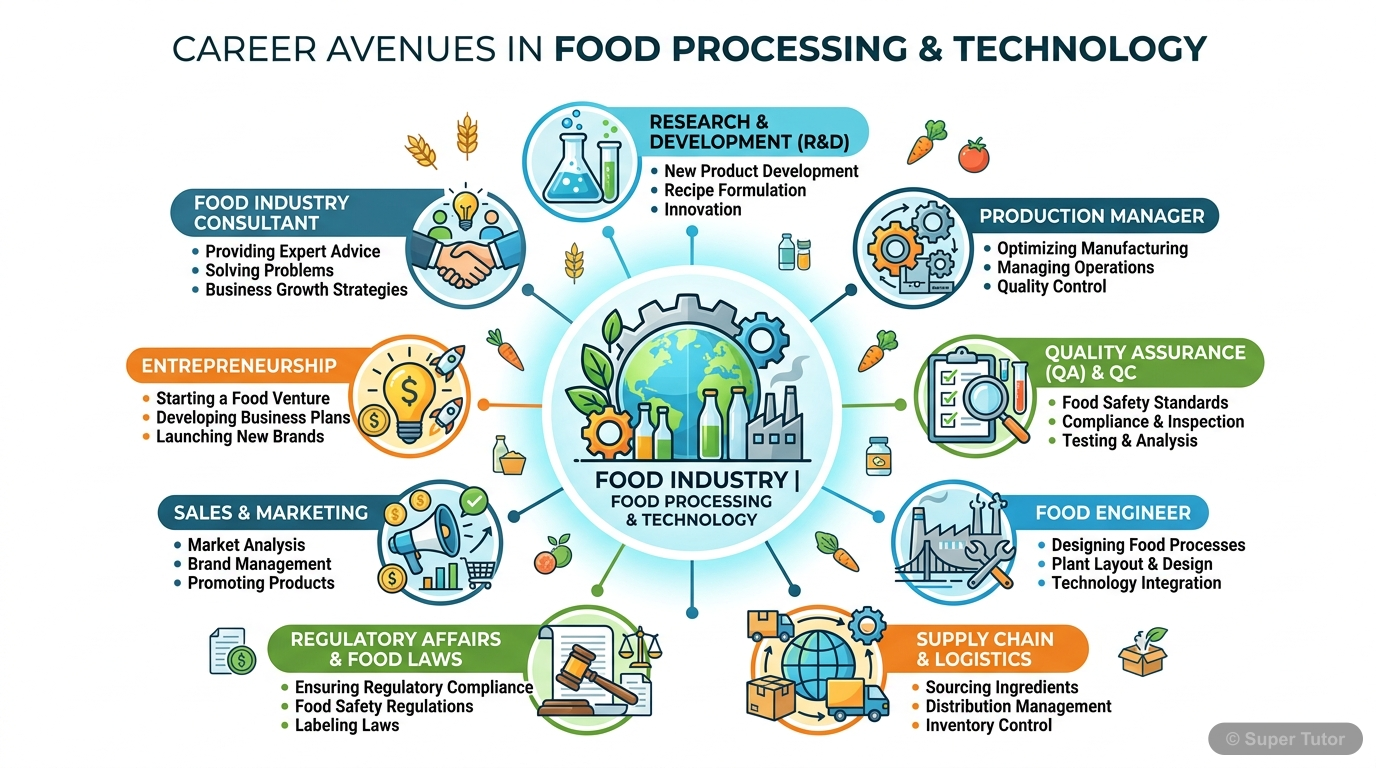
An infographic listing various career opportunities available in the food processing and technology industry, such as production managers, R&D, quality assurance, and entrepreneurship.
Super Tutor

Learn better with visuals Super Tutor has hundreds of illustrations like this across every chapter — all free to try.

Get started
12 Questions Solved · 3 Sections

Review Questions

1Explain why food safety and quality are of global concern.Show solution
Given/Context: Food safety and quality affect every individual, community, and nation worldwide.

Answer:

Food safety and quality are of global concern due to the following reasons:

1. Universal Need: Food is a basic necessity for all human beings regardless of nationality, culture, or economic status. Any compromise in food quality directly affects human health universally.

2. International Trade: With globalisation, food is traded across borders. Unsafe or poor-quality food exported from one country can cause illness in another, making it a shared international responsibility.

3. Spread of Foodborne Illnesses: Pathogens, contaminants, and adulterants in food can cause widespread outbreaks of foodborne diseases that cross national boundaries (e.g., contaminated imported spices, dairy products).

4. Economic Impact: Foodborne illnesses lead to loss of productivity, increased healthcare costs, and damage to the food industry and tourism sector globally.

5. Vulnerable Populations: Children, elderly, pregnant women, and immunocompromised individuals worldwide are especially susceptible to food hazards. Protecting them is a global humanitarian concern.

6. Adulteration and Fraud: Food adulteration is practised in many countries. Without global standards, consumers everywhere remain at risk.

7. International Standards Bodies: Organisations like WHO, FAO, and Codex Alimentarius Commission work globally to set food safety standards, recognising that food safety cannot be managed by one nation alone.

Conclusion: Because food moves across borders and affects all people, ensuring its safety and quality requires coordinated global effort, making it a matter of global concern.
2Explain the terms: hazard, toxicity, contamination, food quality, adulteration.Show solution
Given/Context: These are key terms related to food safety and quality.

Definitions:

1. Hazard:
A hazard is any biological, chemical, or physical agent in food that has the potential to cause harm or adverse health effects to the consumer. Hazards can be:
- *Biological* – bacteria, viruses, parasites (e.g., Salmonella, E. coli)
- *Chemical* – pesticides, heavy metals, food additives in excess
- *Physical* – stones, glass pieces, metal fragments, hair

2. Toxicity:
Toxicity refers to the degree to which a substance (chemical, biological agent, or physical contaminant) can cause harm or damage to a living organism. It depends on the dose, duration of exposure, and the nature of the substance. For example, aflatoxins produced by moulds are highly toxic even in small amounts.

3. Contamination:
Contamination is the unintended introduction of harmful substances or microorganisms into food at any stage of production, processing, storage, or preparation. It can be:
- *Biological contamination* – microorganisms such as bacteria, fungi
- *Chemical contamination* – pesticides, cleaning agents, heavy metals
- *Physical contamination* – foreign objects like stones, hair, insect parts

4. Food Quality:
Food quality refers to the characteristics of food that are acceptable to consumers and meet established standards. It includes:
- Sensory attributes: appearance, colour, flavour, texture, aroma
- Nutritional value
- Safety (absence of harmful substances)
- Compliance with legal and regulatory standards
High food quality means the food is safe, nutritious, and meets consumer expectations.

5. Adulteration:
Adulteration is the deliberate addition of inferior, harmful, or foreign substances to food, or the removal of a valuable component from food, with the intent to deceive the consumer or reduce cost. Examples include:
- Adding water to milk
- Mixing chalk powder with flour
- Adding metanil yellow (a toxic dye) to turmeric powder
- Mixing sand or stones with pulses

Conclusion: Understanding these terms is essential for identifying, preventing, and controlling food safety risks.
3What is Codex Alimentarius?Show solution
Given/Context: Codex Alimentarius is an international food standards body.

Answer:

Codex Alimentarius (Latin for 'Food Code') is a collection of internationally recognised standards, codes of practice, guidelines, and other recommendations relating to food, food production, and food safety.

Key Points:

1. Established by: It was established in 1963 by the Food and Agriculture Organization (FAO) and the World Health Organization (WHO) of the United Nations.

2. Purpose:
- To protect the health of consumers.
- To ensure fair practices in the international food trade.
- To coordinate all international food standards work.

3. Scope: It covers standards for a wide range of foods including processed, semi-processed, and raw foods. It also includes standards for food additives, contaminants, pesticide residues, veterinary drug residues, labelling, and hygiene.

4. Significance:
- Codex standards serve as a reference point for international food trade disputes under the World Trade Organization (WTO).
- Countries use Codex standards as a basis for developing their own national food laws and regulations.
- It promotes consumer confidence in the food supply.

5. Membership: The Codex Alimentarius Commission has over 180 member countries, including India.

Conclusion: Codex Alimentarius plays a vital role in harmonising food standards globally, thereby protecting consumer health and facilitating safe international food trade.
4Discuss the significance of HACCP.Show solution
Given/Context: HACCP is a food safety management system.

Full Form: HACCP stands for Hazard Analysis and Critical Control Points.

Definition: HACCP is a systematic, science-based approach used to identify, evaluate, and control food safety hazards in the food production process, from raw material procurement to final consumption.

Significance of HACCP:

1. Preventive Approach: Unlike traditional end-product testing, HACCP is a *preventive* system. It identifies potential hazards before they occur and puts controls in place to prevent them, rather than detecting problems after the fact.

2. Identification of Critical Control Points (CCPs): HACCP identifies specific points in the food production process where hazards can be controlled or eliminated (e.g., cooking temperature, refrigeration, pH levels). This ensures targeted and effective control.

3. Covers All Types of Hazards: HACCP addresses biological (microbial), chemical (pesticides, additives), and physical (foreign objects) hazards comprehensively.

4. Ensures Consumer Safety: By systematically controlling hazards at every stage of food production, HACCP significantly reduces the risk of foodborne illnesses, thereby protecting consumer health.

5. Internationally Recognised: HACCP is recognised and recommended by international bodies such as WHO, FAO, and Codex Alimentarius Commission. It is a requirement for food export in many countries.

6. Legal and Regulatory Compliance: Many national food safety laws (including India's Food Safety and Standards Act) are based on HACCP principles, making its adoption essential for food businesses.

7. Economic Benefits: By preventing food safety failures, HACCP reduces product recalls, legal liabilities, and loss of consumer confidence, thereby benefiting the food industry economically.

8. Documentation and Accountability: HACCP requires systematic record-keeping, which ensures accountability and traceability throughout the food supply chain.

Seven Principles of HACCP:
1. Conduct Hazard Analysis\text{1. Conduct Hazard Analysis}
2. Identify Critical Control Points (CCPs)\text{2. Identify Critical Control Points (CCPs)}
3. Establish Critical Limits\text{3. Establish Critical Limits}
4. Establish Monitoring Procedures\text{4. Establish Monitoring Procedures}
5. Establish Corrective Actions\text{5. Establish Corrective Actions}
6. Establish Verification Procedures\text{6. Establish Verification Procedures}
7. Establish Record-Keeping and Documentation\text{7. Establish Record-Keeping and Documentation}

Conclusion: HACCP is significant because it provides a proactive, systematic, and internationally accepted framework for ensuring food safety at every stage of the food chain, ultimately protecting consumers and supporting the food industry.
5List the national and international food standards.Show solution
Given/Context: Food standards are established at both national and international levels to ensure food safety and quality.

Answer:

## International Food Standards

1. Codex Alimentarius Commission (CAC):
- Established by FAO and WHO in 1963.
- Sets international standards for food safety, quality, labelling, additives, contaminants, and hygiene.
- Standards are used as reference in international food trade under WTO agreements.

2. World Health Organization (WHO):
- Provides guidelines on food safety, foodborne diseases, and safe use of food additives and pesticides.

3. Food and Agriculture Organization (FAO):
- Works with WHO on Codex standards; provides guidelines on food production, nutrition, and safety.

4. International Organization for Standardization (ISO):
- ISO 22000 is an international standard for food safety management systems applicable to all organisations in the food chain.

5. World Trade Organization (WTO) – SPS Agreement:
- The Sanitary and Phytosanitary (SPS) Agreement sets rules for food safety and animal/plant health standards in international trade.

---

## National Food Standards (India)

1. Food Safety and Standards Act (FSSA), 2006:
- The primary legislation governing food safety in India.
- Established the Food Safety and Standards Authority of India (FSSAI) under the Ministry of Health and Family Welfare.
- Consolidates various earlier food laws (Prevention of Food Adulteration Act, Fruit Products Order, Meat Food Products Order, etc.).
- Sets standards for food additives, contaminants, pesticide residues, labelling, and packaging.

2. Food Safety and Standards Authority of India (FSSAI):
- Regulatory body that frames science-based standards for food articles.
- Regulates manufacture, storage, distribution, sale, and import of food.

3. Bureau of Indian Standards (BIS) – ISI Mark:
- Sets quality standards for food products; the ISI mark certifies that a product meets Indian standards.

4. Agmark:
- A certification mark for agricultural products in India under the Agricultural Produce (Grading and Marking) Act, 1937.
- Ensures quality and purity of products like ghee, honey, spices, and edible oils.

5. Prevention of Food Adulteration Act (PFA), 1954:
- Earlier legislation (now subsumed under FSSA 2006) that prohibited adulteration of food and set standards for food quality.

6. Export Inspection Council (EIC):
- Ensures that food products exported from India meet the quality and safety standards of importing countries.

Conclusion: Both national and international food standards work together to ensure that food is safe, of good quality, and fairly traded, thereby protecting consumers and supporting the food industry worldwide.

Practical 1 — Theme: Test of Food Adulteration

Task 1-5 (Worksheet)Visit local shops and collect various food materials – raw and cooked. Examine the foods for presence of adulterants. Record observations using the worksheet provided. Compare and comment on the quality of various food items.Show solution
Purpose: To expose students to simple ways of identifying adulteration in foods and understand the importance of quality and safety.

Procedure:

Step 1 – Collection of Samples:
- *Group A* collects raw foods: rice, wheat, pulses, spices (mustard seeds, coriander seeds, jeera), tea leaves — 100 g each from two different shops (preferably loose/unpacked).
- *Group B* collects snacks: pakodas, idlis, samosas, or locally available snacks from 2–3 different roadside vendors.
- *Group C* collects assorted mithais/Indian sweets from two different vendors.

Step 2 – Examination:
Each group examines their food samples visually and physically for the presence of the following physical hazards/adulterants:

| Physical Hazard | Present in Large Amounts | Present in Moderate Amounts | Present in Small Amounts | Absent |
|---|---|---|---|---|
| Hair | | | | |
| Stones | | | | |
| Stems & seeds | | | | |
| Matchsticks | | | | |
| Stapler pins | | | | |
| Bidis/Cigarettes | | | | |
| Camphor balls | | | | |
| Worms/Insect parts | | | | |
| Mercury balls | | | | |
| Infested grains | | | | |
| Any other | | | | |

*(Use separate worksheets for each vendor and each food item.)*

Step 3 – Observations (Sample):
- Loose unpacked foods from roadside vendors are more likely to show physical contaminants such as stones, hair, insect parts, and infested grains compared to branded packed foods.
- Mithais from unorganised vendors may show presence of hair, dust, or insect parts.
- Snacks from roadside vendors may show presence of stems, seeds, or other foreign matter.

Step 4 – Interpretation and Comparison:
- Foods from branded/packed sources generally show fewer physical hazards.
- Loose, unpacked foods from roadside vendors tend to have more physical contaminants.
- The presence of any of the above hazards indicates poor food quality and unsafe food handling practices.

Conclusion:
This practical demonstrates that physical adulteration and contamination are common in loosely sold, unpackaged foods. Consumers should prefer certified, properly packaged food products and be aware of food safety standards to protect their health.

Practical 2 — Theme: Qualitative Tests for Food Adulteration

Test 1Test for Detection of Sesame Oil in Pure Ghee to determine whether the ghee is adulterated with hydrogenated fat/vanaspati which contains sesame oil. Chemicals: 1 per cent sucrose solution, Concentrated hydrochloric acid.Show solution
Aim: To detect the presence of sesame oil in pure ghee (indicating adulteration with vanaspati/hydrogenated fat).

Principle: Sesame oil contains a compound called sesamol (a lignan). When sesame oil is treated with sucrose solution and concentrated hydrochloric acid, sesamol reacts to produce a characteristic pink colour. This reaction is known as the Baudouin Test.

Materials Required:
- 5 test tubes (A, B, C, D, E)
- Sesame oil, groundnut oil, melted vanaspati, melted branded ghee, melted loose ghee (approx. 2 ml each)
- 1% sucrose solution
- Concentrated hydrochloric acid

Procedure:
1. Label five test tubes A, B, C, D, and E.
2. Pour approximately 2 ml of the respective oil/fat into each test tube:
- Test tube A: Sesame oil (positive control)
- Test tube B: Groundnut oil (negative control)
- Test tube C: Melted vanaspati
- Test tube D: Melted branded ghee
- Test tube E: Melted loose ghee
3. Add 1 ml of 1% sucrose solution to each test tube.
4. Add 1 ml of concentrated hydrochloric acid to each test tube.
5. Shake each test tube well.
6. Observe for the development of pink colour.

Observation:
| Test Tube | Sample | Pink Colour Developed? |
|---|---|---|
| A | Sesame oil | Yes (positive control) |
| B | Groundnut oil | No |
| C | Vanaspati | Yes (contains sesame oil) |
| D | Branded ghee | To be observed |
| E | Loose ghee | To be observed |

Interpretation:
- Development of pink colour indicates the presence of sesame oil.
- If pink colour develops in test tubes D or E, the ghee sample is adulterated with vanaspati.
- If no pink colour develops, the ghee sample is pure.
- Vanaspati (hydrogenated fat) is required by law to contain sesame oil as a marker to detect adulteration of ghee.

Conclusion: This test helps identify whether pure ghee has been adulterated with vanaspati/hydrogenated fat.
Test 2Test for presence of excessive amount of stalks in tea leaves.Show solution
Aim: To determine the percentage of stalks in tea leaves and assess whether it exceeds the permissible limit.

Principle: Tea leaves of good quality contain a limited proportion of stalks. Excessive stalks indicate poor quality or adulteration. The stalks are separated, dried, and weighed to calculate their percentage.

Materials Required:
- Tea leaf samples (branded, unbranded packed, loose) — 5 g each
- Conical flask or beaker
- Water (500 ml)
- Filter paper and funnel
- Flat white plate
- Forceps
- Pre-weighed petri dish or crucible
- Oven (set at 100°C)
- Weighing balance

Procedure:
1. Weigh exactly 5 g of tea leaves into a labelled conical flask or beaker.
2. Add 500 ml of water and boil for 15 minutes.
3. Filter out the water through filter paper.
4. Transfer the tea residue to a flat white plate.
5. Using forceps, carefully pick out all the stalks and place them in a pre-weighed petri dish or crucible.
6. Dry the stalks in an oven at 100°C until all moisture has evaporated (constant weight).
7. Weigh the dried stalks.
8. Calculate the percentage of stalks using the formula:

Percentage of stalks=Weight of dried stalks (g)Weight of tea sample (g)×100\text{Percentage of stalks} = \frac{\text{Weight of dried stalks (g)}}{\text{Weight of tea sample (g)}} \times 100

Percentage of stalks=Weight of dried stalks5×100\text{Percentage of stalks} = \frac{\text{Weight of dried stalks}}{5} \times 100

Observation:
Record the weight of stalks obtained from each sample and calculate the percentage.

Interpretation:
- The proportion of stalks in tea should be less than 25 per cent.
- If the percentage of stalks exceeds 25%, the tea is of poor quality.
- Loose tea samples are likely to have a higher percentage of stalks compared to branded packed tea.

Conclusion: This test helps assess the quality of tea leaves by determining the proportion of stalks, which should not exceed 25% as per food quality standards.
Test 3Test for detecting Light berries in Black Pepper. Chemicals: Alcohol water mixture (sp.gr 0.8 to 0.82).Show solution
Aim: To detect the presence of light berries (exhausted/extracted berries) in black pepper.

Principle: Genuine black pepper berries are dense and sink in an alcohol-water mixture of specific gravity 0.8–0.82. Light berries (from which the essential oils/piperine have been extracted) are less dense and float on the surface. A higher proportion of floating berries indicates adulteration.

Materials Required:
- Black pepper sample — 10 g
- 250 ml beaker
- Alcohol-water mixture (specific gravity 0.8 to 0.82) — 150–200 ml
- Filter paper
- Oven
- Weighing balance

Procedure:
1. Take approximately 10 g of the black pepper sample in a 250 ml beaker.
2. Add approximately 150–200 ml of the alcohol-water mixture (sp. gr. 0.8 to 0.82).
3. Observe and pick out the berries that rise to the top and float.
4. Dry the floating (light) berries and weigh them.
5. Calculate the percentage of light berries:

Percentage of light berries=Weight of light (floating) berries (g)Total weight of pepper sample (g)×100\text{Percentage of light berries} = \frac{\text{Weight of light (floating) berries (g)}}{\text{Total weight of pepper sample (g)}} \times 100

Percentage of light berries=Weight of light berries10×100\text{Percentage of light berries} = \frac{\text{Weight of light berries}}{10} \times 100

Observation:
Record the weight of floating berries and calculate the percentage for each sample (branded, unbranded, loose).

Interpretation:
- A higher percentage of light berries suggests that the essential oils or piperine have been extracted from the black pepper berries, making them hollow and light.
- Such pepper is of inferior quality and is considered adulterated.
- Good quality black pepper should have a very low percentage of light berries.

Conclusion: This test helps identify adulteration in black pepper by detecting the presence of exhausted/light berries that have been stripped of their active components.
Test 4Test for the presence of metanil yellow in turmeric. Chemicals: Hydrochloric acid concentrated.Show solution
Aim: To detect the presence of metanil yellow (an artificial, toxic dye) in turmeric powder.

Principle: Metanil yellow is an azo dye sometimes illegally added to turmeric powder to enhance its yellow colour. When treated with concentrated hydrochloric acid, metanil yellow produces a characteristic pink to magenta colour, which confirms its presence.

Materials Required:
- Turmeric powder samples (branded, unbranded packed, loose) — 2 g each
- Test tubes
- Distilled water — 5 ml
- Concentrated hydrochloric acid — 5–10 ml
- Dropper

Procedure:
1. Take approximately 2 g of the turmeric sample in a test tube.
2. Add 5 ml of distilled water to the test tube.
3. Mix well.
4. Slowly add 5–10 ml of concentrated hydrochloric acid into the test tube.
5. Observe the test tube for colour change.

Observation:
| Sample | Colour Developed |
|---|---|
| Branded turmeric | No pink/magenta colour (pure) |
| Unbranded packed | To be observed |
| Loose turmeric | To be observed |

Interpretation:
- Development of pink to magenta colour confirms the presence of metanil yellow.
- Metanil yellow is a toxic adulterant and is not permitted in food.
- Its presence indicates that the turmeric sample is adulterated and unsafe for consumption.
- If no colour change occurs (or only a slight yellow colour from natural curcumin), the sample is likely pure.

Conclusion: This simple chemical test effectively detects the presence of metanil yellow in turmeric, helping consumers identify adulterated and potentially harmful turmeric powder.
Test 5Test for the presence of starch in milk and ice cream. Chemicals: Iodine solution.Show solution
Aim: To detect the presence of starch in milk and ice cream.

Principle: Starch is sometimes added to milk or ice cream as an adulterant to increase thickness and viscosity. Iodine reacts with starch to form a characteristic blue-black colour (iodine-starch complex), confirming the presence of starch.

Materials Required:
- Milk samples (branded packaged, loose) — 10 ml each
- Ice cream samples (branded, unbranded/local vendor) — melted, 10 ml each
- Test tubes
- Iodine solution
- Dropper

Procedure:
1. In a test tube, add approximately 10 ml of milk (or melted ice cream).
2. Add iodine solution drop by drop using a dropper.
3. Mix the contents of the test tube gently.
4. Observe for colour change.

Observation:
| Sample | Colour Developed |
|---|---|
| Branded milk | No blue colour (pure) |
| Loose milk | To be observed |
| Branded ice cream | No blue colour (pure) |
| Local vendor ice cream | To be observed |

Interpretation:
- Development of blue colour indicates the presence of starch in the sample.
- Starch is an adulterant added to increase the thickness of milk or ice cream.
- If no blue colour develops, the sample does not contain added starch and is likely pure.

Conclusion: The iodine test is a quick and reliable method to detect starch adulteration in milk and ice cream. Loose/unbranded products are more likely to be adulterated with starch compared to branded products.
Test 6Test for the presence of colophenial resins in asafetida (hing). Chemicals: 0.5 per cent copper acetate solution in water, Petroleum ether.Show solution
Aim: To detect the presence of colophony (colophenial) resins in asafetida (hing).

Principle: Colophony (also called rosin) is a resin derived from pine trees that is sometimes added to asafetida as an adulterant. When the petroleum ether extract of asafetida is treated with copper acetate solution, the presence of colophony resins is indicated by the development of a blue or green colour in the ether layer.

Materials Required:
- Asafetida (hing) samples (branded, unbranded loose) — 1–2 g each
- Test tubes
- Petroleum ether — 10 ml
- 0.5% copper acetate solution in water — 5 ml
- Filter paper and funnel

Procedure:
1. Take approximately 1–2 g of the asafetida sample in a test tube.
2. Add approximately 10 ml of petroleum ether to the test tube.
3. Shake the test tube well to dissolve the resin.
4. Filter the contents of the tube through filter paper.
5. Take 5 ml of the filtrate in a clean test tube.
6. Add 5 ml of 0.5% copper acetate solution to the filtrate.
7. Shake well and allow the layers to separate.
8. Observe the colour of the ether (upper) layer.

Observation:
| Sample | Colour in Ether Layer |
|---|---|
| Branded asafetida | No blue/green colour (pure) |
| Unbranded loose asafetida | To be observed |

Interpretation:
- Development of blue or green colour in the ether layer denotes the presence of colophony (colophenial) resins.
- Colophony resins are not permitted as food additives and their presence indicates adulteration.
- If no colour change occurs in the ether layer, the sample is likely free from colophony resins.

Conclusion: This test effectively identifies the presence of colophony resin adulteration in asafetida. Loose, unbranded asafetida is more likely to be adulterated. Consumers should prefer certified, branded products to ensure safety and quality.

Stuck on a step?

Ask Super Tutor AI to explain any solution on this page in a simpler way — free, 24x7.

Ask a Doubt Free

Frequently Asked Questions

What are the important topics in Food Quality and Food Safety for CBSE Class 12 Home Science?
Key topics in Food Quality and Food Safety include Food Safety and Quality Concept Overview, Food Quality and Safety Overview, Food Safety and Quality Concept Overview. These are the concepts CBSE Class 12 examiners draw on most — study them first, then practise related questions.
How to score full marks in Food Quality and Food Safety — CBSE Class 12 Home Science?
Start by understanding all key concepts. Practise previous year questions from this chapter. Revise formulas and definitions regularly. Use flashcards for quick revision before the exam.
Where can I get free NCERT Solutions for Food Quality and Food Safety Class 12 Home Science?
This page has free step-by-step NCERT Solutions for every exercise question in Food Quality and Food Safety (CBSE Class 12 Home Science) — written the way examiners award marks: given, formula, working, answer.

Sources & Official References

Content is aligned to the official syllabus. Refer to the board website for the latest curriculum.

For serious students

Get the full Food Quality and Food Safety chapter — for free.

Quizzes, flashcards, AI doubt-solver and a step-by-step study plan for CBSE Class 12 Home Science.