Chapter 11 of 14
NCERT Solutions

Early Childhood Care and Education

CBSE · Class 12 · Home Science

NCERT Solutions for Early Childhood Care and Education — CBSE Class 12 Home Science.

5 concepts

Interactive on Super Tutor

Studying Early Childhood Care and Education? Get the full interactive chapter.

Quizzes, flashcards, AI doubt-solver and a step-by-step study plan — built for ncert solutions and more.

1,000+ Class 12 students started this chapter today

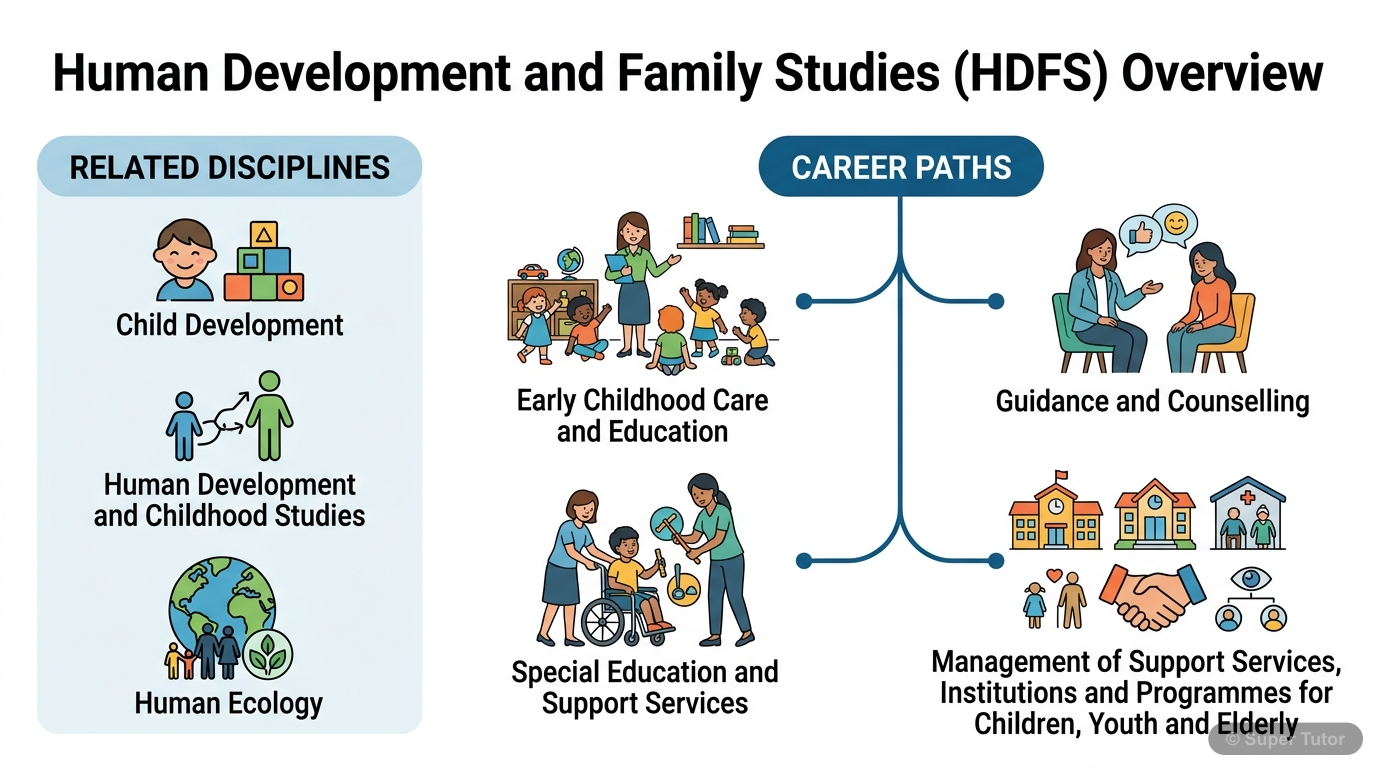
An infographic illustrating the scope of Human Development and Family Studies (HDFS), showing its various sub-disciplines like Child Development, Human Development and Childhood Studies, Human Ecology
Super Tutor

This is just one of 11+ visuals inside Super Tutor's Early Childhood Care and Education chapter

Explore the full set
11 Questions Solved · 5 Sections

Activity 3

Activity 3Name the different types of child care services available in your neighbourhood.Show solution
Given/Task: Observe and identify child care services in the local neighbourhood.

Concept: Child care services are organised arrangements that provide care, protection, and early education to young children, especially when parents are at work or otherwise unavailable.

Answer (sample response — students should fill in services actually present in their area):

The different types of child care services that may be available in a neighbourhood include:

1. Crèche / Day Care Centre — Provides full-day care for infants and toddlers (0–3 years) whose parents are working. Services include feeding, sleeping arrangements, basic health care, and play.

2. Anganwadi Centre (under ICDS) — A government-run centre providing supplementary nutrition, non-formal pre-school education, health check-ups, immunisation, and referral services to children below 6 years.

3. Preschool / Nursery School / Kindergarten — Offers structured early childhood education (play-based learning) to children aged 3–6 years to prepare them for formal schooling.

4. Balwadi — A community-based centre, often run by NGOs, providing basic care and early education to young children in low-income areas.

5. Mobile Crèche — Provides care for children of migrant construction workers at worksites.

6. Private Day Care / Play School — Commercially run centres offering care and early learning activities.

7. Home-based Care — Informal care provided by a relative, neighbour, or paid caregiver at home.

Conclusion: Students should visit or enquire about the services actually operating in their neighbourhood and record the name, location, age group served, and services offered for each centre.

Review Questions

1What do you understand by the term early childhood care and education?Show solution
Given: The term to be explained is 'Early Childhood Care and Education (ECCE)'.

Concept: ECCE refers to the holistic development and care of children from birth to 8 years of age.

Answer:

Early Childhood Care and Education (ECCE) refers to all programmes, services, and activities that are designed to support the overall development — physical, cognitive, social, emotional, and language — of children from birth up to 8 years of age.

Key features of ECCE:
- It covers the period from birth to 8 years, which is considered the most critical phase of human development.
- It includes both care (nutrition, health, protection, hygiene) and education (stimulation, learning, play-based activities).
- It recognises that early experiences have a lasting impact on a child's brain development and future learning.
- It involves not only formal preschool programmes but also home-based care, crèches, anganwadis, and day care centres.
- It emphasises a child-centred approach where activities are planned according to the child's needs, interests, and developmental stage.

Conclusion: ECCE is a comprehensive approach that ensures every young child receives the care, stimulation, and learning opportunities needed for healthy and holistic development.
2What are the different care arrangements young children may require?Show solution
Given: We need to identify various care arrangements suitable for young children.

Concept: Young children require care arrangements that ensure their safety, health, nutrition, and developmental stimulation, especially when parents are working or unavailable.

Answer:

The different care arrangements that young children may require are:

1. Home-based care by parents: The most common arrangement where one or both parents (usually the mother) stay at home and provide full-time care.

2. Care by a family member: A grandparent, older sibling, aunt, or uncle takes care of the child at home. This is an informal but widely used arrangement.

3. Care by a paid caregiver / babysitter / ayah: A trained or untrained person is hired to look after the child at home while parents are at work.

4. Crèche / Day Care Centre: The child is left at a centre during working hours. The centre provides feeding, sleeping, play, and basic health care.

5. Anganwadi Centre: A government-run centre under the Integrated Child Development Services (ICDS) scheme that provides care, nutrition, and pre-school education.

6. Preschool / Nursery / Kindergarten: A part-day programme that provides early education and socialisation for children aged 3–6 years.

7. Balwadi / Community Centre: Run by NGOs or community organisations, providing basic care and early learning.

Conclusion: The choice of care arrangement depends on the family's economic status, availability of family members, and the child's age and needs.
3What are some of the reasons why young children need a special informal programme before formal schooling?Show solution
Given: We need to explain why an informal programme (preschool/ECCE) is necessary before formal schooling begins.

Concept: The early years (0–6) are the most sensitive period for brain development; hence, a specially designed informal programme helps prepare children for formal school.

Answer:

Young children need a special informal programme before formal schooling for the following reasons:

1. Critical period of brain development: The first six years of life are the most important for brain development. Appropriate stimulation during this period lays the foundation for all future learning.

2. School readiness: An informal programme helps children develop the basic skills — listening, following instructions, holding a pencil, sitting in a group — that are needed to cope with formal schooling.

3. Social development: Children learn to interact with peers and adults outside the family, developing sharing, cooperation, and communication skills.

4. Emotional development: Children learn to manage separation from parents, control emotions, and build self-confidence in a safe and supportive environment.

5. Language development: Through stories, songs, rhymes, and conversations, children's vocabulary and communication skills are enriched.

6. Cognitive development: Play-based activities develop curiosity, problem-solving, creativity, and concept formation (colour, shape, size, number).

7. Physical development: Activities involving running, drawing, cutting, and building develop both gross and fine motor skills.

8. Bridging home and school: An informal programme eases the transition from the home environment to the more structured school environment, reducing anxiety.

Conclusion: A well-designed informal programme before formal schooling ensures that children are physically, emotionally, socially, and cognitively ready to benefit from formal education.
4What is meant by a child-centred approach?Show solution
Given: The concept to be explained is 'child-centred approach' in ECCE.

Concept: A child-centred approach places the child's needs, interests, abilities, and developmental stage at the centre of all planning and activities.

Answer:

A child-centred approach is a philosophy and method of education and care in which:

1. The child is the focus: All activities, materials, and interactions are planned keeping in mind the individual child's age, developmental level, interests, and needs — rather than following a rigid adult-imposed curriculum.

2. Learning through play: Children learn best through play and hands-on exploration. Activities are designed to be enjoyable and meaningful to the child.

3. Respect for individuality: Each child is recognised as unique. Differences in pace of learning, abilities, and background are respected and accommodated.

4. Active participation: Children are encouraged to explore, question, experiment, and discover rather than passively receiving information.

5. Role of the caregiver/teacher: The adult acts as a facilitator or guide rather than a director. The teacher observes the child, provides appropriate materials, and supports learning without imposing.

6. Holistic development: The approach addresses all areas of development — physical, cognitive, language, social, and emotional — simultaneously.

7. Safe and stimulating environment: The physical and emotional environment is arranged to encourage the child's natural curiosity and sense of security.

Conclusion: A child-centred approach ensures that education and care are responsive to the child's natural development, making learning a joyful and effective experience.
5What is a crèche, and what services does this centre provide?Show solution
Given: We need to define a crèche and describe the services it offers.

Concept: A crèche is a type of child care centre specifically designed for infants and very young children.

Answer:

Definition of a Crèche:
A crèche is a day care facility for infants and young children (typically from birth to 3 years, sometimes up to 6 years) where they are cared for during the day, usually while their parents are at work. The word 'crèche' comes from the French word meaning 'crib' or 'manger'.

Services provided by a Crèche:

1. Safe shelter and supervision: A safe, clean, and secure physical environment where children are looked after by trained caregivers throughout the day.

2. Nutrition and feeding: Provision of age-appropriate meals, snacks, and feeding support (including bottle feeding or weaning foods for infants).

3. Health care: Basic health monitoring, first aid, immunisation records, and referral to health services when needed.

4. Hygiene and sanitation: Bathing, diaper changing, toilet training, and maintaining personal hygiene of children.

5. Rest and sleep: Adequate rest periods and sleeping arrangements for infants and toddlers.

6. Play and stimulation: Age-appropriate play activities, toys, and interactions that promote cognitive, language, social, and physical development.

7. Emotional support: Providing warmth, affection, and a sense of security to children separated from their parents during the day.

8. Early learning activities: Simple pre-school activities such as stories, songs, and sensory play to stimulate early learning.

Conclusion: A crèche plays a vital role in supporting working parents by ensuring their young children receive quality care, nutrition, health support, and early stimulation in a safe environment.
6List the skills an ECCE worker must have.Show solution
Given: We need to identify and list the skills required by an Early Childhood Care and Education (ECCE) worker.

Concept: An ECCE worker (also called a caregiver, preschool teacher, or child care worker) needs a combination of personal qualities, knowledge, and practical skills to effectively care for and educate young children.

Answer:

An ECCE worker must possess the following skills:

A. Personal Qualities / Attitudes:
1. Love and warmth for children — genuine affection and patience towards young children.
2. Sensitivity and empathy — ability to understand and respond to children's emotional needs.
3. Patience and calmness — ability to remain composed even in challenging situations.
4. Flexibility — willingness to adapt plans and activities to children's responses.
5. Enthusiasm and creativity — ability to make activities interesting and engaging.

B. Knowledge-based Skills:
6. Knowledge of child development — understanding of physical, cognitive, language, social, and emotional milestones at different ages.
7. Knowledge of health, nutrition, and hygiene — ability to ensure children's basic health needs are met.
8. Knowledge of play and learning — understanding of how children learn through play and exploration.

C. Practical / Professional Skills:
9. Planning and organising activities — ability to plan age-appropriate, stimulating, and safe activities.
10. Communication skills — ability to communicate effectively with children, parents, and colleagues.
11. Observation skills — ability to observe and record children's development and identify any concerns.
12. First aid and safety skills — ability to handle minor injuries and emergencies.
13. Ability to make low-cost teaching aids — using locally available materials to create learning resources.
14. Storytelling and use of puppets/songs — skills to engage children through creative methods.

Conclusion: An effective ECCE worker combines a caring personality with professional knowledge and practical skills to create a nurturing and stimulating environment for young children.
7Describe how we can prepare for a career in ECCE.Show solution
Given: We need to describe the steps and pathways to prepare for a career in Early Childhood Care and Education (ECCE).

Concept: A career in ECCE requires both formal education/training and practical experience, along with the development of appropriate personal qualities.

Answer:

We can prepare for a career in ECCE in the following ways:

1. Develop the right personal qualities:
- Cultivate love, patience, warmth, and sensitivity towards young children.
- Develop creativity, enthusiasm, and good communication skills.
- Build an understanding of and respect for children's individual differences.

2. Pursue relevant education and training:
- At the school level: Study Home Science, Psychology, or Child Development as subjects in Classes 11 and 12 to build a foundation.
- Certificate courses: Enrol in short-term certificate programmes in Early Childhood Care and Education offered by institutions such as NIPCCD (National Institute of Public Cooperation and Child Development), state government bodies, or NGOs.
- Diploma courses: Pursue a Diploma in Early Childhood Education (ECE) or Nursery Teacher Training (NTT) offered by various universities and training institutes.
- Degree courses: Pursue a B.Ed. (Early Childhood Education), B.Sc. in Child Development, or B.A./B.Sc. in Human Development and Family Studies from recognised universities.
- Postgraduate courses: M.Sc. or M.A. in Child Development / Human Development for advanced roles in research, policy, or programme management.

3. Gain practical experience:
- Volunteer or intern at anganwadis, crèches, preschools, or NGOs working with young children.
- Participate in school practicals and community visits (as described in this chapter) to gain hands-on experience in planning activities and making teaching aids.
- Observe experienced ECCE workers and learn from their methods.

4. Stay updated:
- Read books, journals, and government guidelines related to child development and ECCE policies (e.g., National Education Policy 2020 emphasises ECCE).
- Attend workshops, seminars, and training programmes.

5. Career opportunities in ECCE:
- Preschool/nursery teacher
- Anganwadi worker or supervisor
- Crèche worker or manager
- Child development specialist
- ECCE programme coordinator in NGOs or government
- Researcher or trainer in child development

Conclusion: A career in ECCE is both rewarding and socially significant. With the right education, training, practical experience, and personal commitment, one can make a meaningful contribution to the lives of young children and their families.

Practical 1 — Activities for Preschool Children

Practical 1Theme: Activities for preschool children. Tasks: (1) Visit to playground or outside open area. (2) Collection of play material. Purpose: To prepare students for planning and preparing materials for activities with young children, with emphasis on locally available low-cost or no-cost material. Conduct the practical as described and prepare one activity for children using any one or more of the following concepts: Colour, Texture, Number, Shape, Type of material, Size.Show solution
Given/Purpose: To plan and prepare a low-cost activity for young children (3–6 years) using materials collected from the natural environment.

Materials collected (examples): Leaves of different sizes and shapes, pebbles, stones, flowers, sticks, seeds.

Concept chosen (example): Shape and Size

---

Step-by-Step Conduct of the Practical:

Step 1 — Group formation and walk:
Divide the class into groups of 5. Take a walk around the school playground or an open area outside. Observe the surroundings carefully.

Step 2 — Collection of material:
Collect materials that are clean, safe, and appropriate for young children — for example, leaves of different shapes and sizes, small pebbles, flowers, and sticks.

Step 3 — Cleaning the material:
Wash the collected leaves and pebbles with water and allow them to dry so they are safe for children to handle.

Step 4 — Planning the activity:

*Activity Title:* 'Sorting Leaves by Shape and Size'

*Concept addressed:* Shape and Size

*Age group:* 4–6 years

*Materials needed:* Leaves of different shapes (round, oval, long, pointed) and sizes (big, medium, small), two sheets of newspaper or chart paper, glue/paste.

*Procedure:*
1. Spread all the collected leaves on a table or mat.
2. Ask the children: *'Can you find two leaves that look the same shape?'* and *'Which leaf is the biggest? Which is the smallest?'*
3. Guide children to sort the leaves into groups — first by size (big/small) and then by shape (round/long/pointed).
4. Paste the sorted leaves on two sheets of newspaper — one sheet for 'big leaves' and one for 'small leaves', or one for each shape group.
5. Discuss with children: What are the names of the plants/trees these leaves came from? What colour are the leaves? Do they feel smooth or rough (texture)?

*Learning outcomes:*
- Children develop concepts of shape, size, and colour.
- Fine motor skills are practised through picking, sorting, and pasting.
- Language skills are developed through discussion.
- Children connect with their natural environment.

Step 5 — Reflection:
After the activity, each group discusses: What did the children enjoy most? What concepts were reinforced? How could the activity be extended?

Conclusion: Using locally available, no-cost natural materials, meaningful and developmentally appropriate activities can be planned for young children that promote cognitive, language, and motor development in an enjoyable way.

Practical 2 — Making a Puzzle for Young Children

Practical 2Theme: Preparation and use of teaching aids using indigenous and locally available material. Task: Make a puzzle for young children with indigenous material. Purpose: To provide learning experiences of developing and preparing play material (a puzzle) so that young children's development is facilitated.Show solution
Given/Purpose: To make a simple, low-cost puzzle using locally available materials that can be used to facilitate young children's cognitive and fine motor development.

Materials required:
- Used cardboard boxes (gatta) or old notebook covers
- Pencil, sketch pens or paints (bright colours)
- Scissors
- Glue / fevicol
- Newspaper or magazine pictures (optional)

---

Step-by-Step Procedure:

Step 1: Collect used cardboard boxes or old notebook covers. Cut two equal-sized pieces of cardboard.

Step 2: On one piece of cardboard, draw a simple, bold picture of a familiar object — for example, a fish, an elephant, a mango, or a banana. Draw the same identical picture on the second piece of cardboard.

Step 3: Paint both pictures in bright, attractive colours so they are visually appealing to young children. Allow the paint to dry completely.

Step 4: Stick (glue) one picture firmly on the inside of the cardboard box or on one piece of cardboard. This will serve as the base/guide picture.

Step 5: Glue the second identical picture on the other piece of cardboard. Allow it to dry completely.

Step 6: Once dry, cut the second picture into four pieces (simple straight cuts for younger children; slightly irregular cuts for older children).

Step 7: The puzzle is now ready. The child places the four cut pieces on top of the base picture to complete the puzzle.

---

How to use the puzzle with children:
- Show the child the complete base picture and name the object.
- Mix up the four cut pieces and ask the child to arrange them correctly on the base.
- Encourage the child to try independently, offering help only when needed.
- Discuss the picture: *'What colour is the fish? How many fins does it have?'*

Learning outcomes for children:
- Develops problem-solving and cognitive skills (matching, spatial reasoning).
- Improves fine motor skills (picking up and placing pieces).
- Builds concentration and persistence.
- Introduces concepts of whole and parts.
- Enriches vocabulary through discussion.

Extension idea: Puzzles can also be made from pictures cut from newspapers or magazines. Cut pictures can also be used to make scrap books on themes such as 'My Family', 'My School', 'Fruits', 'Animals', or 'My Neighbourhood'.

Conclusion: Making a puzzle from recycled cardboard is an excellent example of a low-cost, indigenous teaching aid that promotes multiple areas of young children's development.

Practical 3 — Making Puppets and Masks

Practical 3Theme: Preparation of play materials. Task: Making puppets and masks. Purpose: Students learn to make play material for children. Usage of masks and puppets promotes language and socio-emotional development in young children (4–6 years). Conduct the practical and analyse what children can learn through such an activity.Show solution
Given/Purpose: To make puppets and masks using low-cost materials and use them to promote language and socio-emotional development in young children aged 4–6 years.

Materials required:
- Stiff paper / cardboard
- Newspaper
- Pieces of cloth, thread, wool
- Leaves and flowers (for natural colour/decoration)
- Sketch pens, paints, crayons
- Scissors, glue
- Sticks (for stick puppets)

---

Step-by-Step Procedure:

A. Making a Mask:

1. Take a piece of stiff paper or cardboard large enough to cover a child's face (approximately the size of a 10-year-old child's face).
2. Draw the outline of a mask in the shape of a sun, flower, animal (lion, rabbit, bird), or any character.
3. Draw and colour the facial features (eyes, nose, mouth, ears) using sketch pens or paints in bright colours. Leaves and flowers can be used to add natural decoration.
4. Cut out holes for the eyes so the child can see through the mask.
5. Attach a string or rubber band on both sides so the mask can be worn on the face.
6. The mask is ready.

B. Making a Puppet:

1. Take a piece of stiff paper or cardboard.
2. Draw a small face on it.
3. Attach pieces of cloth as arms, legs, and hair using glue or thread to create a simple flat puppet.
4. Alternatively, attach the puppet figure to a stick to make a stick puppet.
5. Wool can be used for hair; cloth scraps for clothes.
6. The puppet is ready.

---

Using Puppets and Masks with Children:

1. Once the puppets and masks are prepared, use them to tell a story — for example, a story about a lion and a rabbit, or a farmer and his animals.
2. Children can wear the masks and act out the characters in the story (role-play).
3. The teacher can use stick puppets to narrate the story while children watch and respond.
4. Children can be encouraged to make up their own dialogues for the puppet characters.

---

Analysis — What children can learn through this activity:

1. Language development: Children listen to stories, learn new words, and practise speaking through role-play and puppet dialogue.
2. Socio-emotional development: Role-play helps children understand different emotions, develop empathy, and learn social roles and relationships.
3. Creativity and imagination: Making and using puppets and masks stimulates creative thinking and imaginative play.
4. Fine motor skills: Cutting, pasting, colouring, and assembling the puppet/mask develops hand-eye coordination and fine motor control.
5. Cognitive development: Following a story sequence develops memory, attention, and logical thinking.
6. Self-confidence: Performing with a puppet or wearing a mask reduces shyness and builds confidence in expression.
7. Cultural connection: Using locally relevant characters and stories connects children to their cultural heritage.

Conclusion: Making and using puppets and masks is a highly effective, low-cost activity that simultaneously promotes language, socio-emotional, cognitive, and motor development in young children, making it an invaluable tool for any ECCE worker.

Stuck on a step?

Ask Super Tutor AI to explain any solution on this page in a simpler way — free, 24x7.

Ask a Doubt Free

Frequently Asked Questions

What are the important topics in Early Childhood Care and Education for CBSE Class 12 Home Science?
Key topics in Early Childhood Care and Education include ECCE Core Components and Relationships, Early Childhood Care and Education Overview, Early Childhood Care and Education Framework. These are the concepts CBSE Class 12 examiners draw on most — study them first, then practise related questions.
How to score full marks in Early Childhood Care and Education — CBSE Class 12 Home Science?
Start by understanding all key concepts. Practise previous year questions from this chapter. Revise formulas and definitions regularly. Use flashcards for quick revision before the exam.
Where can I get free NCERT Solutions for Early Childhood Care and Education Class 12 Home Science?
This page has free step-by-step NCERT Solutions for every exercise question in Early Childhood Care and Education (CBSE Class 12 Home Science) — written the way examiners award marks: given, formula, working, answer.

Sources & Official References

Content is aligned to the official syllabus. Refer to the board website for the latest curriculum.

For serious students

Get the full Early Childhood Care and Education chapter — for free.

Quizzes, flashcards, AI doubt-solver and a step-by-step study plan for CBSE Class 12 Home Science.