Public Nutrition and Health
CBSE · Class 12 · Home Science
NCERT Solutions for Public Nutrition and Health — CBSE Class 12 Home Science.
Interactive on Super Tutor
Studying Public Nutrition and Health? Get the full interactive chapter.
Quizzes, flashcards, AI doubt-solver and a step-by-step study plan — built for ncert solutions and more.
1,000+ Class 12 students started this chapter today

Learn better with visuals Super Tutor has hundreds of illustrations like this across every chapter — all free to try.
Get startedReview Questions — Public Nutrition and Health
1Explain the terms: Stunting, low birthweight baby, IDD, wasting, 'double burden of malnutrition', marasmus, kwashiorkor, community.Show solution
Explanations:
(i) Stunting:
Stunting refers to impaired growth and development in children resulting from chronic undernutrition, repeated infections, and inadequate psychosocial stimulation. It is defined as height-for-age that is more than two standard deviations below the WHO Child Growth Standards median. It reflects long-term nutritional deprivation and has irreversible consequences on physical and cognitive development.
(ii) Low Birthweight (LBW) Baby:
A baby born weighing less than 2.5 kg (2500 g) at birth is termed a low birthweight baby. LBW can result from preterm birth or intrauterine growth restriction (IUGR). It is associated with higher risk of neonatal mortality, infections, and developmental delays. Maternal undernutrition, anaemia, and poor antenatal care are major causes.
(iii) IDD (Iodine Deficiency Disorders):
IDD refers to a spectrum of disorders caused by inadequate iodine intake. These include:
- Goitre (enlargement of the thyroid gland)
- Cretinism (severe mental retardation, deaf-mutism, and physical stunting in children born to iodine-deficient mothers)
- Increased risk of stillbirths and miscarriages
- Impaired mental function and reduced IQ
Iodine is essential for the synthesis of thyroid hormones which regulate metabolism and brain development.
(iv) Wasting:
Wasting refers to low weight-for-height, indicating acute undernutrition. It results from recent and severe weight loss, often due to acute illness (e.g., diarrhoea) or severe food shortage. A child is said to be wasted when weight-for-height is more than two standard deviations below the WHO median. Severe wasting is life-threatening.
(v) Double Burden of Malnutrition:
The 'double burden of malnutrition' refers to the co-existence of undernutrition (stunting, wasting, micronutrient deficiencies) alongside overnutrition (overweight, obesity, and diet-related non-communicable diseases such as diabetes and cardiovascular disease) within the same country, community, household, or even individual across the life course. India faces this dual challenge prominently.
(vi) Marasmus:
Marasmus is a severe form of protein-energy malnutrition (PEM) caused by deficiency of both energy and protein. It is most common in infants under one year of age. Characteristics include:
- Severe wasting of muscles and subcutaneous fat
- 'Skin and bones' appearance
- The child looks like an 'old man'
- Irritability, weakness, and retarded growth
- No oedema (unlike kwashiorkor)
(vii) Kwashiorkor:
Kwashiorkor is a severe form of PEM caused primarily by protein deficiency with relatively adequate energy intake. It commonly occurs in children aged 1–3 years (after weaning). Characteristics include:
- Oedema (swelling), especially of the feet and legs
- Pot belly (ascites)
- Skin lesions and depigmentation of hair (flag sign)
- Moon face
- Apathy and misery
- Fatty liver
(viii) Community:
A community is a group of people living in a defined geographical area who share common interests, resources, social institutions, and cultural practices. In the context of public health nutrition, a community may be a village, town, urban neighbourhood, or any defined population group that is the target of nutrition interventions and programmes.
2Discuss the various strategies that can be adopted to combat public nutrition problems.Show solution
Concept: Public nutrition problems require multi-pronged strategies at individual, community, and national levels.
Strategies to Combat Public Nutrition Problems:
(1) Dietary Diversification:
Encouraging consumption of a variety of foods — cereals, pulses, fruits, vegetables, milk, and animal products — to ensure adequate intake of all macro- and micronutrients. Promotion of locally available, low-cost, nutrient-dense foods is key.
(2) Food Fortification:
Adding micronutrients to commonly consumed foods to increase their nutritional value without changing their taste or appearance. Examples:
- Iodisation of salt (to prevent IDD)
- Fortification of wheat flour and rice with iron and folic acid
- Fortification of edible oil with Vitamin A and D
- Double-fortified salt (DFS) with iron and iodine
(3) Supplementation:
Providing concentrated doses of specific nutrients to vulnerable groups:
- Iron and folic acid (IFA) tablets to pregnant and lactating women and adolescent girls
- Vitamin A supplementation to children under 5 years
- Calcium supplements during pregnancy
(4) Nutrition Education and Communication:
Raising awareness among communities about balanced diets, hygiene, breastfeeding, complementary feeding, and prevention of deficiency diseases through:
- Mass media campaigns
- Community health workers (ASHAs, ANMs, Anganwadi workers)
- School nutrition education
(5) Government Nutrition Programmes:
Implementing targeted programmes such as:
- ICDS (Integrated Child Development Services): Supplementary nutrition, immunisation, health check-up for children under 6 and pregnant/lactating women
- Mid-Day Meal Scheme (PM POSHAN): Hot cooked meals for school children
- POSHAN Abhiyaan (National Nutrition Mission): To reduce stunting, undernutrition, anaemia, and LBW
- PDS (Public Distribution System): Subsidised food grains to below-poverty-line families
- National Food Security Act (NFSA): Legal entitlement to subsidised food
(6) Improvement of Food Security:
Ensuring physical and economic access to adequate, safe, and nutritious food through agricultural development, food storage, and poverty alleviation programmes.
(7) Control of Infections and Diseases:
Addressing the nutrition–infection cycle by:
- Immunisation programmes
- Oral Rehydration Therapy (ORT) for diarrhoea
- Deworming (National Deworming Day)
- Safe drinking water and sanitation (Swachh Bharat Mission)
(8) Promotion of Optimal Infant and Young Child Feeding (IYCF):
- Exclusive breastfeeding for the first 6 months
- Timely introduction of complementary foods at 6 months
- Continued breastfeeding up to 2 years
(9) Women's Empowerment and Education:
Educating and empowering women improves household food security, child care practices, and health-seeking behaviour, all of which positively impact nutritional status.
(10) Research and Monitoring:
Conducting regular nutrition surveys (e.g., NFHS, NNMB surveys) to monitor nutritional status and evaluate programme effectiveness.
Conclusion: A combination of these strategies, implemented in a coordinated manner by government, NGOs, and communities, is essential to effectively combat public nutrition problems.
3What is public health nutrition?Show solution
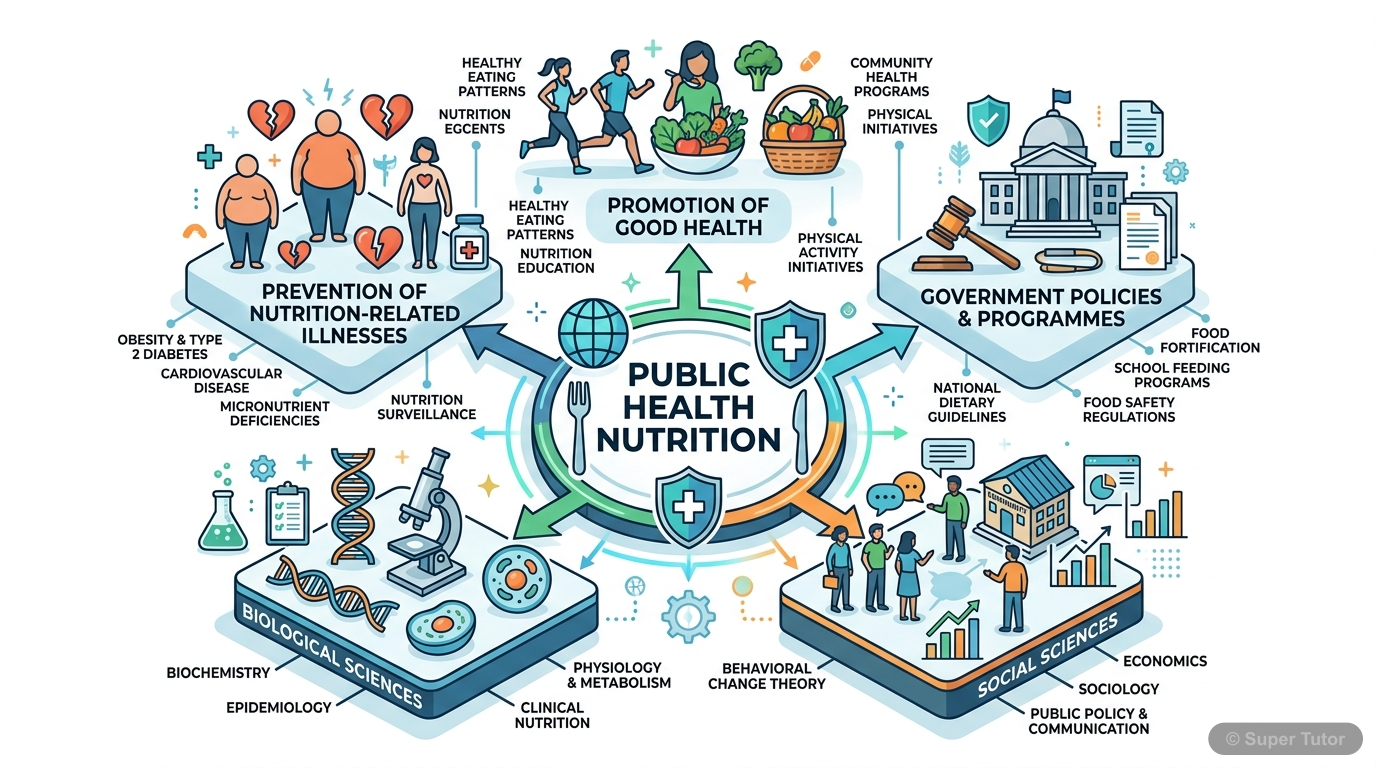
Public health nutrition is the application of nutrition science to promote and maintain the health and nutritional well-being of populations (communities and groups) rather than individuals alone. It focuses on preventing nutrition-related diseases and disorders at the community and national level.
Key Features of Public Health Nutrition:
1. Population-focused: It addresses the nutritional needs and problems of entire communities, regions, or nations, not just individual patients.
2. Preventive approach: It emphasises prevention of nutritional deficiencies and diet-related non-communicable diseases (NCDs) through policy, education, and intervention programmes.
3. Multi-disciplinary: It integrates knowledge from nutrition science, epidemiology, public health, social sciences, food technology, and policy.
4. Assessment and surveillance: It involves monitoring the nutritional status of populations through surveys and surveillance systems (e.g., NFHS, NNMB).
5. Programme planning and implementation: It includes designing, implementing, and evaluating nutrition intervention programmes (e.g., ICDS, Mid-Day Meal Scheme, POSHAN Abhiyaan).
6. Policy advocacy: Public health nutritionists work to influence food and nutrition policies at local, national, and international levels.
In summary, public health nutrition aims to improve the nutritional status of communities by identifying nutritional problems, understanding their causes, and implementing evidence-based strategies and programmes to address them.
4What are the common nutritional problems facing India?Show solution
Common Nutritional Problems in India:
(1) Protein-Energy Malnutrition (PEM):
PEM is one of the most serious nutritional problems in India, especially among children under 5 years. It manifests as:
- Stunting (chronic undernutrition — low height-for-age)
- Wasting (acute undernutrition — low weight-for-height)
- Underweight (low weight-for-age)
- Severe forms: Marasmus and Kwashiorkor
(2) Iron Deficiency Anaemia (IDA):
IDA is the most widespread nutritional deficiency in India. It affects:
- Pregnant and lactating women
- Adolescent girls
- Children under 5 years
- Women of reproductive age
Consequences include fatigue, reduced work capacity, poor pregnancy outcomes, and increased maternal and infant mortality.
(3) Iodine Deficiency Disorders (IDD):
Due to iodine-poor soil in many regions (especially sub-Himalayan belt), IDD is prevalent. It causes goitre, cretinism, mental retardation, and increased risk of stillbirths.
(4) Vitamin A Deficiency (VAD):
VAD is a major public health problem among preschool children. It leads to:
- Night blindness
- Bitot's spots
- Xerophthalmia (dryness of the eye)
- Keratomalacia (corneal ulceration leading to blindness)
- Increased susceptibility to infections
(5) Vitamin D Deficiency:
Despite abundant sunlight, Vitamin D deficiency is increasingly reported in India, leading to rickets in children and osteomalacia in adults.
(6) Zinc Deficiency:
Zinc deficiency contributes to stunting, impaired immune function, and poor wound healing, particularly in children.
(7) Double Burden of Malnutrition:
India simultaneously faces undernutrition (in rural and poor populations) and overnutrition/obesity (in urban and affluent populations), leading to a rising burden of diet-related NCDs such as type 2 diabetes, hypertension, and cardiovascular diseases.
(8) Low Birthweight (LBW):
A significant proportion of babies in India are born with LBW (< 2.5 kg), largely due to maternal undernutrition and anaemia.
(9) Fluorosis:
In areas with high fluoride content in groundwater, fluorosis (dental and skeletal) is a public health concern.
Conclusion: India faces a complex nutritional situation requiring targeted interventions for different population groups and regions.
5What are the consequences of IDA and IDD?Show solution
---
A. Consequences of IDA (Iron Deficiency Anaemia):
IDA occurs when the body does not have enough iron to produce adequate haemoglobin. Its consequences include:
(i) In Children:
- Impaired cognitive development and poor school performance
- Reduced attention span, memory, and learning ability
- Delayed physical growth and development
- Reduced immunity and increased susceptibility to infections
- Fatigue and weakness
(ii) In Pregnant Women:
- Increased risk of maternal mortality
- Preterm delivery and low birthweight babies
- Increased risk of postpartum haemorrhage
- Fatigue, breathlessness, and reduced work capacity
(iii) In Adults (General):
- Reduced physical work capacity and productivity
- Fatigue, pallor, dizziness, and headache
- Reduced immune function
- Impaired thermoregulation
(iv) At National Level:
- Significant economic loss due to reduced productivity
---
B. Consequences of IDD (Iodine Deficiency Disorders):
Iodine is essential for the synthesis of thyroid hormones (thyroxine — T4 and triiodothyronine — T3), which regulate metabolism and brain development.
(i) Goitre:
Enlargement of the thyroid gland due to its overactivity in trying to compensate for low iodine levels. It is the most visible sign of IDD.
(ii) Cretinism:
Severe iodine deficiency during pregnancy leads to cretinism in the newborn, characterised by:
- Severe and irreversible mental retardation
- Deaf-mutism
- Stunted growth
- Spastic diplegia (muscle stiffness)
(iii) Effects on Pregnancy:
- Increased risk of stillbirths, miscarriages, and abortions
- Congenital abnormalities in the foetus
(iv) Effects on Children:
- Impaired mental function and reduced IQ
- Poor school performance
- Retarded physical and neurological development
(v) Effects on Adults:
- Hypothyroidism (reduced thyroid hormone production)
- Mental sluggishness, fatigue, and reduced work capacity
- Weight gain and cold intolerance
Conclusion: Both IDA and IDD have serious consequences for individuals, communities, and national development, making their prevention a public health priority.
6What is the scope of public health nutrition? List some of the career choices in this area.Show solution
Scope of Public Health Nutrition:
The scope of public health nutrition is vast and encompasses the following areas:
(1) Assessment of Nutritional Status:
Conducting surveys and studies to assess the nutritional status of communities and populations using anthropometric, biochemical, clinical, and dietary methods.
(2) Nutrition Surveillance:
Monitoring trends in nutritional status and food consumption patterns of populations over time to identify at-risk groups and guide policy.
(3) Planning and Implementation of Nutrition Programmes:
Designing, implementing, and evaluating government and non-government nutrition intervention programmes (e.g., ICDS, Mid-Day Meal Scheme, POSHAN Abhiyaan, National Anaemia Control Programme).
(4) Nutrition Education and Communication:
Developing and delivering nutrition education programmes for communities, schools, and workplaces to promote healthy eating behaviours.
(5) Food and Nutrition Policy:
Advocating for and contributing to the development of national food and nutrition policies, food safety regulations, and food labelling standards.
(6) Research:
Conducting research on nutritional problems, their causes, and effective interventions at the community and national level.
(7) International Nutrition:
Working with international organisations (WHO, UNICEF, FAO, WFP) on global nutrition programmes and policies.
(8) Food Fortification and Technology:
Working on food fortification programmes and developing food-based solutions to address micronutrient deficiencies.
(9) Disaster and Emergency Nutrition:
Managing nutrition in emergency situations such as famines, floods, and refugee crises.
---
Career Choices in Public Health Nutrition:
1. Community Nutritionist in Preventive and Social Medicine (PSM) departments of hospitals
2. Nutritionist in Government Programmes such as ICDS (Integrated Child Development Services) and Food and Nutrition Board
3. Nutritionist/Programme Officer in voluntary organisations — regional, national (e.g., Nutrition Foundation of India), and international (e.g., WHO, UNICEF, WFP, FAO)
4. Consultant Nutritionist for government bodies, NGOs, or private organisations
5. Nutritionist or Counsellor for schools, industries, and corporate wellness programmes
6. Teaching and Academics — as a lecturer or professor in colleges and universities offering nutrition and dietetics courses
7. Research Scientist in nutrition research institutes (e.g., NIN — National Institute of Nutrition, Hyderabad)
8. Policy Analyst in food and nutrition policy-making bodies
Conclusion: Public health nutrition offers a wide and rewarding scope for professionals committed to improving the health and nutritional well-being of communities and nations.
Stuck on a step?
Ask Super Tutor AI to explain any solution on this page in a simpler way — free, 24x7.
Ask a Doubt FreeFrequently Asked Questions
What are the important topics in Public Nutrition and Health for CBSE Class 12 Home Science?
How to score full marks in Public Nutrition and Health — CBSE Class 12 Home Science?
Where can I get free NCERT Solutions for Public Nutrition and Health Class 12 Home Science?
Sources & Official References
- NCERT Official — ncert.nic.in
- CBSE Academic — cbseacademic.nic.in
- CBSE Official — cbse.gov.in
- National Education Policy 2020 — education.gov.in
Content is aligned to the official syllabus. Refer to the board website for the latest curriculum.
More resources for Public Nutrition and Health
Important Questions
Practice with board exam-style questions
Syllabus
What topics to cover
Revision Notes
Key points for last-minute revision
Study Plan
Step-by-step plan to ace this chapter
Flashcards
Quick-fire cards for active recall
Formula Sheet
All formulas in one place
Chapter Summary
Understand the chapter at a glance
Practice Quiz
Test yourself with a quick quiz
Concept Maps
See how topics connect visually
For serious students
Get the full Public Nutrition and Health chapter — for free.
Quizzes, flashcards, AI doubt-solver and a step-by-step study plan for CBSE Class 12 Home Science.