Chapter 12 of 14
NCERT Solutions

Development Communication and Journalism

CBSE · Class 12 · Home Science

NCERT Solutions for Development Communication and Journalism — CBSE Class 12 Home Science.

5 concepts

Interactive on Super Tutor

Studying Development Communication and Journalism? Get the full interactive chapter.

Quizzes, flashcards, AI doubt-solver and a step-by-step study plan — built for ncert solutions and more.

1,000+ Class 12 students started this chapter today

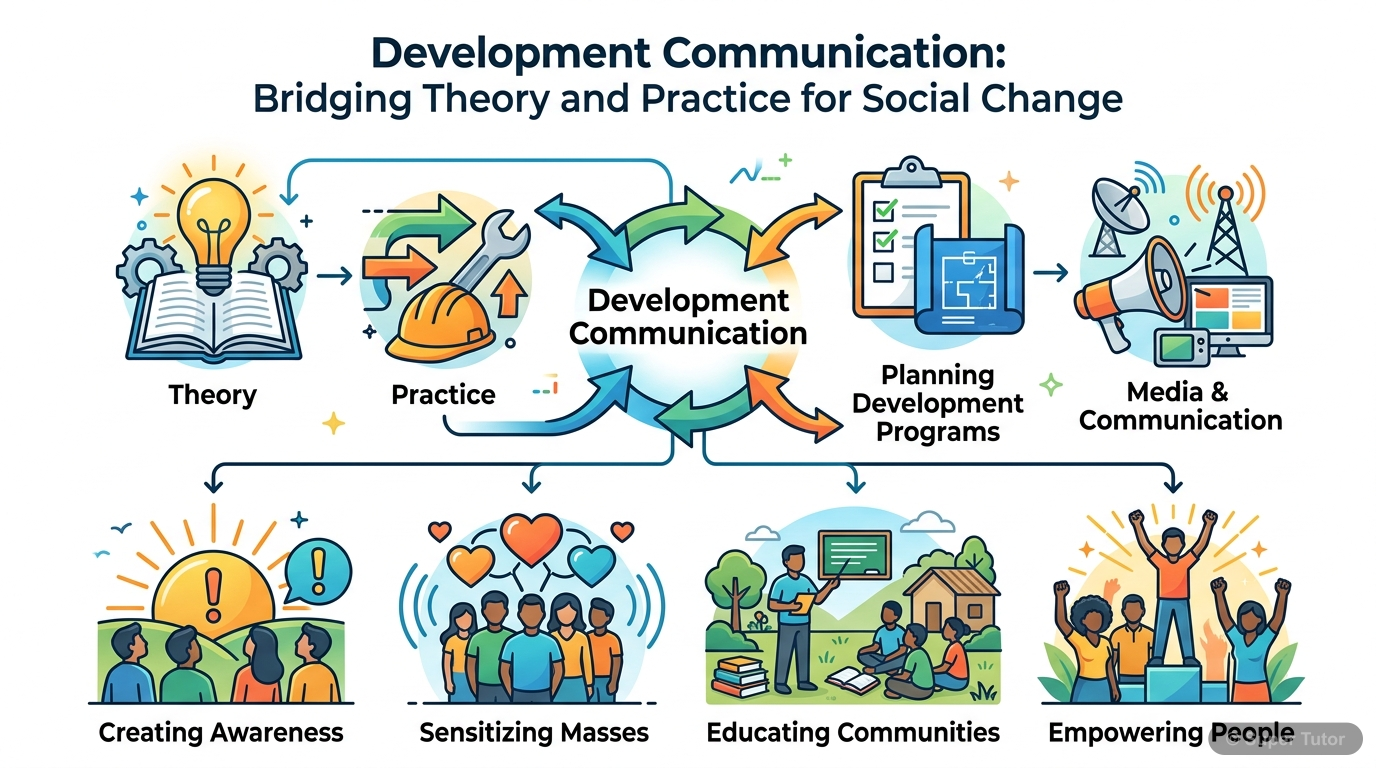
An infographic illustrating the core components and goals of Development Communication, showing how it integrates theory and practice to plan development programs, use media, and achieve social change
Super Tutor

Super Tutor has 11+ illustrations like this for Development Communication and Journalism alone — flashcards, concept maps, and step-by-step visuals.

See them all
7 Questions Solved · 2 Sections

Review Questions — Development Communication and Journalism

1What is Development Communication? And what is its role in development?Show solution
What is Development Communication?

Development Communication is the use of communication processes, techniques, and media to help people find a common solution to development problems. It is a planned and purposeful use of communication channels and strategies to bring about positive social change by informing, educating, and motivating people.

Role of Development Communication in Development:

1. Spreading Awareness: It informs communities about important development issues such as health, sanitation, education, agriculture, gender equality, and the environment.

2. Behaviour Change: It motivates individuals and communities to adopt positive behaviours — for example, encouraging vaccination, promoting hygiene, or discouraging child marriage.

3. Empowerment: It empowers marginalised groups (women, rural poor, tribal communities) by giving them access to information and a platform to voice their concerns.

4. Policy Advocacy: It helps communicate government policies and programmes to the grassroots level, ensuring effective implementation.

5. Participation: It encourages community participation in development planning and decision-making, making development more inclusive and sustainable.

6. Bridging the Gap: It bridges the gap between policy makers and the common people by translating complex development messages into simple, understandable language.

Conclusion: Development Communication is thus a vital tool that links knowledge with action and ensures that development reaches every section of society.
2What are the essential features of Development Communication?Show solution
Essential Features of Development Communication:

1. People-Centred Approach: Development Communication places people at the centre. It focuses on the needs, problems, and aspirations of the community rather than being top-down.

2. Two-Way Communication: Unlike traditional mass media which is one-way, Development Communication encourages dialogue, feedback, and participation from the audience.

3. Use of Multiple Media: It uses a combination of media — print, radio, television, community radio, traditional/folk media, ICTs — to reach diverse audiences effectively.

4. Context-Specific: Messages are designed keeping in mind the local language, culture, traditions, and socio-economic context of the target group.

5. Goal-Oriented: Every communication effort has a clear development objective — whether it is to promote literacy, improve health, protect the environment, or empower women.

6. Participatory: Communities are not just receivers of information but active participants in identifying problems and finding solutions.

7. Questioning Approach: Development Communication encourages critical thinking and questioning among the audience so that they can analyse their situation and take informed action.

8. Sustained Effort: It is not a one-time activity but a continuous, long-term process aimed at bringing about lasting social change.

9. Relevance and Simplicity: Messages are kept simple, relevant, and actionable so that even people with low literacy levels can understand and act upon them.

Conclusion: These features make Development Communication a powerful and inclusive tool for achieving sustainable development goals.
3What is a Campaign? Design a slogan for a campaign on any issue of your choice.Show solution
What is a Campaign?

A campaign is a planned, organised, and sustained series of communication activities aimed at achieving a specific goal or bringing about a desired change in knowledge, attitude, or behaviour of a target audience. Campaigns use various media channels — television, radio, print, social media, street plays, posters — to spread a consistent message over a period of time.

Key characteristics of a Campaign:
- It has a clear objective.
- It targets a specific audience.
- It uses multiple communication channels.
- It is time-bound but sustained.
- It has a central theme or message.

Example: The *Swachh Bharat Abhiyan* is a campaign aimed at promoting cleanliness and sanitation across India.

---

Slogan Designed for a Campaign on Water Conservation:

Campaign Issue: Save Water

"Save Water Today — Secure Life Tomorrow!"\boxed{\text{"Save Water Today — Secure Life Tomorrow!"}}

*(Hindi version: "जल बचाओ, जीवन बचाओ!" — Save Water, Save Life!)*

Justification: This slogan is short, memorable, and conveys a sense of urgency. It connects the act of saving water directly to the survival of future generations, making it emotionally impactful and motivating for the audience.
4How is community radio different from All India Radio?Show solution
Difference between Community Radio and All India Radio (AIR):

| Basis | Community Radio | All India Radio (AIR) |
|---|---|---|
| Ownership | Owned and managed by a local community, NGO, or educational institution | Owned and managed by the Government of India |
| Coverage Area | Very limited — covers a small geographical area (usually a radius of 10–15 km) | Covers the entire country and even broadcasts internationally |
| Target Audience | Specific local community — farmers, women, tribal groups, rural poor | General public across the nation |
| Content | Locally relevant content — local issues, local language, folk music, agriculture, health | National and regional content — news, entertainment, education, national programmes |
| Participation | High community participation; community members create and broadcast content | Professional broadcasters and journalists produce content |
| Purpose | Empowerment of marginalised communities; addressing local development issues | Mass information, entertainment, and national integration |
| Language | Local dialects and languages | National languages and major regional languages |
| Funding | Funded by community, NGOs, grants | Funded by the Government of India |

Conclusion: Community radio is a grassroots, participatory medium that gives voice to local communities, while All India Radio is a national broadcaster serving the entire country with a broader mandate. Community radio is thus a more powerful tool for localised development communication.
5Take one newspaper from your school library. Look for news related to environment. Discuss in the class the visibility of news related to cinema, life styles and development and the possible reasons.Show solution
Activity-Based Answer:

Observation (Sample Analysis):
On examining a newspaper from the school library, the following pattern of news visibility is typically observed:

| Type of News | Visibility (Pages/Space) |
|---|---|
| Cinema / Entertainment | High — dedicated pages, large photographs, prominent placement |
| Lifestyle (Fashion, Food, Travel) | High — special supplements, colour pages |
| Development (Health, Education, Agriculture, Rural Issues) | Low — small columns, inside pages |
| Environment | Very Low — occasional articles, rarely front page |

Discussion Points:

1. Commercial Interests: Newspapers are largely funded by advertisements. Cinema, fashion, and lifestyle attract more advertisers (film studios, clothing brands, restaurants), so these sections receive more space.

2. Reader Demand and TRP/Circulation: Publishers believe that entertainment and lifestyle news attracts more readers, increasing circulation and revenue. Development and environment news is perceived as less 'exciting.'

3. Urban Bias: Most mainstream newspapers target urban, middle-class readers who are more interested in entertainment and lifestyle than in rural development or environmental issues.

4. Lack of Trained Development Journalists: There are fewer journalists specialised in development and environment reporting, leading to less coverage of these issues.

5. Complexity of Issues: Development and environment stories require in-depth research and are complex to present in an engaging way, making editors less likely to prioritise them.

Conclusion: The low visibility of environment and development news reflects the commercial nature of mainstream media. There is a need for more development journalists and media policies that ensure adequate coverage of issues that affect the majority of the population.
6'ICTs are the future vehicles of development'. Comment.Show solution
'ICTs are the Future Vehicles of Development' — Comment:

Introduction:
Information and Communication Technologies (ICTs) refer to technologies that provide access to information through telecommunications — including the internet, mobile phones, computers, digital platforms, and social media.

Arguments Supporting the Statement:

1. Wide Reach: ICTs can reach remote and rural areas where traditional media (newspapers, television) may not be accessible. Mobile phones, for instance, have penetrated even the most isolated communities in India.

2. Speed of Information: ICTs transmit information instantly. In emergencies (floods, disease outbreaks), timely information through ICTs can save lives.

3. Interactive and Participatory: Unlike traditional one-way media, ICTs allow two-way communication. Farmers can ask questions, citizens can give feedback, and communities can share their experiences through platforms like WhatsApp, YouTube, and community apps.

4. Cost-Effective: Spreading development messages through ICTs (SMS, social media, apps) is far cheaper than printing pamphlets or producing television programmes.

5. Empowerment of Marginalised Groups: ICTs empower women, youth, and marginalised communities by giving them access to information about their rights, government schemes, health services, and market prices.

6. E-Governance: Government services (ration cards, scholarships, health records) are increasingly delivered through ICT platforms, making governance more transparent and accessible.

7. Education and Skill Development: Online learning platforms, e-libraries, and digital classrooms are transforming education, especially in rural areas.

8. Agriculture and Livelihood: Farmers use mobile apps and internet services to get information about weather, crop prices, and new farming techniques, directly improving their livelihoods.

Limitations to Keep in Mind:
- The digital divide (unequal access to technology based on income, gender, geography) remains a challenge.
- Digital literacy is still low among older generations and rural populations.
- Issues of misinformation and fake news on digital platforms can hinder development.

Conclusion:
Despite these challenges, ICTs hold immense potential as vehicles of development. With increasing internet penetration, affordable smartphones, and government initiatives like *Digital India*, ICTs are rapidly becoming the most powerful tools for achieving inclusive and sustainable development. The statement is thus largely valid and forward-looking.

Practical 1 — Study of Radio Public Service Announcement (PSA)

P1Theme: Study of Radio Public Service Announcement (PSA). Task: Listen and record PSA on radio for its content, relevance, impact and technique. Analyse the recorded PSA on the given parameters and scoring rubric.Show solution
Practical 1: Study of Radio Public Service Announcement (PSA)

Purpose: To gain an insight into how radio as a mass medium creates awareness through Public Service Announcements (PSAs).

---

PART A — Analysis Parameters (Sample Filled Format)

| Parameter | Details |
|---|---|
| Topic / Message | Importance of Hand Washing / Swachh Bharat Abhiyan |
| Date and Time | Morning slot, 7:00 AM – 8:00 AM (peak listening time) |
| Duration | 30–60 seconds |
| Techniques Used | Jingle with catchy music; dialogue between two characters with a humorous tone |
| Channel | All India Radio / FM Rainbow / Community Radio |
| Target Group | General public, especially rural households and children |
| Medium of Instruction | Hindi / Local dialect |
| Objectives | To promote hand washing before meals and after using the toilet; to reduce spread of disease |

---

PART B — Scoring Rubric (Sample Evaluation)

| Parameter | Excellent (3) | Good (2) | Average (1) | Poor (0) |
|---|---|---|---|---|
| Suitability of day/date/time | ✓ (Morning peak hour) | | | |
| Engage the listener | ✓ (Jingle is catchy) | | | |
| Create Interest | | ✓ (Humour used) | | |
| Promote Awareness | ✓ (Clear message) | | | |
| Motivate Audience | | ✓ | | |
| Selection of voice over | ✓ (Clear, friendly voice) | | | |
| Clarity of message | ✓ | | | |
| Clarity of sound recording | | ✓ | | |
| Appropriateness of sound effects | ✓ | | | |
| Mention of source/originator | | ✓ (Ministry of Health) | | |

Total Score = 27/30

---

Discussion Points:

1. Contribution of Radio to Social Awareness:
Radio reaches areas where television and internet are not available. PSAs on radio are an effective, low-cost method to spread development messages.

2. Swachh Bharat Abhiyan Example:
PSAs on Swachh Bharat Abhiyan used simple language, local dialects, and jingles to motivate people to build and use toilets, stop open defecation, and maintain cleanliness. These PSAs were broadcast at peak listening times (morning and evening) to maximise reach.

3. Effectiveness of Techniques:
- Jingles make messages memorable.
- Dialogue with humour keeps the listener engaged without being preachy.
- Celebrity voices add credibility and attract attention.
- Repetition of the PSA at regular intervals reinforces the message.

4. Limitations:
- Radio is a one-way medium; listener feedback is not immediate.
- Effectiveness depends on the quality of the script and voice-over.
- Reach is limited to those who have access to a radio or FM receiver.

Conclusion:
Radio PSAs are a powerful and cost-effective tool for development communication. When well-designed with appropriate techniques, timing, and language, they can significantly contribute to creating awareness and motivating behaviour change on critical social issues.

Stuck on a step?

Ask Super Tutor AI to explain any solution on this page in a simpler way — free, 24x7.

Ask a Doubt Free

Frequently Asked Questions

What are the important topics in Development Communication and Journalism for CBSE Class 12 Home Science?
Key topics in Development Communication and Journalism include Development Communication and Journalism Overview, Development Communication and Journalism Overview, Development Communication Ecosystem. These are the concepts CBSE Class 12 examiners draw on most — study them first, then practise related questions.
How to score full marks in Development Communication and Journalism — CBSE Class 12 Home Science?
Start by understanding all key concepts. Practise previous year questions from this chapter. Revise formulas and definitions regularly. Use flashcards for quick revision before the exam.
Where can I get free NCERT Solutions for Development Communication and Journalism Class 12 Home Science?
This page has free step-by-step NCERT Solutions for every exercise question in Development Communication and Journalism (CBSE Class 12 Home Science) — written the way examiners award marks: given, formula, working, answer.

Sources & Official References

Content is aligned to the official syllabus. Refer to the board website for the latest curriculum.

For serious students

Get the full Development Communication and Journalism chapter — for free.

Quizzes, flashcards, AI doubt-solver and a step-by-step study plan for CBSE Class 12 Home Science.