The First World War (1914-18)
ICSE · Class 10 · History & Civics
Practice quiz for The First World War (1914-18) — ICSE Class 10 History & Civics. MCQs and questions with answers to test your preparation.
Interactive on Super Tutor
Studying The First World War (1914-18)? Get the full interactive chapter.
Quizzes, flashcards, AI doubt-solver and a step-by-step study plan — built for practice quiz and more.
1,000+ Class 10 students started this chapter today
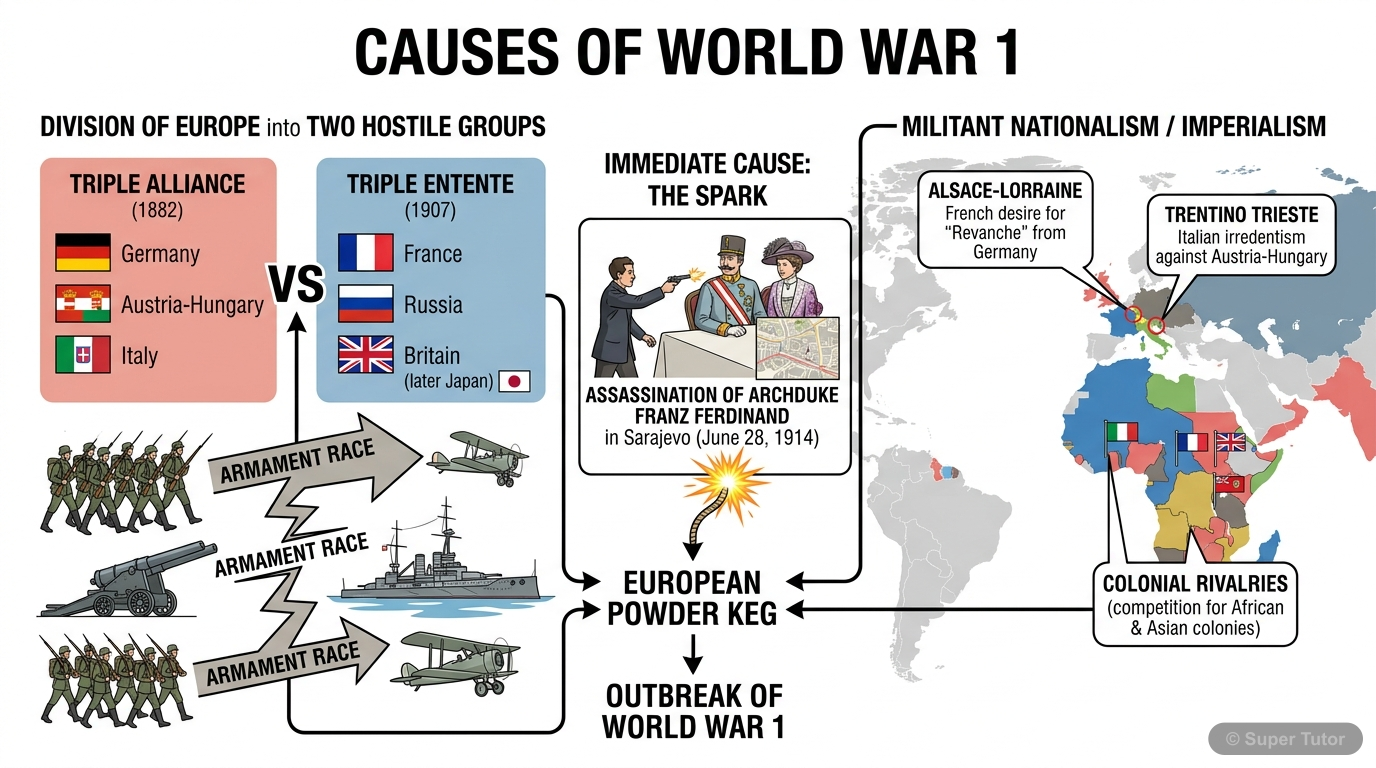
Super Tutor has 6+ illustrations like this for The First World War (1914-18) alone — flashcards, concept maps, and step-by-step visuals.
See them allQuick Quiz: The First World War (1914-18)
0/4Tap an answer to check it instantly. No sign-up needed for these 4.
In which year did the First World War begin?
Which German Chancellor kept France isolated through diplomatic policies after 1871?
What was the immediate cause of the First World War?
Which three countries formed the Triple Entente in 1907?
Sample Questions
On which date was the Treaty of Versailles signed?
Show answer
June 28, 1919
The Treaty of Versailles was signed on June 28, 1919, in the Hall of Mirrors at Versailles, France. This date is exactly five years after the assassination of Archduke Ferdinand, which started the war. The treaty was negotiated during the Paris Peace Conference by the 'Big Four' - Lloyd George (Britain), Woodrow Wilson (USA), Georges Clemenceau (France), and Vittorio Orlando (Italy). The treaty imposed harsh terms on Germany and officially ended the state of war between Germany and the Allied Powers.
Which battle is considered a turning point of the war because it failed German attempts to crush France?
Show answer
Battle of Marne
The Battle of Marne, fought in September 1914, was a turning point of the war because it failed all German attempts to crush France. In this battle, French and British armies attacked the Germans and pushed them back to the River Aisne, where the German army had to dig trenches. This battle marked the beginning of trench warfare and showed that Germany's quick victory plan (Schlieffen Plan) had failed. The German failure at Marne meant the war would be prolonged rather than ending quickly.
In which year did the USA enter the First World War?
Show answer
1917
The USA entered the First World War on April 6, 1917. The main reason was the sinking of the RMS Lusitania by a German U-boat on May 7, 1915, which killed about 1,100 passengers including 128 Americans. This incident outraged the American public. The USA's entry was significant because it brought enormous resources to the Allied side and helped turn the tide of the war. The fresh American troops and supplies proved crucial in the final Allied victory in 1918.
Where was the headquarters of the League of Nations established?
Show answer
Geneva, Switzerland
The headquarters of the League of Nations was established in Geneva, Switzerland. The League was set up on January 10, 1920, by American President Woodrow Wilson as an international organization to maintain world peace and prevent future wars. Geneva was chosen because Switzerland was neutral during World War I and was seen as a suitable location for an international peace organization. The League had five main organs: the General Assembly, the Council, the Permanent Court of International Justice, the Secretariat, and various Commissions and Committees.
+38 more questions available
Practice AllFrequently Asked Questions
What are the important topics in The First World War (1914-18) for ICSE Class 10 History & Civics?
How to score full marks in The First World War (1914-18) — ICSE Class 10 History & Civics?
Sources & Official References
Content is aligned to the official syllabus. Refer to the board website for the latest curriculum.
More resources for The First World War (1914-18)
Important Questions
Practice with board exam-style questions
Revision Notes
Key points for last-minute revision
Formula Sheet
All formulas in one place
Chapter Summary
Understand the chapter at a glance
Concept Maps
See how topics connect visually
Study Plan
Step-by-step plan to ace this chapter
Flashcards
Quick-fire cards for active recall
Syllabus
What topics to cover
NCERT Solutions
Every textbook question solved step by step
For serious students
Get the full The First World War (1914-18) chapter — for free.
Quizzes, flashcards, AI doubt-solver and a step-by-step study plan for ICSE Class 10 History & Civics.