Subordinate Courts
ICSE · Class 10 · History & Civics
Practice quiz for Subordinate Courts — ICSE Class 10 History & Civics. MCQs and questions with answers to test your preparation.
Interactive on Super Tutor
Studying Subordinate Courts? Get the full interactive chapter.
Quizzes, flashcards, AI doubt-solver and a step-by-step study plan — built for practice quiz and more.
1,000+ Class 10 students started this chapter today
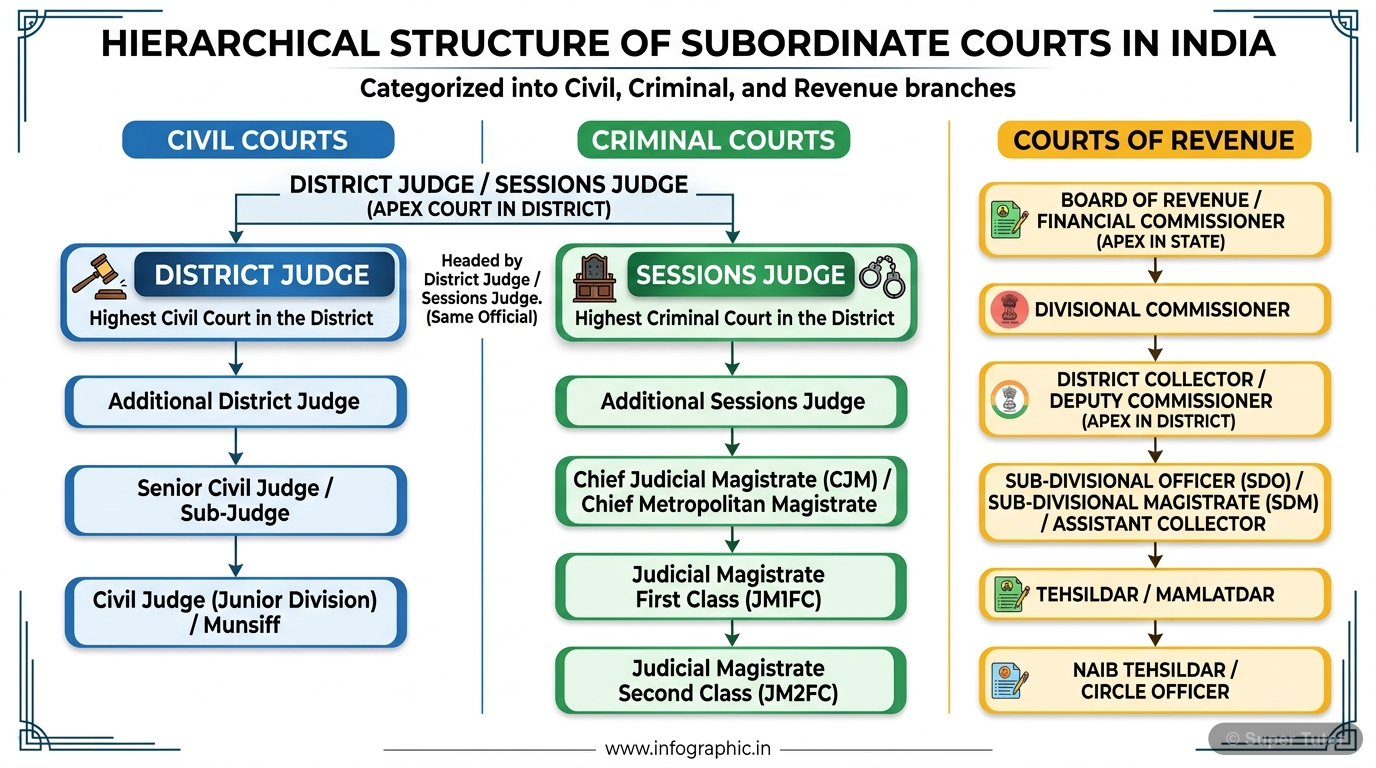
Super Tutor has 5+ illustrations like this for Subordinate Courts alone — flashcards, concept maps, and step-by-step visuals.
See them allQuick Quiz: Subordinate Courts
0/4Tap an answer to check it instantly. No sign-up needed for these 4.
Who appoints the District Judge and Additional District Judge?
What is the maximum imprisonment that a Second Class Judicial Magistrate can award?
Which court is considered the highest civil court in a district?
In which state was the first Lok Adalat inaugurated?
Sample Questions
What does 'Lok Adalat' literally mean?
Show answer
People's Court
Lok Adalat literally means 'People's Court' where 'Lok' means people and 'Adalat' means court. It represents a forum that belongs to and serves the people directly. Fast Court (option A) refers to speed but not the literal meaning. Village Court (option C) is incorrect as Lok Adalats operate at various levels, not just villages. Free Court (option D) relates to cost but not the literal translation of the term.
Who can award capital punishment in the district court system?
Show answer
Sessions Judge
Only the Sessions Judge can award capital punishment (death sentence) in the district court system, subject to approval by the High Court. First Class Judicial Magistrate (option A) can award maximum 3 years imprisonment. Chief Judicial Magistrate (option B) can award maximum 7 years imprisonment but cannot award death sentence. District Collector (option D) is an administrative officer who heads revenue courts, not criminal courts, and cannot award capital punishment.
Which act established Lok Adalats as legal forums?
Show answer
Legal Services Authorities Act, 1987
The Legal Services Authorities Act, 1987 formally established Lok Adalats as legal forums based on recommendations by Justice P.N. Bhagwati. This act gave legal backing to the concept and made Lok Adalat decisions binding like civil court decrees. Option A (1985) has wrong year. Option C (Lok Adalat Act, 1982) is incorrect as no such specific act exists. Option D (Judicial Services Act, 1987) is not the correct act name for this purpose.
What is the maximum fine that a First Class Judicial Magistrate can impose?
Show answer
₹10,000
A First Class Judicial Magistrate can impose a fine up to ₹10,000 or award imprisonment up to 3 years or both. This is higher than Second Class Judicial Magistrates who can impose only ₹5,000 fine (option A). Options C (₹15,000) and D (₹20,000) exceed the actual limit. The monetary limits reflect the hierarchy of courts, with higher courts having greater powers to impose penalties.
+35 more questions available
Practice AllFrequently Asked Questions
What are the important topics in Subordinate Courts for ICSE Class 10 History & Civics?
How to score full marks in Subordinate Courts — ICSE Class 10 History & Civics?
Sources & Official References
Content is aligned to the official syllabus. Refer to the board website for the latest curriculum.
More resources for Subordinate Courts
Important Questions
Practice with board exam-style questions
Revision Notes
Key points for last-minute revision
Formula Sheet
All formulas in one place
Chapter Summary
Understand the chapter at a glance
Concept Maps
See how topics connect visually
Study Plan
Step-by-step plan to ace this chapter
Flashcards
Quick-fire cards for active recall
Syllabus
What topics to cover
NCERT Solutions
Every textbook question solved step by step
For serious students
Get the full Subordinate Courts chapter — for free.
Quizzes, flashcards, AI doubt-solver and a step-by-step study plan for ICSE Class 10 History & Civics.