The Union Judiciary The Supreme Court
ICSE · Class 10 · History & Civics
Practice quiz for The Union Judiciary The Supreme Court — ICSE Class 10 History & Civics. MCQs and questions with answers to test your preparation.
Interactive on Super Tutor
Studying The Union Judiciary The Supreme Court? Get the full interactive chapter.
Quizzes, flashcards, AI doubt-solver and a step-by-step study plan — built for practice quiz and more.
1,000+ Class 10 students started this chapter today
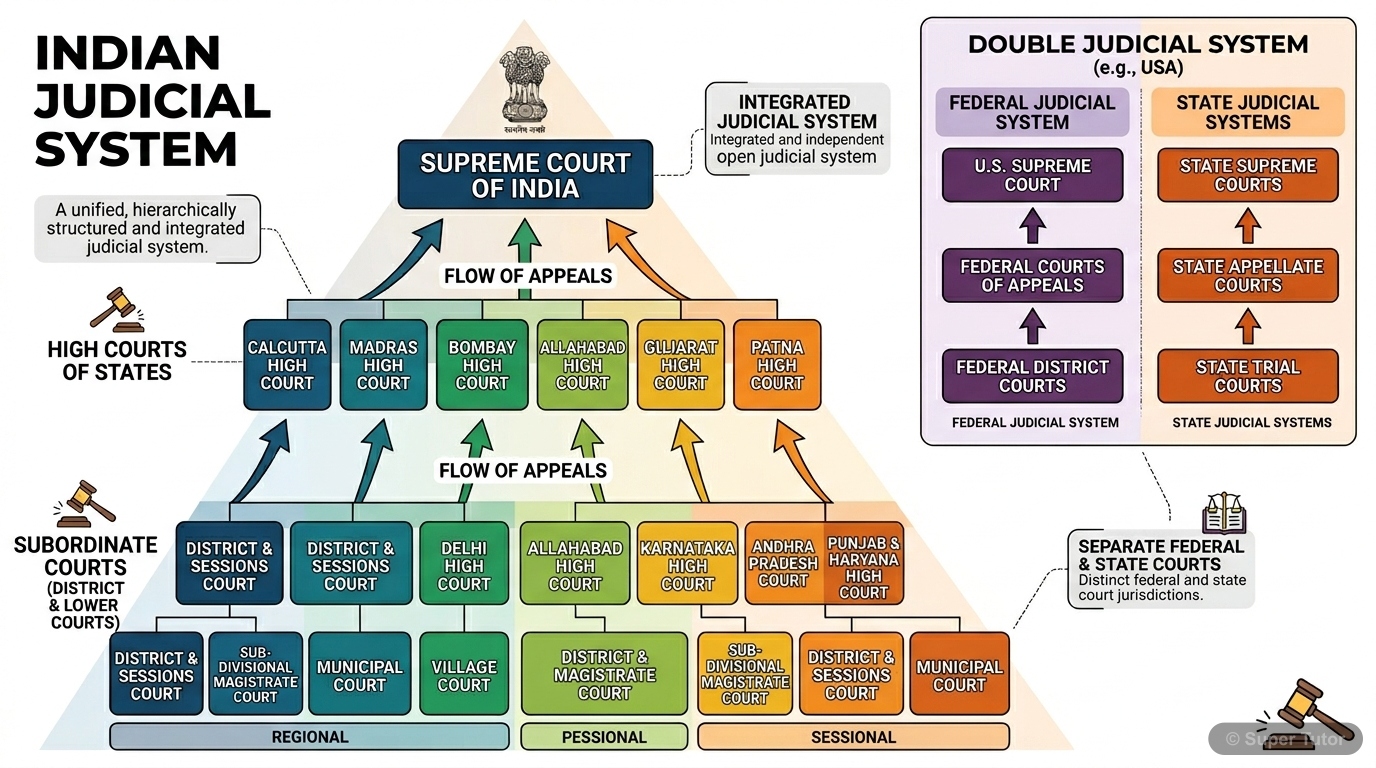
Learn better with visuals Super Tutor has hundreds of illustrations like this across every chapter — all free to try.
Get startedQuick Quiz: The Union Judiciary The Supreme Court
0/4Tap an answer to check it instantly. No sign-up needed for these 4.
What is the current total number of judges in the Supreme Court of India including the Chief Justice?
Who appoints the judges of the Supreme Court of India?
At what age do Supreme Court judges retire?
Which writ means 'to have a body' and protects personal freedom?
Sample Questions
What is meant by 'Original Jurisdiction' of the Supreme Court?
Show answer
Cases filed directly in the Supreme Court
Step 1: Original jurisdiction means cases that can be directly brought to a court without going through lower courts first. Step 2: The Supreme Court has original jurisdiction in specific types of cases. Step 3: These include disputes between Centre and states, disputes between states, and cases involving interpretation of the Constitution. Step 4: In these matters, the Supreme Court has exclusive jurisdiction - no other court can hear these cases. Step 5: This is different from appellate jurisdiction where cases come from lower courts through appeals.
Which article of the Constitution is called the 'heart and soul' of the Constitution?
Show answer
Article 32
Step 1: Article 32 is known as the 'Right to Constitutional Remedies'. Step 2: Dr. B.R. Ambedkar called it the 'heart and soul' of the Constitution. Step 3: This article allows citizens to directly approach the Supreme Court when their fundamental rights are violated. Step 4: It empowers the Supreme Court to issue writs for the enforcement of fundamental rights. Step 5: Without this article, fundamental rights would be merely paper declarations with no real protection.
What is the procedure called when the President consults senior judges before appointing new judges?
Show answer
Collegium system
Step 1: The collegium system is a method where senior judges collectively decide on judicial appointments. Step 2: The Chief Justice must consult the four senior-most judges of the Supreme Court. Step 3: This 'college' or group of senior judges makes recommendations to the President. Step 4: This system was developed to ensure judicial independence in appointments. Step 5: It prevents executive interference in judicial appointments and maintains the separation of powers.
Which power allows the Supreme Court to declare laws passed by Parliament as unconstitutional?
Show answer
Judicial Review
Step 1: Judicial Review is the power to examine laws and determine if they conform to the Constitution. Step 2: If a law contradicts the Constitution, the Supreme Court can declare it null and void. Step 3: This power helps maintain the supremacy of the Constitution over ordinary laws. Step 4: It acts as a check on the legislative and executive branches of government. Step 5: Examples include the Court declaring bank nationalization and privy purse abolition ordinances as unconstitutional.
+37 more questions available
Practice AllFrequently Asked Questions
What are the important topics in The Union Judiciary The Supreme Court for ICSE Class 10 History & Civics?
How to score full marks in The Union Judiciary The Supreme Court — ICSE Class 10 History & Civics?
Sources & Official References
Content is aligned to the official syllabus. Refer to the board website for the latest curriculum.
More resources for The Union Judiciary The Supreme Court
Important Questions
Practice with board exam-style questions
Revision Notes
Key points for last-minute revision
Formula Sheet
All formulas in one place
Chapter Summary
Understand the chapter at a glance
Concept Maps
See how topics connect visually
Study Plan
Step-by-step plan to ace this chapter
Flashcards
Quick-fire cards for active recall
Syllabus
What topics to cover
NCERT Solutions
Every textbook question solved step by step
For serious students
Get the full The Union Judiciary The Supreme Court chapter — for free.
Quizzes, flashcards, AI doubt-solver and a step-by-step study plan for ICSE Class 10 History & Civics.