The Second World War (1939-45)
ICSE · Class 10 · History & Civics
Practice quiz for The Second World War (1939-45) — ICSE Class 10 History & Civics. MCQs and questions with answers to test your preparation.
Interactive on Super Tutor
Studying The Second World War (1939-45)? Get the full interactive chapter.
Quizzes, flashcards, AI doubt-solver and a step-by-step study plan — built for practice quiz and more.
1,000+ Class 10 students started this chapter today
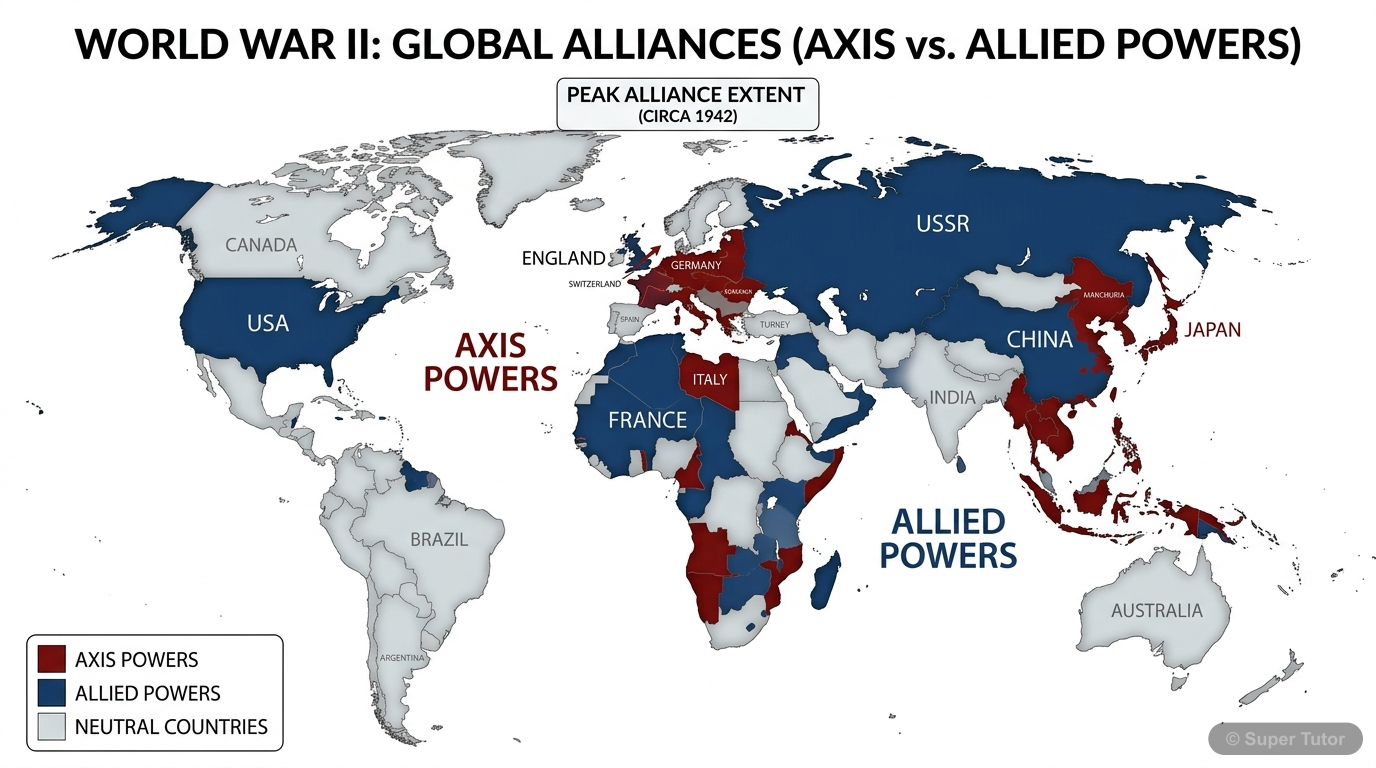
Super Tutor has 5+ illustrations like this for The Second World War (1939-45) alone — flashcards, concept maps, and step-by-step visuals.
See them allQuick Quiz: The Second World War (1939-45)
0/4Tap an answer to check it instantly. No sign-up needed for these 4.
Which treaty's harsh terms created resentment in Germany and became a major cause of the Second World War?
Who was the leader of Nazi Germany during the Second World War?
Which three countries formed the Rome-Berlin-Tokyo Axis?
What was the immediate cause that started the Second World War?
Sample Questions
Which American naval base was attacked by Japan in 1941?
Show answer
Pearl Harbor
Japan launched a surprise attack on Pearl Harbor in Hawaii on December 7, 1941. This attack was ordered by Japanese Premier General Tojo. The attack sank American battleships, destroyed airfields, and killed about 3,700 people. The Pearl Harbor attack unified American public opinion in favor of entering World War II, and the USA declared war on Japan. While it was a tactical victory for Japan, it proved to be a strategic blunder as it brought America fully into the war.
On which two Japanese cities were atomic bombs dropped?
Show answer
Hiroshima and Nagasaki
After Japan ignored the Allied ultimatum to surrender, an atom bomb was dropped on Hiroshima in August 1945, destroying half the city. When Japan still refused to surrender, a second atom bomb was dropped on Nagasaki on 9 August 1945, forcing Japan to surrender unconditionally on 2 September 1945. Cities like Tokyo, Kyoto, Kobe, and Yokohama were not the targets of these atomic bombings.
What was the policy followed by Britain and France to avoid war with aggressive powers called?
Show answer
Policy of Appeasement
The Policy of Appeasement was followed by Britain and France to avoid war with aggressive powers like Germany and Italy. This policy involved giving in to the demands of aggressive nations hoping to maintain peace. The most famous example was the Munich Agreement of 1938, where Britain and France agreed to Hitler's demand for Sudetenland without consulting Czechoslovakia. Churchill called this agreement 'a disaster of the first magnitude.' This policy ultimately failed and became one of the major causes of World War II.
Which organization was established in 1945 to maintain world peace after World War II?
Show answer
United Nations Organization
After the massive destruction caused by the Second World War, nations realized the urgent need to prevent such devastation in the future. This led to the establishment of the United Nations Organization (UNO) in 1945, with the aim of maintaining world peace and fostering cooperation among countries. The League of Nations is incorrect because it was formed after the First World War and had already failed by the time WWII began; NATO and the EU were established much later for different purposes.
+33 more questions available
Practice AllFrequently Asked Questions
What are the important topics in The Second World War (1939-45) for ICSE Class 10 History & Civics?
How to score full marks in The Second World War (1939-45) — ICSE Class 10 History & Civics?
Sources & Official References
Content is aligned to the official syllabus. Refer to the board website for the latest curriculum.
More resources for The Second World War (1939-45)
Important Questions
Practice with board exam-style questions
Revision Notes
Key points for last-minute revision
Formula Sheet
All formulas in one place
Chapter Summary
Understand the chapter at a glance
Concept Maps
See how topics connect visually
Study Plan
Step-by-step plan to ace this chapter
Flashcards
Quick-fire cards for active recall
Syllabus
What topics to cover
NCERT Solutions
Every textbook question solved step by step
For serious students
Get the full The Second World War (1939-45) chapter — for free.
Quizzes, flashcards, AI doubt-solver and a step-by-step study plan for ICSE Class 10 History & Civics.