The Union Executive
ICSE · Class 10 · History & Civics
Practice quiz for The Union Executive — ICSE Class 10 History & Civics. MCQs and questions with answers to test your preparation.
Interactive on Super Tutor
Studying The Union Executive? Get the full interactive chapter.
Quizzes, flashcards, AI doubt-solver and a step-by-step study plan — built for practice quiz and more.
1,000+ Class 10 students started this chapter today
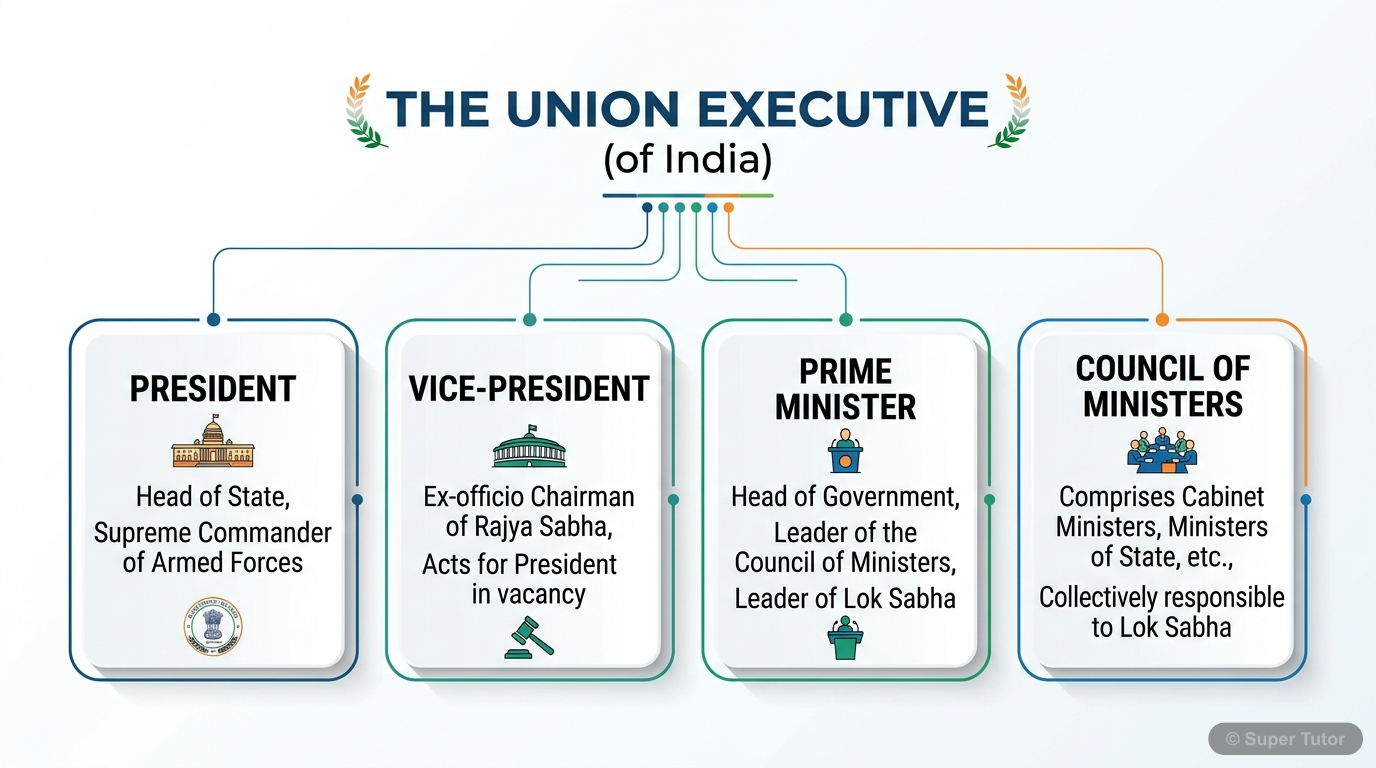
This is just one of 6+ visuals inside Super Tutor's The Union Executive chapter
Explore the full setQuick Quiz: The Union Executive
0/4Tap an answer to check it instantly. No sign-up needed for these 4.
Who is the head of the executive in India?
What is the minimum age required to become the President of India?
The President of India is elected by which method?
What is the term of office of the President of India?
Sample Questions
Who administers the oath of office to the President?
Show answer
Chief Justice of India
The Chief Justice of India administers the oath to the President as the highest judicial authority in the country. Step 1: The Constitution designates the Chief Justice as the appropriate authority to administer the presidential oath. Step 2: This symbolizes the separation of powers and the independence of judiciary. Step 3: The oath includes promises to preserve, protect and defend the Constitution and serve the people. Step 4: If the Chief Justice is unavailable, the senior-most available Supreme Court judge performs this duty.
Under which article can the President declare a National Emergency?
Show answer
Article 352
Article 352 of the Constitution empowers the President to declare National Emergency during threats to national security. Step 1: Article 352 specifically deals with emergency provisions for external aggression, war, or armed rebellion. Step 2: This emergency affects the entire country or part of its territory when national security is threatened. Step 3: It requires written advice from the Union Cabinet and parliamentary approval within one month. Step 4: Article 356 deals with President's Rule in states, while Article 360 covers Financial Emergency.
Who acts as the ex-officio Chairman of the Rajya Sabha?
Show answer
Vice-President
The Vice-President of India serves as the ex-officio Chairman of the Rajya Sabha by constitutional provision. Step 1: Article 64 of the Constitution makes the Vice-President the ex-officio Chairman of the Rajya Sabha. Step 2: This dual role gives the Vice-President active participation in the legislative process. Step 3: As Chairman, the Vice-President can cast a deciding vote in case of ties in the Rajya Sabha. Step 4: The Deputy Chairman presides only in the absence of the Vice-President.
How many members does the President nominate to the Rajya Sabha?
Show answer
12
The President nominates exactly 12 members to the Rajya Sabha from among distinguished persons in various fields. Step 1: Article 80 of the Constitution provides for 12 nominated members in the 250-member Rajya Sabha. Step 2: These nominees should have special knowledge or practical experience in literature, science, art, and social service. Step 3: This provision ensures representation of expertise that might not come through elections. Step 4: Famous nominees have included eminent writers, scientists, sports personalities, and social workers.
+39 more questions available
Practice AllFrequently Asked Questions
What are the important topics in The Union Executive for ICSE Class 10 History & Civics?
How to score full marks in The Union Executive — ICSE Class 10 History & Civics?
Sources & Official References
Content is aligned to the official syllabus. Refer to the board website for the latest curriculum.
More resources for The Union Executive
Important Questions
Practice with board exam-style questions
Revision Notes
Key points for last-minute revision
Formula Sheet
All formulas in one place
Chapter Summary
Understand the chapter at a glance
Concept Maps
See how topics connect visually
Study Plan
Step-by-step plan to ace this chapter
Flashcards
Quick-fire cards for active recall
Syllabus
What topics to cover
NCERT Solutions
Every textbook question solved step by step
For serious students
Get the full The Union Executive chapter — for free.
Quizzes, flashcards, AI doubt-solver and a step-by-step study plan for ICSE Class 10 History & Civics.