Breathing and Exchange of Gases — Chapter Summary
ICSE · Class 11 · Biology
Summary of Breathing and Exchange of Gases for ICSE Class 11 Biology. Key concepts: Respiration is the process by, Respiratory organs are and Amoeba.
Interactive on Super Tutor
Studying Breathing and Exchange of Gases? Get the full interactive chapter.
Quizzes, flashcards, AI doubt-solver and a step-by-step study plan — built for chapter summary and more.
Free trial, no card needed.
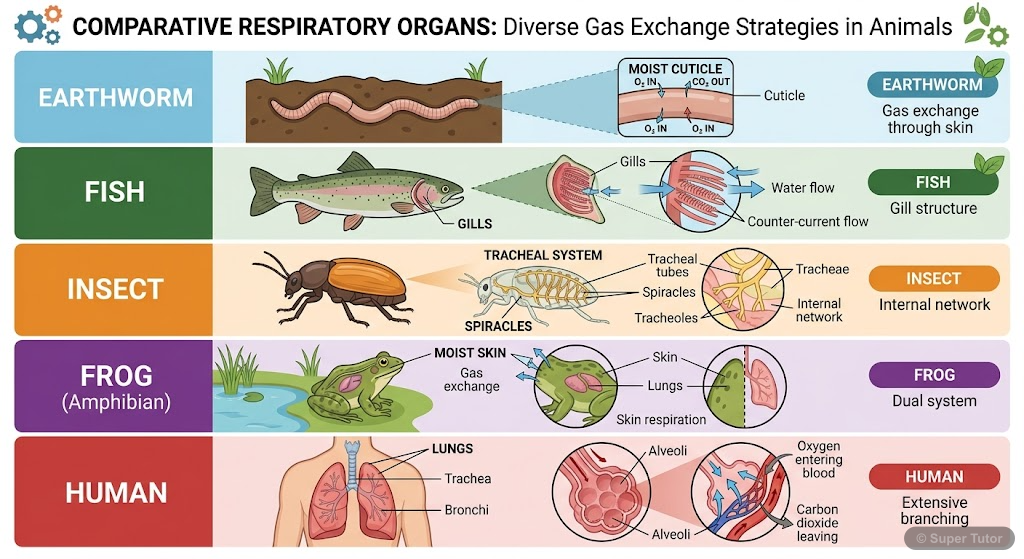
One of 12 illustrations for Breathing and Exchange of Gases in Super Tutor — alongside flashcards, concept maps and practice questions.
Overview
Respiration is the process by which foodstuffs are oxidised in cells to release their bond energy for use in the body. It is a catabolic process in which organic foodstuffs are broken down step by step, and the released energy is stored temporarily as ATP. Respiratory organs carry out gaseous exchan
Key Concepts
Respiration is the process by
Respiration is the process by which food materials are oxidised in cells to release energy. It is a catabolic process, and the energy released is stor
Respiratory organs are structures concerned
Respiratory organs are structures concerned with gaseous exchange, meaning intake of oxygen and output of carbon dioxide.
Amoeba
Amoeba, aerobic bacteria, and Euglena exchange gases through the general body surface. Sycon and Hydra exchange gases by simple diffusion between flow
Earthworms and leeches exchange gases through
Earthworms and leeches exchange gases through moist skin over the entire body surface. Frogs and toads also use moist, vascular skin, especially durin
Insects respire through a network
Insects respire through a network of branched tracheae that open outside by spiracles and end in tracheoles that contact individual cells.
Learning Objectives
- Understand the meaning and nature of respiration.
- Identify different respiratory organs in animals and compare them.
- Describe the human respiratory system and the route of air.
- Explain the mechanism of breathing in humans.
- Understand gas exchange in alveoli and tissues.
Frequently Asked Questions
What are the important topics in Breathing and Exchange of Gases for ICSE Class 11 Biology?
How should I revise Breathing and Exchange of Gases for Class 11 exams?
Sources & Official References
Content is aligned to the official syllabus. Refer to the board website for the latest curriculum.
More resources for Breathing and Exchange of Gases
Practice Quiz
Test yourself with a quick quiz
Important Questions
Exam-style questions with answers
Revision Notes
Key points for last-minute revision
Formula Sheet
The chapter's formulas in one place
Concept Maps
See how topics connect
Study Plan
Step-by-step plan for this chapter
Flashcards
Quick-fire cards for active recall
Syllabus
What topics to cover
For serious students
Get the full Breathing and Exchange of Gases chapter — start free.
Quizzes, flashcards, an AI doubt solver and a study plan for ICSE Class 11 Biology. Free to start, no card needed.