Breathing and Exchange of Gases — Flashcards
ICSE · Class 11 · Biology
40 flashcards for Breathing and Exchange of Gases (ICSE Class 11 Biology) to test yourself on key terms and facts.
Interactive on Super Tutor
Studying Breathing and Exchange of Gases? Get the full interactive chapter.
Quizzes, flashcards, AI doubt-solver and a step-by-step study plan — built for flashcards and more.
Free trial, no card needed.
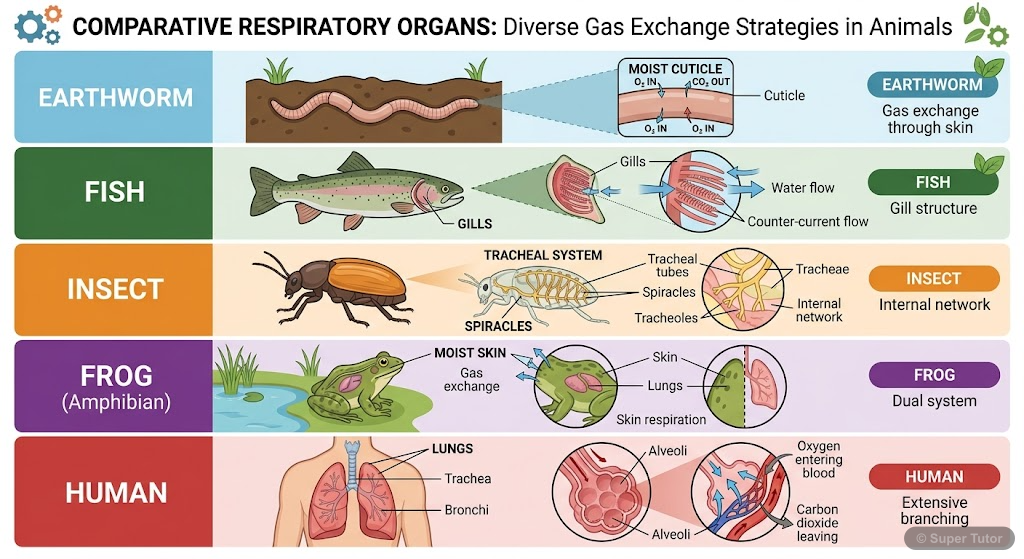
One of 12 illustrations for Breathing and Exchange of Gases in Super Tutor — alongside flashcards, concept maps and practice questions.
What is respiration in living organisms?
Answer
Respiration is the process by which foodstuffs are oxidised in cells to release bond energy for use in the body. It is a catabolic process involving stepwise degradation of organic food materials, and…
What are respiratory organs?
Answer
Respiratory organs are the organs concerned with gaseous exchange, that is, intake of oxygen and output of carbon dioxide. In different animals, these may be general body surface, tracheae, gills, or …
How does Amoeba exchange gases?
Answer
Amoeba exchanges gases through its general body surface, the plasmalemma. Oxygen diffuses into the cytoplasm and carbon dioxide diffuses out into the surrounding water. No special respiratory organ is…
Why is parapodia important in Nereis?
Answer
Parapodia are thin, unjointed, leg-like flattened outgrowths in Nereis. They help in locomotion and also in gaseous exchange because they contain extensive capillary networks close to the surface.
What is cutaneous respiration? Give examples.
Answer
Cutaneous respiration is gaseous exchange through the skin over the entire body surface. Earthworms and leeches respire in this way. Frogs and toads also use moist skin for gas exchange, especially du…
Why do insects need tracheal respiration?
Answer
Insects use tracheal respiration because their skin is impermeable to gases, which helps reduce water loss. Their respiratory system consists of branched tracheae that open through spiracles and end i…
What are gills and where are they found?
Answer
Gills are specialized respiratory organs of aquatic animals such as prawns, fish, and tadpoles. They are made of gill plates with gill lamellae and are richly supplied with blood capillaries for effic…
Why are lungs efficient respiratory organs in humans?
Answer
Lungs are efficient because they contain 300 to 400 million alveoli in an adult lung, giving about 140 square metres of alveolar surface area. The capillary surface area is about 125 square metres, al…
+32 more flashcards
Practise AllFrequently Asked Questions
What are the important topics in Breathing and Exchange of Gases for ICSE Class 11 Biology?
How many flashcards are available for Breathing and Exchange of Gases?
How should I revise Breathing and Exchange of Gases for Class 11 exams?
Sources & Official References
Content is aligned to the official syllabus. Refer to the board website for the latest curriculum.
More resources for Breathing and Exchange of Gases
Practice Quiz
Test yourself with a quick quiz
Important Questions
Exam-style questions with answers
Revision Notes
Key points for last-minute revision
Formula Sheet
The chapter's formulas in one place
Chapter Summary
Understand the chapter at a glance
Concept Maps
See how topics connect
Study Plan
Step-by-step plan for this chapter
Syllabus
What topics to cover
For serious students
Get the full Breathing and Exchange of Gases chapter — start free.
Quizzes, flashcards, an AI doubt solver and a study plan for ICSE Class 11 Biology. Free to start, no card needed.