Fluid Pressure — Flashcards
ICSE · Class 11 · Physics
33 flashcards for Fluid Pressure (ICSE Class 11 Physics) to test yourself on key terms and facts. Sample: "What is a fluid?"
Interactive on Super Tutor
Studying Fluid Pressure? Get the full interactive chapter.
Quizzes, flashcards, AI doubt-solver and a step-by-step study plan — built for flashcards and more.
Free trial, no card needed.
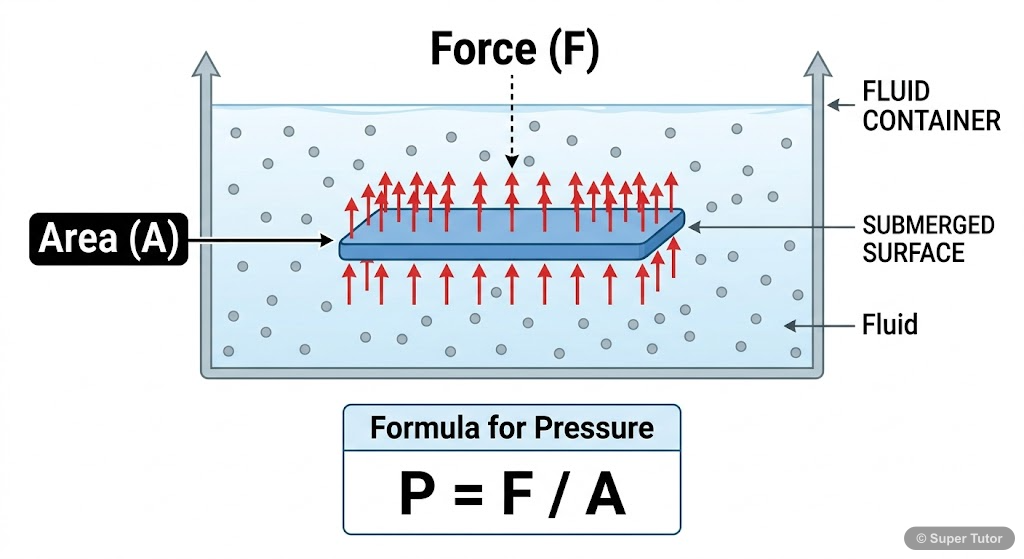
Learn better with visuals Super Tutor pairs illustrations like this with notes and quizzes for Fluid Pressure.
What is a fluid?
Answer
A fluid is a substance with no definite shape of its own, so it takes the shape of the container and can flow. Both liquids and gases are fluids.
How are solids different from fluids?
Answer
Solids resist shearing stress strongly, while fluids offer very little resistance to shearing stress. The shearing stress of fluids is about million times smaller than that of solids.
State fluid thrust and fluid pressure.
Answer
Fluid thrust is the total normal force exerted by a fluid at rest on a surface in contact with it. Fluid pressure is the thrust exerted per unit area. Formula: p = F/A Here, p = pressure, F = thrust o…
A force of 120 N acts normally on an area of 0.30 m². Find the pressure.
Answer
Given: F = 120 N, A = 0.30 m² Formula: p = F/A Step 1: p = 120 N / 0.30 m² Step 2: p = 400 N m⁻² Answer: 400 Pa Unit check: N m⁻² is the SI unit of pressure.
State the SI unit and dimensional formula of pressure.
Answer
SI unit of pressure: newton per metre squared (N m⁻²) or pascal (Pa) Dimensional formula: [M L⁻¹ T⁻²]…
Why is the force exerted by a fluid at rest always normal to a surface?
Answer
A fluid at rest cannot withstand tangential force. If a tangential force acted, the fluid would start flowing. Therefore, the force exerted by a fluid at rest on a surface is always perpendicular to t…
A 50 kg girl stands on one heel of diameter 1.0 cm. Find the pressure on the floor. Take g = 9.8 N/kg.
Answer
Given: M = 50 kg, g = 9.8 N/kg, diameter = 1.0 cm, so r = 0.5 cm = 0.005 m Formula: p = F/A = Mg/(πr²) Step 1: F = Mg = 50 × 9.8 = 490 N Step 2: A = πr² = 3.14 × (0.005 m)² = 7.85 × 10⁻⁵ m² Step 3: p …
Why are suitcase handles broad, pins pointed, and railway sleepers used under tracks?
Answer
Broad handles spread the force over a larger area, so the pressure on the hand is small. Pins and nails have pointed ends, so the area is very small and the pressure is large, which helps penetration.
+25 more flashcards
Practise AllFrequently Asked Questions
What are the important topics in Fluid Pressure for ICSE Class 11 Physics?
How many flashcards are available for Fluid Pressure?
How should I revise Fluid Pressure for Class 11 exams?
Sources & Official References
Content is aligned to the official syllabus. Refer to the board website for the latest curriculum.
More resources for Fluid Pressure
Practice Quiz
Test yourself with a quick quiz
Important Questions
Exam-style questions with answers
Revision Notes
Key points for last-minute revision
Formula Sheet
The chapter's formulas in one place
Chapter Summary
Understand the chapter at a glance
Concept Maps
See how topics connect
Study Plan
Step-by-step plan for this chapter
Syllabus
What topics to cover
For serious students
Get the full Fluid Pressure chapter — start free.
Quizzes, flashcards, an AI doubt solver and a study plan for ICSE Class 11 Physics. Free to start, no card needed.