Superposition of Waves-2 : Stationary (Standing) Waves : Vibration of Air Columns — Syllabus
ICSE · Class 11 · Physics
What Superposition of Waves-2 : Stationary (Standing) Waves : Vibration of Air Columns covers in ICSE Class 11 Physics: 4 topics, for the 2026-27 session.
Interactive on Super Tutor
Studying Superposition of Waves-2 : Stationary (Standing) Waves : Vibration of Air Columns? Get the full interactive chapter.
Quizzes, flashcards, AI doubt-solver and a step-by-step study plan — built for syllabus and more.
Free trial, no card needed.
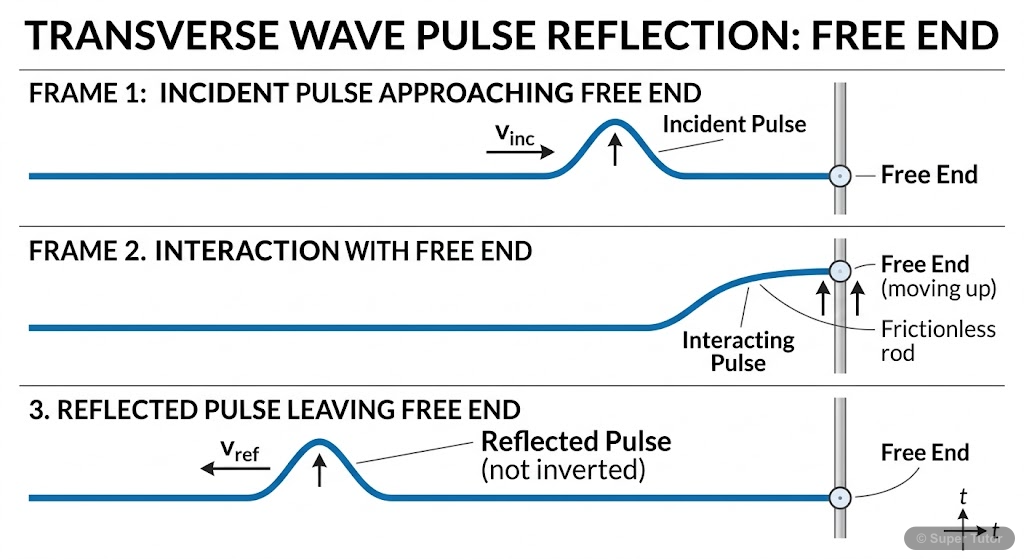
An illustration from Super Tutor's Superposition of Waves-2 : Stationary (Standing) Waves : Vibration of Air Columns chapter — alongside flashcards, concept maps and practice questions.
Topics in Superposition of Waves-2 : Stationary (Standing) Waves : Vibration of Air Columns
1. Bounded Medium and Reflection of Waves
- A bounded medium has definite boundaries separated from other media by distinct surfaces.
- A bounded medium is essential for the formation of stationary waves.
- A wave reflected from a free or open end does not suffer any phase change.
2. Stationary Waves: Formation and Properties
- A stationary wave is formed by superposition of two identical progressive waves of the same speed moving in opposite directions.
- Stationary waves do not transmit energy in the medium.
- The amplitude is zero at nodes and maximum at antinodes.
3. Closed Organ Pipe
- A closed organ pipe is closed at one end and open at the other end.
- The closed end is always a node and the open end is always an antinode.
- A closed pipe produces only odd harmonics.
4. Open Organ Pipe
- An open organ pipe is open at both ends.
- Each open end is an antinode.
- An open pipe produces all harmonics, both even and odd.
Key Concepts
Central concept: Stationary waves in bounded media and their formation in air columns of closed and open organ pipes
Work through every topic in Superposition of Waves-2 : Stationary (Standing) Waves : Vibration of Air Columns with notes and quizzes
Start This ChapterFrequently Asked Questions
What are the important topics in Superposition of Waves-2 : Stationary (Standing) Waves : Vibration of Air Columns for ICSE Class 11 Physics?
How should I revise Superposition of Waves-2 : Stationary (Standing) Waves : Vibration of Air Columns for Class 11 exams?
Sources & Official References
Content is aligned to the official syllabus. Refer to the board website for the latest curriculum.
More resources for Superposition of Waves-2 : Stationary (Standing) Waves : Vibration of Air Columns
Practice Quiz
Test yourself with a quick quiz
Important Questions
Exam-style questions with answers
Revision Notes
Key points for last-minute revision
Formula Sheet
The chapter's formulas in one place
Chapter Summary
Understand the chapter at a glance
Concept Maps
See how topics connect
Study Plan
Step-by-step plan for this chapter
Flashcards
Quick-fire cards for active recall
For serious students
Get the full Superposition of Waves-2 : Stationary (Standing) Waves : Vibration of Air Columns chapter — start free.
Quizzes, flashcards, an AI doubt solver and a study plan for ICSE Class 11 Physics. Free to start, no card needed.