Health Organizations — Flashcards
ICSE · Class 9 · Biology
27 flashcards for Health Organizations (ICSE Class 9 Biology) to test yourself on key terms and facts. Sample: "What are the three levels of health"
Interactive on Super Tutor
Studying Health Organizations? Get the full interactive chapter.
Quizzes, flashcards, AI doubt-solver and a step-by-step study plan — built for flashcards and more.
Free trial, no card needed.
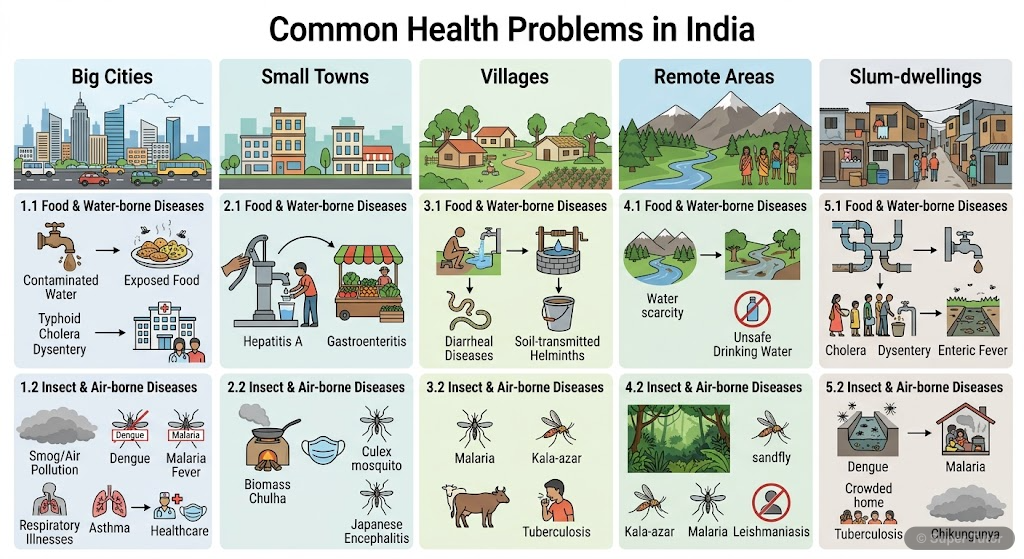
Learn better with visuals Super Tutor pairs illustrations like this with notes and quizzes for Health Organizations.
What are the three levels of health organisations?
Answer
Health organisations are grouped into three levels: local bodies, national organisations, and international organisations. Local bodies look after sanitation and records, national organisations study …
What health work is done by local bodies?
Answer
Local bodies such as municipal corporations and municipalities maintain sanitation, supply safe drinking water, arrange vaccinations, and keep statistical records. They also maintain compulsory regist…
Why are vaccinations important in local health work?
Answer
Vaccinations help protect infants and others from infectious diseases by building resistance. They are especially important when there is a risk of an epidemic. Common diseases covered include tetanus…
What kinds of health problems are common in India due to water and food?
Answer
Food and water borne diseases are common health problems. Examples include diarrhoea, gastroenteritis, typhoid, and dysentery. These often spread where drinking water is contaminated or sewage is not …
What kinds of health problems are caused by insects and air?
Answer
Insect and air-borne diseases are common health problems. Poor cleanliness allows houseflies, mosquitoes, and other insects to breed and spread disease. Flies can contaminate exposed food, and insects…
What are the five types of habitations in India?
Answer
The five types of habitations are big cities, small towns, villages, remote areas, and slum-dwellings. These differ in population density, living conditions, and access to water and medical facilities…
How do slum-dwellings affect health?
Answer
Slum-dwellings usually have unhealthy and unhygienic conditions. Such surroundings increase the chance of disease because sanitation is poor and living conditions are crowded.
What kinds of diseases are studied by national agencies and research centres in India?
Answer
National agencies and research centres in India study malaria, dengue, tuberculosis, leprosy, and cholera. They survey diseases, identify the transmitting agent and breeding places, arrange immunisati…
+19 more flashcards
Practise AllFrequently Asked Questions
What are the important topics in Health Organizations for ICSE Class 9 Biology?
How many flashcards are available for Health Organizations?
How should I revise Health Organizations for Class 9 exams?
Sources & Official References
Content is aligned to the official syllabus. Refer to the board website for the latest curriculum.
More resources for Health Organizations
Practice Quiz
Test yourself with a quick quiz
Important Questions
Exam-style questions with answers
Revision Notes
Key points for last-minute revision
Chapter Summary
Understand the chapter at a glance
Concept Maps
See how topics connect
Study Plan
Step-by-step plan for this chapter
Syllabus
What topics to cover
For serious students
Get the full Health Organizations chapter — start free.
Quizzes, flashcards, an AI doubt solver and a study plan for ICSE Class 9 Biology. Free to start, no card needed.