Aids to Health — Flashcards
ICSE · Class 9 · Biology
38 flashcards for Aids to Health (ICSE Class 9 Biology) to test yourself on key terms and facts. Sample: "What is immunity?"
Interactive on Super Tutor
Studying Aids to Health? Get the full interactive chapter.
Quizzes, flashcards, AI doubt-solver and a step-by-step study plan — built for flashcards and more.
Free trial, no card needed.
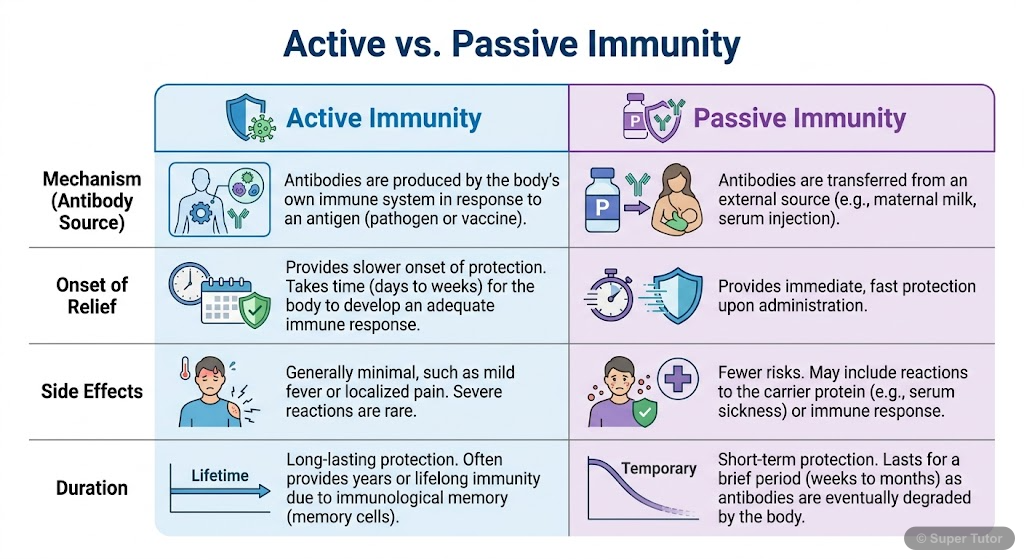
Learn better with visuals Super Tutor pairs illustrations like this with notes and quizzes for Aids to Health.
What is immunity?
Answer
Immunity is the resistance to the onset of a disease after infection by harmful germs. It is the body's defence against disease and helps render harmful substances harmless.
How does the body prevent germs from entering?
Answer
The body has a local defence system that starts working instantaneously. It does not depend on previous exposure and works against a wide range of infectious agents.
Name the four ways germs or pollutants enter the body.
Answer
They enter directly through the skin, through mucous membranes, through food or water, and through the air breathed in.
Why is skin an important barrier against germs?
Answer
The outer tough layer of skin is made of keratin and is almost impermeable to germs. If the skin is cut or scratched, germs can enter more easily.
What are diapedesis and phagocytosis?
Answer
Diapedesis is the squeezing of white blood cells out of capillary walls to reach the infection site. Phagocytosis is the engulfing of germs by these white blood cells.
What is pus made of?
Answer
Pus is a mixture of destroyed germs, killed white blood cells, and damaged tissue cells.
What is the immune system?
Answer
The immune system deals with germs after they have entered the body tissues. It uses special proteins and cells to fight them and provide protection.
Define antibodies.
Answer
Antibodies are special proteins belonging to the class of immunoglobulins. They are produced by specialised lymphocytes in response to antigens and are found in blood, lymph, spleen, and lymph nodes.
+30 more flashcards
Practise AllFrequently Asked Questions
What are the important topics in Aids to Health for ICSE Class 9 Biology?
How many flashcards are available for Aids to Health?
How should I revise Aids to Health for Class 9 exams?
Sources & Official References
Content is aligned to the official syllabus. Refer to the board website for the latest curriculum.
More resources for Aids to Health
Practice Quiz
Test yourself with a quick quiz
Important Questions
Exam-style questions with answers
Revision Notes
Key points for last-minute revision
Chapter Summary
Understand the chapter at a glance
Concept Maps
See how topics connect
Study Plan
Step-by-step plan for this chapter
Syllabus
What topics to cover
For serious students
Get the full Aids to Health chapter — start free.
Quizzes, flashcards, an AI doubt solver and a study plan for ICSE Class 9 Biology. Free to start, no card needed.