Seed Structure and Germination — Flashcards
ICSE · Class 9 · Biology
32 flashcards for Seed Structure and Germination (ICSE Class 9 Biology) to test yourself on key terms and facts. Sample: "What is a fruit?"
Interactive on Super Tutor
Studying Seed Structure and Germination? Get the full interactive chapter.
Quizzes, flashcards, AI doubt-solver and a step-by-step study plan — built for flashcards and more.
Free trial, no card needed.
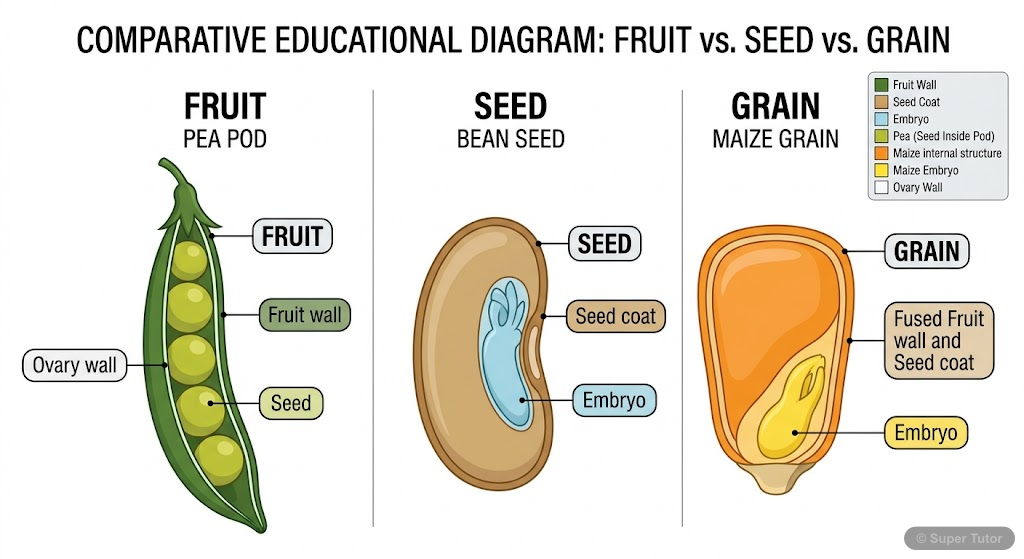
One of 8 illustrations for Seed Structure and Germination in Super Tutor — alongside flashcards, concept maps and practice questions.
What is a fruit?
Answer
Fruit is the enlarged ripened ovary. The ovarian wall forms the fruit wall, which encloses the seed. Fruit protects the seed and helps in seed dispersal. Examples include mango and pea pod.
What is a seed?
Answer
Seed is the ripened ovule. It contains an embryo that develops into a new plant. The seed coat protects the embryo from mechanical damage. Examples include bean seed and pea seed.
What is a grain in maize or wheat?
Answer
A grain is actually a one-seeded fruit. In maize and wheat, the fruit wall and the seed coat are fused together to form a protective layer. So a grain is not a true seed, even though it is commonly ca…
Why are seeds dormant in a dry state?
Answer
A dry seed contains a dormant embryo. It is inactive and appears lifeless, but slow life processes continue inside it. The seed uses oxygen and gives out carbon dioxide in very small amounts and also …
What is germination?
Answer
Germination is the process of formation of a seedling developed from the embryo. It begins when the dormant embryo becomes active and starts growing.
Why does a fresh seed often not germinate immediately even when conditions are suitable?
Answer
A fresh seed normally does not germinate at once because it must pass through a period of dormancy. During this time, it undergoes physiological maturation before it can start germinating.
What are the three conditions necessary for germination?
Answer
Water, suitable temperature, and oxygen are necessary for germination. Without these, the embryo cannot start active growth.
Why is water necessary for germination?
Answer
Water makes the seed swell and helps the seed coat rupture so that the radicle can come out. Water also helps enzymes act on stored food so it can be used by the growing embryo.
+24 more flashcards
Practise AllFrequently Asked Questions
What are the important topics in Seed Structure and Germination for ICSE Class 9 Biology?
How many flashcards are available for Seed Structure and Germination?
How should I revise Seed Structure and Germination for Class 9 exams?
Sources & Official References
Content is aligned to the official syllabus. Refer to the board website for the latest curriculum.
More resources for Seed Structure and Germination
Practice Quiz
Test yourself with a quick quiz
Important Questions
Exam-style questions with answers
Revision Notes
Key points for last-minute revision
Chapter Summary
Understand the chapter at a glance
Concept Maps
See how topics connect
Study Plan
Step-by-step plan for this chapter
Syllabus
What topics to cover
For serious students
Get the full Seed Structure and Germination chapter — start free.
Quizzes, flashcards, an AI doubt solver and a study plan for ICSE Class 9 Biology. Free to start, no card needed.