Skin: The Jack of all Trades — Flashcards
ICSE · Class 9 · Biology
40 flashcards for Skin: The Jack of all Trades (ICSE Class 9 Biology) to test yourself on key terms and facts. Part of the ICSE Class 9 Biology syllabus.
Interactive on Super Tutor
Studying Skin: The Jack of all Trades? Get the full interactive chapter.
Quizzes, flashcards, AI doubt-solver and a step-by-step study plan — built for flashcards and more.
Free trial, no card needed.
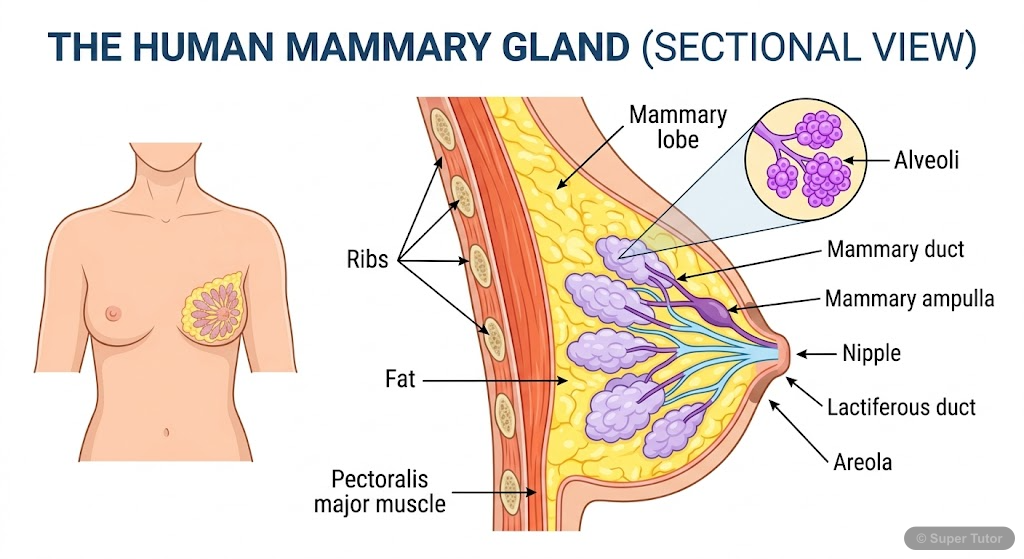
One of 8 illustrations for Skin: The Jack of all Trades in Super Tutor — alongside flashcards, concept maps and practice questions.
Why is skin called the jack of all trades?
Answer
Skin performs many functions at the same time. It protects the body, helps in touch and sensation, regulates temperature, stores food as fat, helps in sweating, and can make vitamin D in sunlight.
What is the skin and why is it important?
Answer
Skin is the outermost covering of the body. It is the largest organ of the body and accounts for 15% of an adult human's total body weight. It forms a protective barrier around the body.
What are the four main protective functions of skin?
Answer
Skin protects the body from mechanical shocks, prevents loss of water by evaporation, stops germs from entering, and protects against harmful ultraviolet rays.
What is the epidermis?
Answer
The epidermis is the outer thinner part of the skin proper. It is made of stratified epithelium and has no blood vessels anywhere in it.
Name the three sublayers of the epidermis.
Answer
The three sublayers are the cornified layer, granular layer, and malpighian layer. They are arranged from outermost to innermost.
What is the cornified layer and what is its function?
Answer
The cornified layer is the outermost sublayer of the epidermis. It has dead, flattened cells containing keratin. It resists mechanical damage, bacterial infection, and loss of water by evaporation.
What is the malpighian layer?
Answer
The malpighian layer is the innermost sublayer of the epidermis. Its cells actively divide to form new cells that replace worn-out cells of the cornified layer. It also contains melanin, which gives s…
What is the granular layer?
Answer
The granular layer is a very thin middle sublayer of the epidermis. It has two or three sublayers of flattened cells and gradually changes into the cornified layer.
+32 more flashcards
Practise AllFrequently Asked Questions
What are the important topics in Skin: The Jack of all Trades for ICSE Class 9 Biology?
How many flashcards are available for Skin: The Jack of all Trades?
How should I revise Skin: The Jack of all Trades for Class 9 exams?
Sources & Official References
Content is aligned to the official syllabus. Refer to the board website for the latest curriculum.
More resources for Skin: The Jack of all Trades
Practice Quiz
Test yourself with a quick quiz
Important Questions
Exam-style questions with answers
Revision Notes
Key points for last-minute revision
Chapter Summary
Understand the chapter at a glance
Concept Maps
See how topics connect
Study Plan
Step-by-step plan for this chapter
Syllabus
What topics to cover
For serious students
Get the full Skin: The Jack of all Trades chapter — start free.
Quizzes, flashcards, an AI doubt solver and a study plan for ICSE Class 9 Biology. Free to start, no card needed.