Pollination and Fertilization — Flashcards
ICSE · Class 9 · Biology
44 flashcards for Pollination and Fertilization (ICSE Class 9 Biology) to test yourself on key terms and facts. Sample: "What is pollination?"
Interactive on Super Tutor
Studying Pollination and Fertilization? Get the full interactive chapter.
Quizzes, flashcards, AI doubt-solver and a step-by-step study plan — built for flashcards and more.
Free trial, no card needed.
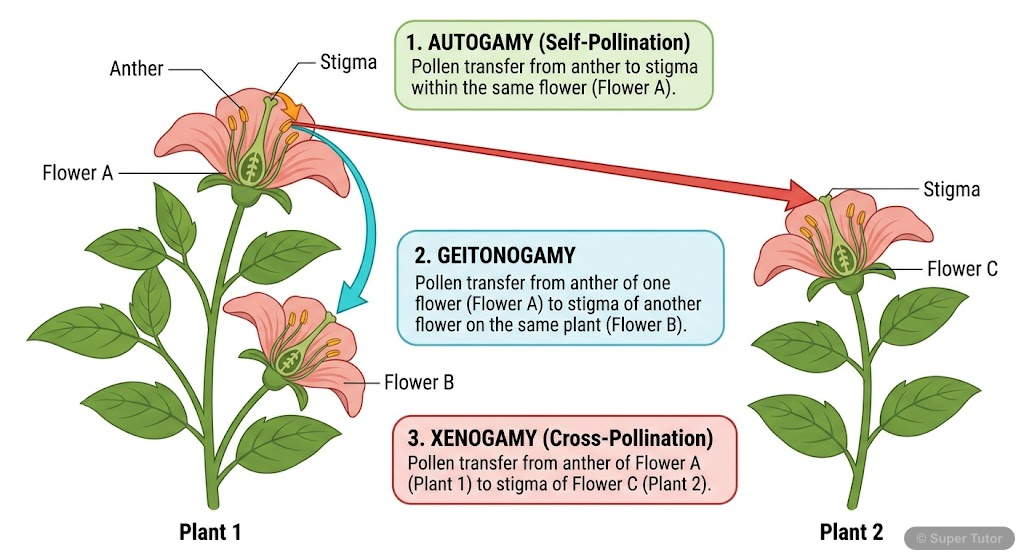
One of 6 illustrations for Pollination and Fertilization in Super Tutor — alongside flashcards, concept maps and practice questions.
What is pollination?
Answer
Pollination is the process of transference of pollen grains from the anther to the stigma. It is the first step that leads to the formation of fruit and seeds in flowering plants.
Name the two kinds of pollination.
Answer
The two kinds of pollination are self-pollination and cross-pollination.
What is self-pollination?
Answer
Self-pollination is the transfer of pollen from the anther to the stigma of the same flower, or to the stigma of another flower of the same plant. It includes autogamy and geitonogamy.
What is cross-pollination?
Answer
Cross-pollination is the transfer of pollen from the anthers of flowers of one plant to the stigma of a flower of another plant of the same species. It is also called allogamy.
Why must pollination occur between plants of the same species?
Answer
Pollination must occur between plants of the same species because pollen of other species does not germinate properly. Only pollen of the same species survives and continues the process of reproductio…
What is autogamy?
Answer
Autogamy is self-pollination in which pollen of the same flower falls on its own stigma. It is a direct form of self-pollination.
What is geitonogamy?
Answer
Geitonogamy is the transfer of pollen from one flower to the stigma of another flower on the same plant. It is classified as self-pollination because both flowers belong to the same plant.
What is allogamy?
Answer
Allogamy is pollination in which pollen of a flower of one plant reaches the stigma of a flower of another plant of the same species. It is cross-pollination.
+36 more flashcards
Practise AllFrequently Asked Questions
What are the important topics in Pollination and Fertilization for ICSE Class 9 Biology?
How many flashcards are available for Pollination and Fertilization?
How should I revise Pollination and Fertilization for Class 9 exams?
Sources & Official References
Content is aligned to the official syllabus. Refer to the board website for the latest curriculum.
More resources for Pollination and Fertilization
Practice Quiz
Test yourself with a quick quiz
Important Questions
Exam-style questions with answers
Revision Notes
Key points for last-minute revision
Chapter Summary
Understand the chapter at a glance
Concept Maps
See how topics connect
Study Plan
Step-by-step plan for this chapter
Syllabus
What topics to cover
For serious students
Get the full Pollination and Fertilization chapter — start free.
Quizzes, flashcards, an AI doubt solver and a study plan for ICSE Class 9 Biology. Free to start, no card needed.