Medieval India (B) The Delhi Sultanate — Chapter Summary
ICSE · Class 9 · History & Civics
Summary of Medieval India (B) The Delhi Sultanate for ICSE Class 9 History & Civics. Part of the ICSE Class 9 History & Civics syllabus.
Interactive on Super Tutor
Studying Medieval India (B) The Delhi Sultanate? Get the full interactive chapter.
Quizzes, flashcards, AI doubt-solver and a step-by-step study plan — built for chapter summary and more.
Free trial, no card needed.
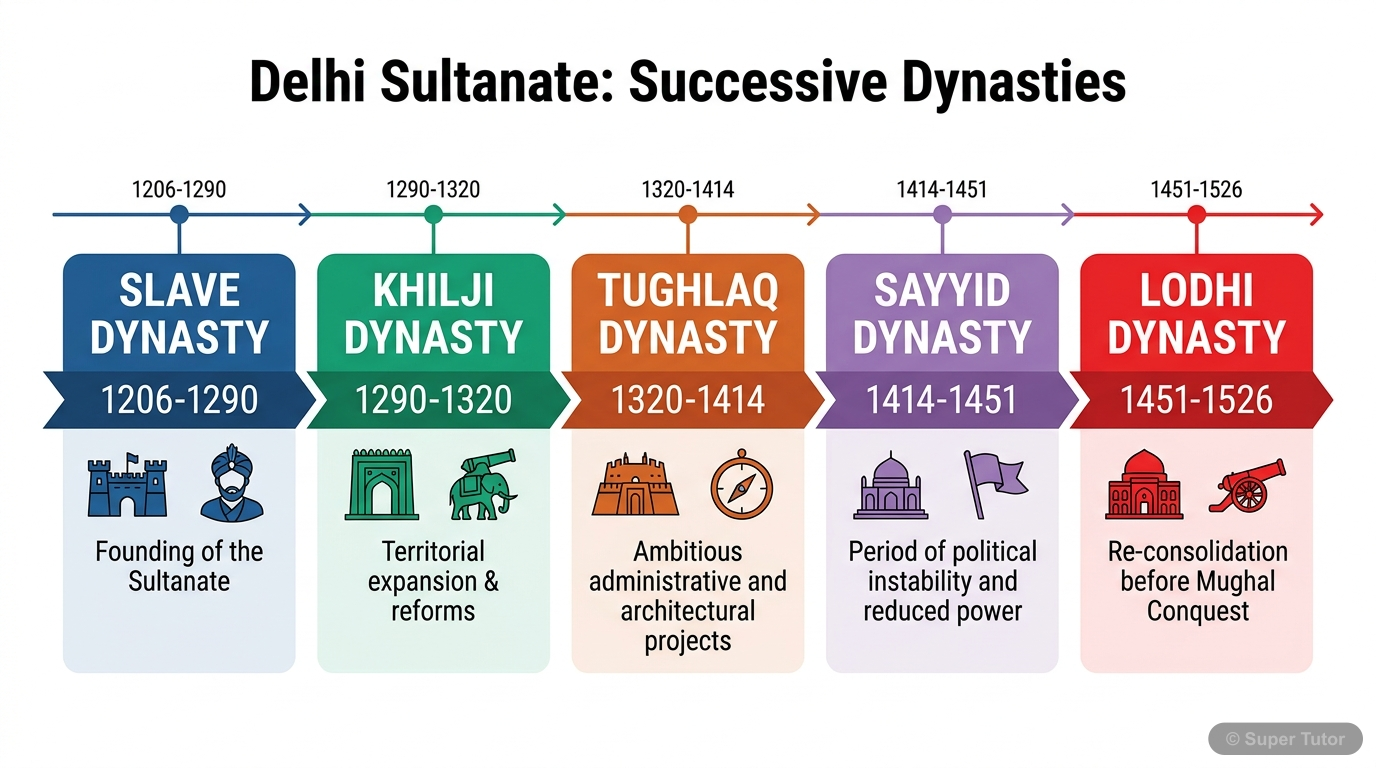
Learn better with visuals Super Tutor pairs illustrations like this with notes and quizzes for Medieval India (B) The Delhi Sultanate.
Overview
The Delhi Sultanate was the period from 1206 to 1526 when five dynasties ruled from Delhi. It began after Turkish conquests weakened older political powers in northern India. The chapter focuses on the rise of the Slave, Khilji and Tughlaq dynasties, their rulers, administration, military reforms, r
Key Concepts
The Delhi Sultanate refers to
The Delhi Sultanate refers to the period from 1206 to 1526 when five dynasties ruled from Delhi. These were the Slave, Khilji, Tughlaq, Sayyid and Lod
Qutab Minar was started by Qutbuddin
Qutab Minar was started by Qutbuddin Aibak and dedicated to the Sufi saint Qutbuddin Bakhtiyar Kaki. It was completed by Iltutmish. It originally rose
Qutbuddin Aibak was a slave general
Qutbuddin Aibak was a slave general of Muhammad Ghori and was left as viceroy of the conquered lands. He is regarded as the founder of the Slave dynas
Iltutmish overthrew Aram Shah
Iltutmish overthrew Aram Shah, completed Qutab Minar and nominated his daughter Razia as successor because he did not consider his sons capable. After
The Khilji dynasty began after
The Khilji dynasty began after the last ruler of the Slave dynasty was murdered in 1290. Jalaluddin Khilji founded the dynasty after killing Kaikubad.
Learning Objectives
- Understand how the Delhi Sultanate was established and why Turkish rule expanded in northern India
- Identify the five dynasties that ruled during the Sultanate period
- Explain the achievements of key rulers such as Qutbuddin Aibak, Iltutmish, Razia, Alauddin Khilji and Muhammad Bin Tughlaq
- Describe the administrative system of the Sultanate, including officials and the iqta system
- Recognise the importance of monuments like Qutab Minar and inscriptions as historical sources
Frequently Asked Questions
What are the important topics in Medieval India (B) The Delhi Sultanate for ICSE Class 9 History & Civics?
How should I revise Medieval India (B) The Delhi Sultanate for Class 9 exams?
Sources & Official References
Content is aligned to the official syllabus. Refer to the board website for the latest curriculum.
More resources for Medieval India (B) The Delhi Sultanate
For serious students
Get the full Medieval India (B) The Delhi Sultanate chapter — start free.
Quizzes, flashcards, an AI doubt solver and a study plan for ICSE Class 9 History & Civics. Free to start, no card needed.