The Modern Age in Europe (A) Renaissance — Chapter Summary
ICSE · Class 9 · History & Civics
Summary of The Modern Age in Europe (A) Renaissance for ICSE Class 9 History & Civics. Part of the ICSE Class 9 History & Civics syllabus.
Interactive on Super Tutor
Studying The Modern Age in Europe (A) Renaissance? Get the full interactive chapter.
Quizzes, flashcards, AI doubt-solver and a step-by-step study plan — built for chapter summary and more.
Free trial, no card needed.
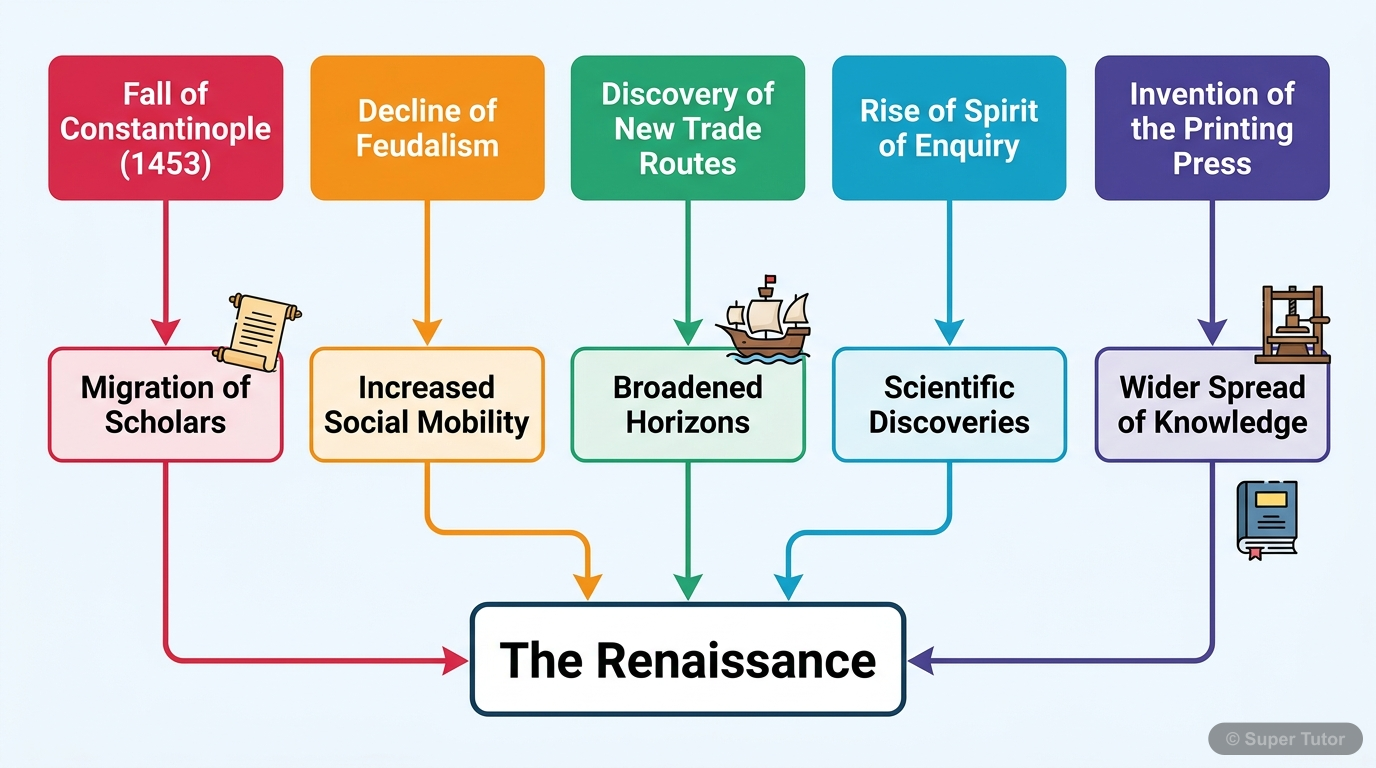
Learn better with visuals Super Tutor pairs illustrations like this with notes and quizzes for The Modern Age in Europe (A) Renaissance.
Overview
Renaissance means rebirth or revival. It was a major movement in Europe that began in Italy in the 14th century and lasted into the 17th century. It brought a new interest in Greek and Roman learning, encouraged free thinking, and changed art, literature and science. It also helped Europe move away
Key Concepts
Renaissance means rebirth or revival
Renaissance means rebirth or revival. It refers to the revival of interest in ancient Greek and Roman learning and the growth of free thought in Europ
Constantinople was the capital of
Constantinople was the capital of the Eastern Roman Empire and a centre of Greek and Roman cultures. When it fell to the Turks in 1453, many Greek and
Feudalism was a rigid social system
Feudalism was a rigid social system based on land and duty. Its decline created more peace, freedom and room for new thinking, learning and progress.
The closing of old trade routes
The closing of old trade routes after the fall of Constantinople encouraged Europeans to search for sea routes. Prince Henry the Navigator discovered
Renaissance thinkers questioned old beliefs
Renaissance thinkers questioned old beliefs, depended on reason, observation and experimentation, and encouraged people to ask why and how things happ
Learning Objectives
- Understand the meaning of Renaissance
- Identify the main causes of the Renaissance
- Explain the role of Constantinople, feudalism, trade routes, enquiry and the printing press
- Recognize the main features of humanism
- Recall the important artists, writers and scientists of the Renaissance
Frequently Asked Questions
What are the important topics in The Modern Age in Europe (A) Renaissance for ICSE Class 9 History & Civics?
How should I revise The Modern Age in Europe (A) Renaissance for Class 9 exams?
Sources & Official References
Content is aligned to the official syllabus. Refer to the board website for the latest curriculum.
More resources for The Modern Age in Europe (A) Renaissance
For serious students
Get the full The Modern Age in Europe (A) Renaissance chapter — start free.
Quizzes, flashcards, an AI doubt solver and a study plan for ICSE Class 9 History & Civics. Free to start, no card needed.